Categories
season three

Episode 50: How The Medici Did It

For our 50th episode, I give an overview of how the Medici went from being just one of several powerful banking families to joining the ranks of European royalty and high nobility.

Before I get started, I just wanted to say sincerely thank you for listening. I started this podcast around the time I was laid off from a job, I didn’t seem to have any real prospects, and I was living in an apartment I didn’t like but I could barely afford. Then during the time I kept on with the podcast I made the difficult decision to go back to school and try to start a new career, I finished my second Master’s degree in Library Science, and…well, things have gotten a lot better since, but I’m still working on the getting a day job I can be happy with or making something like this my job part. I never expected this podcast to become as successful as other history podcasts like the “History of Rome” podcast and…well, it’s not, but that said it’s certainly drawn more regular listeners than I ever expected. On top of the kind emails I often receive and the generous donations from my Patreon supporters, that fact alone helps me get through the bad times, like my recent car accident. It really does.

So thank you.

Categories
season three

Episode 44: Interregnum

After Leo X’s sudden death, the Medici are briefly out of power in the papacy. In the meantime, Emperor Charles V changes the landscape of European politics by getting elected as Holy Roman Emperor, and the fate of the Medici family is put in the hands of an orphaned, illegitimate son.

A 1528 portrait of Giulio de’ Medici, Pope Clement VII, by Sebastiano del Piombo. Source: J. Paul Getty Museum, Los Angeles, California.

Transcript

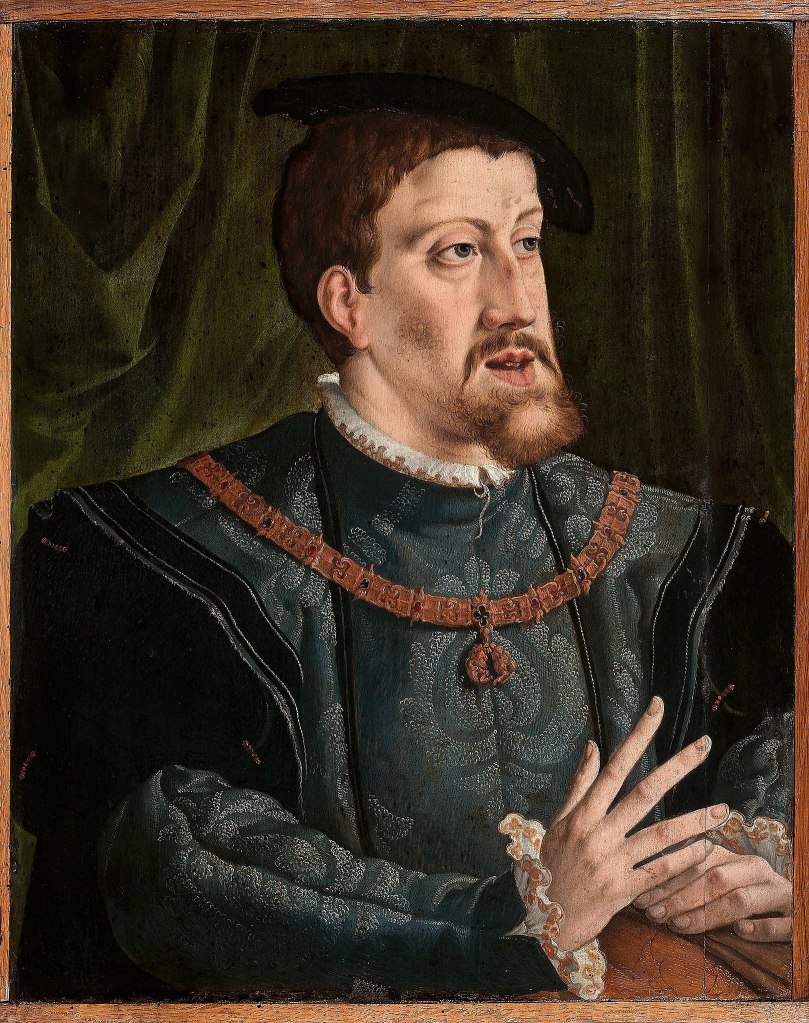
Since I didn’t want to risk adding more to the overstuffed narrative, I did just slide over what I think was one of the most important political events of the sixteenth century: the election of King Charles of Spain as Emperor Charles V of the Holy Roman Empire. It might just seem like icing on the cake from Charles’ point of view. What, being Archduke of Austria, Duke of Burgundy, and king of Castile and Aragon wasn’t enough, you had to be Holy Roman Emperor too? But to be fair Charles himself believed that if didn’t gain the imperial title, it would have been a risky situation. After all, the Holy Roman Emperor had historic claims on many of Charles’ titles in the Netherlands, and having an unfriendly emperor would even threaten the Hapsburg ownership of their own heartland, Austria. That definitely would have been the outcome if that emperor also happened to be the king of France. With the encouragement of the Elector of Brandenburg and the Elector of Saxony, King Francois threw his own crown in the ring. France wasn’t part of the Holy Roman Empire, but in the past foreign princes had run for the office and had come very close to claiming it, like the English prince Richard of Cornwall who was elected King of the Germans, but was never actually crowned emperor, in the thirteenth century.

Categories
season three

Episode 43: The Drunken German

While Pope Leo works with the artist Raphael toward the preservation of Roman antiquities and tries to steer Italy between the deadly rocks of France, the Holy Roman Empire, and the Ottoman Empire, a little problem crops up to demand his attention. And that little problem had a name: Martin Luther. 

Michelangelo’s engravings with the tomb of Lorenzo “the Younger” in the New Sacristy at the Church of San Lorenzo, depicting Dusk and Dawn. Source: Romain Rolland, The Life of Michael Angelo (1912).
Michelangelo’s engravings with the tomb of Giuliano de’ Medici in the New Sacristy at the Church of San Lorenzo, depicting Day and Night. Source: Romain Rolland, The Life of Michael Angelo (1912).
A contemporaneous portrait of Martin Luther by Lucas Cranach the Elder. Date: 1528. Source: Coburg Fortress Gallery.

Transcript

So with that, let’s go back to the year 1505, on a July afternoon…

A university student was returning home after visiting his parents. He found himself caught in the middle of a sudden thunderstorm. Lightning struck the ground near him. On the spot, Luther prayed to Saint Anne, vowing he would give up his studies in law and become a monk if he survived the thunderstorm. The young student did indeed survive and joined an Augustinian monastery. And that university student was Martin Luther.

Categories
season three

Episode 41: The Prince

Pope Leo X goes through his own “annus mirabilis.” Meanwhile the next generation of Medici men come into their own: the wannabe aristocrat, Lorenzo “the Younger”, and the juvenile delinquent turned freelance mercenary, Giovanni of the Black Bands. 

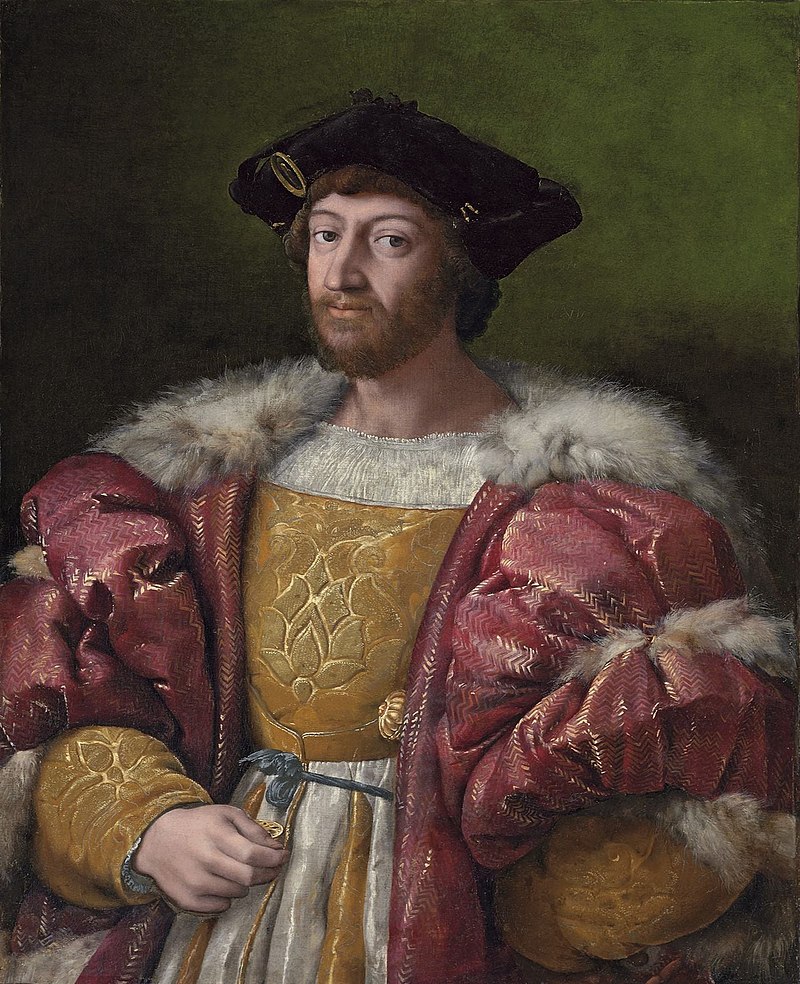
A portrait of Lorenzo di Piero de’ Medici, Duke of Urbino, by Raphael (1518). Note the ostentatious dress in the style of a French nobleman in contrast to the more modest patrician clothing worn by his grandfather Lorenzo the Magnificent and his uncle Giuliano. Source: Private collection.
A portrait depicting Giovanni “of the Black Bands” painted after his death by Francesco de’ Rossi (1548). Source: Soprintendenza Speciale Per Il Polo Museale Fiorentino.

Transcript

1516 was a very bad year for Leo X. To paraphrase Queen Elizabeth II of England centuries later, 1516 was Leo’s annus mirabilis. His brother Giuliano died in March, which was not only a personal loss but a political one for the family, since he seems he might have been the most politically talented and popular member of the family since his father Lorenzo the Magnificent. Then, that summer, a monk named Bonaventura had declared himself the true, “Angelic Pope”, excommunicated the Pope and all his cardinals, and warned that the Ottoman Turks would invade Italy before converting to Christianity thanks to the King of France.

Categories
season three

Episode 40: New World Order

We look at Pope Leo X’s reign, from how he got an edition of a pivotal Jewish text dedicated to him to the elaborate practical joke he engineered involving his pet elephant and an old-fashioned Roman triumph. But Leo also has to face the fact that  the fate of Europe now lays in the hands of three young, ambitious, and powerful monarchs. 

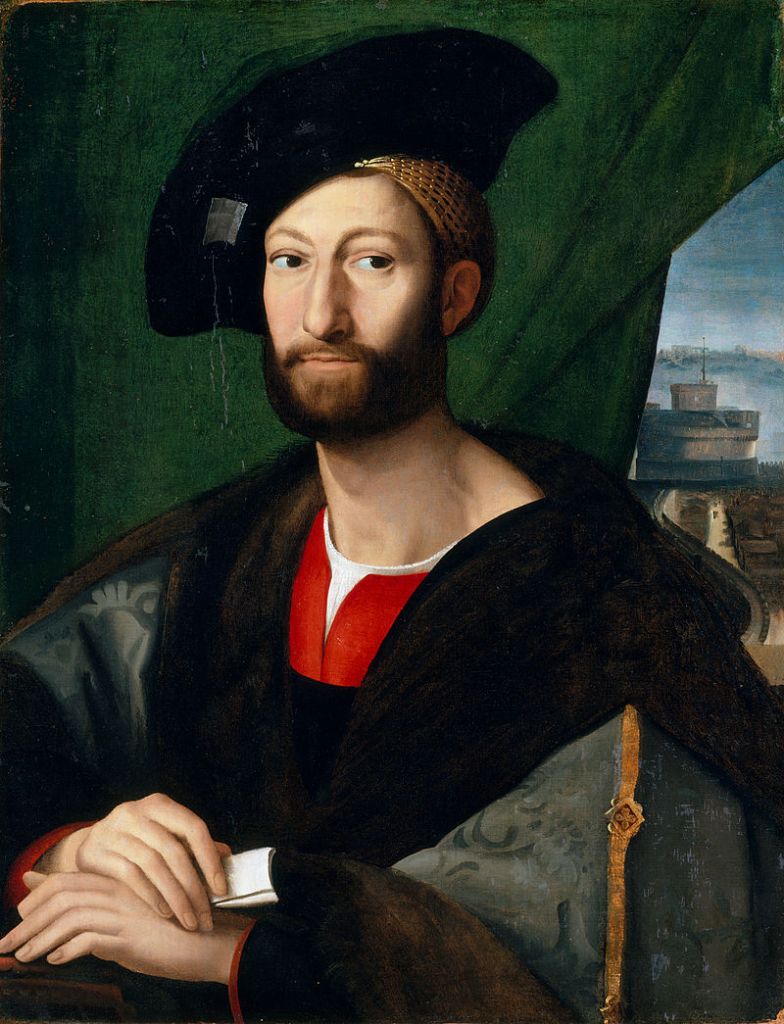
A portrait of Giuliano de’ Medici, duc de Nemours, who was Lorenzo the Magnificent’s youngest son (c. 1515) by Raphael’s workshop. Source: The Metropolitan Museum of Art, New York City.
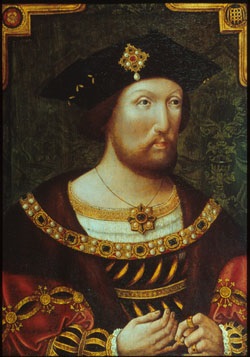
King Henry VIII as a young man. Date and artist unknown. Source: National Portrait Gallery, London.
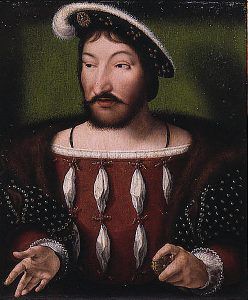
King François I of France (c. 1530) from the workshop of Joos van Cleve. Source: Private collection.
Portrait of Emperor Charles V as a young man by Jan Cornelisz Vermeyen (1535). Source: Private collection.

Transcript

When last we left Giovanni de’ Medici, he had exceeded even his father’s wildest ambitions by becoming Pope Leo X. So, from here on out, we’ll start to refer to him as Leo. There’s too many Giovannis in the story of the Medici anyway.

Categories
season three

Episode 39: The Lion of God

The unlikely partnership between the bookish, affable Giovanni de’ Medici and the rough-and-tumble Pope Julius II will finally bring the Medici back to power and set the stage for Giovanni’s turn as Pope Leo X, which would prove to be one of the most consequential papal reigns in history for reasons no one could have predicted.

A contemporaneous portrait of Giuliano della Rovere, Pope Julius II, by Raphael (1511). Despite their very different personalities, Pope Julius was Giovanni de’ Medici’s mentor and biggest benefactor, playing an essential role in the Medici’s restoration. Source: The National Gallery, London.

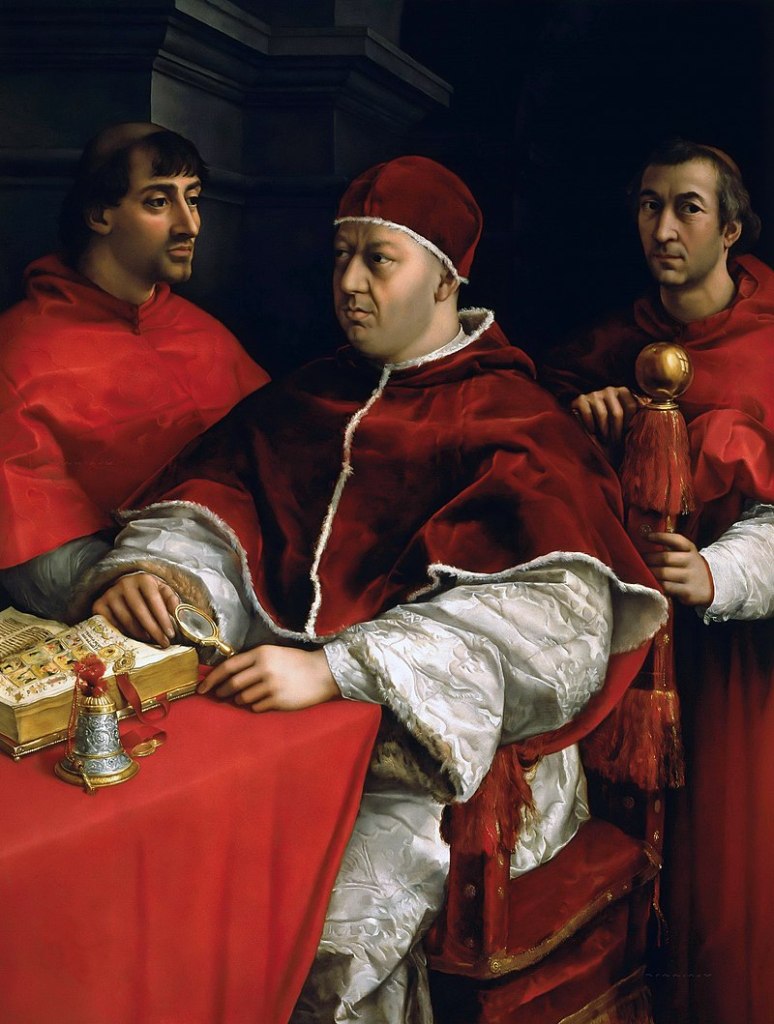
Raphael’s portrait of Pope Leo X with his cousins, Giulio de’ Medici (the future Pope Clement VII) and Luigi de’ Rossi, who were both cardinals (1518). Source: Uffizi Gallery, Florence.

Sketches of Hanno the Elephant by Giulio Romano (c. 1515). Hanno proved to be the most popular attraction at Leo X’s coronation and essentially became the Pope’s pet.

Transcript

According to a story, when Lucrezia was about to give birth to her son Giovanni, she had a dream that she gave birth to a lion. You don’t have to be all that skeptical to suspect this account is probably apocryphal. Still, there’s a tinge of truth in that Giovanni de’ Medici did end up becoming the hero that saved the future of the family. That much his father, Lorenzo the Magnificent, glimpsed when he boasted that making Giovanni a cardinal was his greatest achievement.

Categories
season three

Episode 34: The Borgia Vs. The Prophet

Savonarola may be enjoying the peak of his influence over Florence, but he’s made a relentless enemy who just so happens to be a pope and, worse, a Borgia. Meanwhile, Piero and his supporters spin plots for a Medici restoration. 

A portrait of Pope Alexander VI (Rodrigo Borgia) by Pedro Berruguete (c. 1492). Source: Vatican Museums.

Transcript

So my only excuse for being late this week is that honestly I caught Savonarola fever. Seriously, my script for this episode just kept getting longer and longer and I kept finding new tidbits of research that I felt like I had to include. I really, really wanted to wrap up Savonarola’s story in this episode, but I had to split it. I just like to think there is something special about the fact that, centuries after his death, Savonarola is still big enough of a figure that he took over a podcast that’s supposed to be about the Medici.

Categories
season three

Episode 33: God’s Republic

Charles VIII marches on Naples not knowing a brand-new plague is waiting for him, the Medici adapt to the existence of the new republic in different ways, and Savonarola and his allies in government tighten their grip over Florence, even while Rodrigo Borgia closes in on Florence’s popular preacher.

Transcript

Savonarola never really ruled Florence. In fact, you couldn’t even say that he had an invisible throne like the Medici did. But his sermons captivated his audiences with how they shifted gracefully from apocalyptic thunder to gentle cries for social reform, and as a result he had a great deal of influence over both the average people and the elites. As much as Savonarola owed to his skills as a preacher, he was also lucky enough to have a chance to hedge his bets on King Charles VIII of France. As Florence and Savonarola were about to christen their reformed republic, Charles was marching on Rome to face Pope Alexander VI, and it still seemed like King Charles really would reform the papacy itself.

Categories
season three

Episode 32: The Friar and the King

Piero de’ Medici is gone, and a new rising star is a hotshot preacher named Girolamo Savonarola. Once an itinerant preacher and lecturer, Savonarola now finds himself hobnobbing with King Charles VIII of France and even having a say in Florence’s newly rebuilt, Medici-free republic. 

The only known contemporaneous portrait of Girolamo Savonarola (1497 or 1498) by Fra Bartolomeo. Source: Museo di San Marco, Firenze.
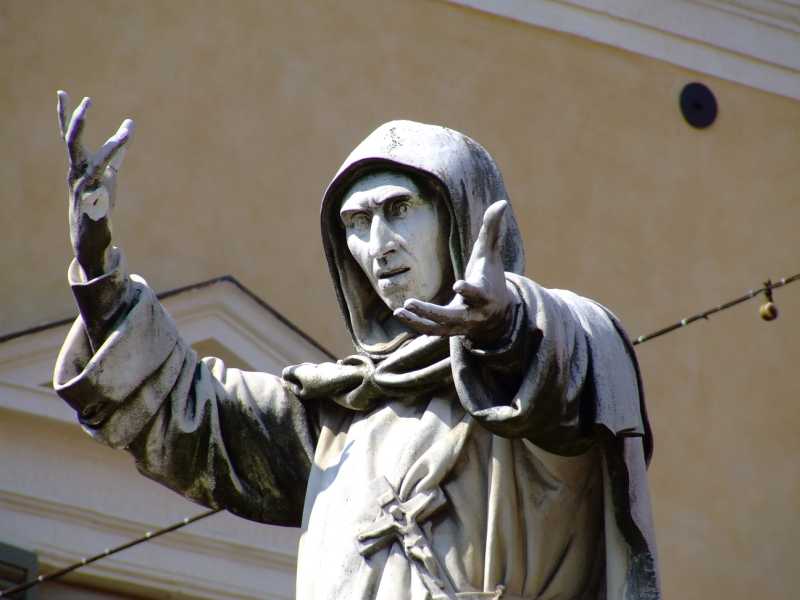
A statue of Girolamo Savonarola in the Palazzo Savonarola in Ferrara (1875) by Stefano Galletti. Source: Dominican Friars of England, Wales, and Scotland website.

Transcript

Today, we’re leaving behind the Medici golden age. This episode marks the start of a new season, the Holy Family. It’s an era that begins with the Medici being driven out of their home city. By rights they should have faded into obscurity. Yet, ironically, this will be the time when they really left their mark on European and even world history. A Medici would assume the role of antagonist in a little tiff you might have heard of called the Protestant Reformation. The family would also, like that other great Italian family the Borgias, take a part in the story of how the golden age of the Italian city-states drew to a close and how Italy would lose much of its independence to the great powers of Europe for roughly 300 years. Basically, this season is about how a dynasty stripped of political power and the bank they founded and driven into exile just simply refused to step off the stage of history.

Categories
season two

Episode 30: Piero the Brief

The fourth Medici to come to power as “unofficial lord” of Florence is Lorenzo the Magnificent’s son, Piero. Although a strapping, handsome, and popular young man, forces within the regime are already working against him. But the real threat is starting to stir many miles outside of Florence…

A portrait of Piero II “the Brief” de’ Medici by Gherardo di Giovanni del Fora. Date: 1494. Source: National Library of Naples.

Transcript

Piero de Medici or Piero II if you want to be specific was the oldest of Lorenzo the Magnificent’s sons who lived past infancy, born on February 15, 1472. This is a bit of a spoiler but I should mention he’s also remembered by history with the sobriquets “the Unfortunate” or “The Brief”, as you probably noticed in this episode’s title. There was never really any question that Lorenzo’s place on the invisible throne of the Medici would be filled by his eldest son Piero. After Lorenzo’s death only a single vote in the Council of Seventy, out of all the legislative councils in the government, went against a bill that would have Piero inherit everything from Lorenzo, including his political responsibilities. This was despite the fact that Piero was too young for political office according to Florentine law.