Categories
season two

Episode 18: Succession

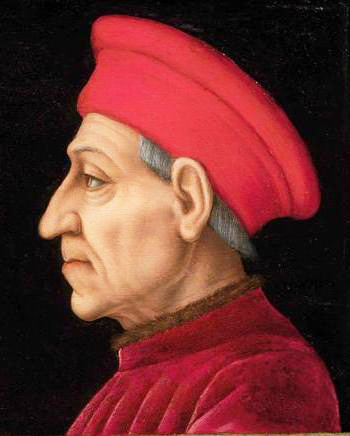
At the height of his political power, Cosimo de’ Medici is being overwhelmed with illness and personal tragedy. Who will succeed him to his invisible, nameless throne? His son Piero, who unfortunately is a middle-aged man so sick no one thinks he will live for much longer.

Transcript

As far as we know, it was smooth sailing for Cosimo after the general assembly of 1458. The old lists of enfranchised lists that had been put together under the Albizzi were burned. Through Cosimo’s new council, the Cento, not only were hundreds of citizens disenfranchised but new lists of citizens were drawn up to be placed in the electoral bags. And although the republic still operated the same way it had since the Ordinances of Justice were enacted, few if any important decisions were made without Cosimo’s input. In his memoirs Pope Pius II observed that after the general assembly “Cosimo was refused nothing. He was regarded as the arbiter of war and peace, the regulator of law; not so much a citizen as the master of his city. Political councils were held at his house; the magistrates he nominated were elected; he was king in all but name and state.”
Categories
season two

Episode 17: The Invisible Throne

Cosimo de’ Medici quickly established a regime that operated within Florence’s constitution but gave Cosimo an almost unchallenged power over the state. Unfortunately, Cosimo’s government was a delicate structure, and the pandemonium of Italian Renaissance politics threatened to bring it all tumbling down. 

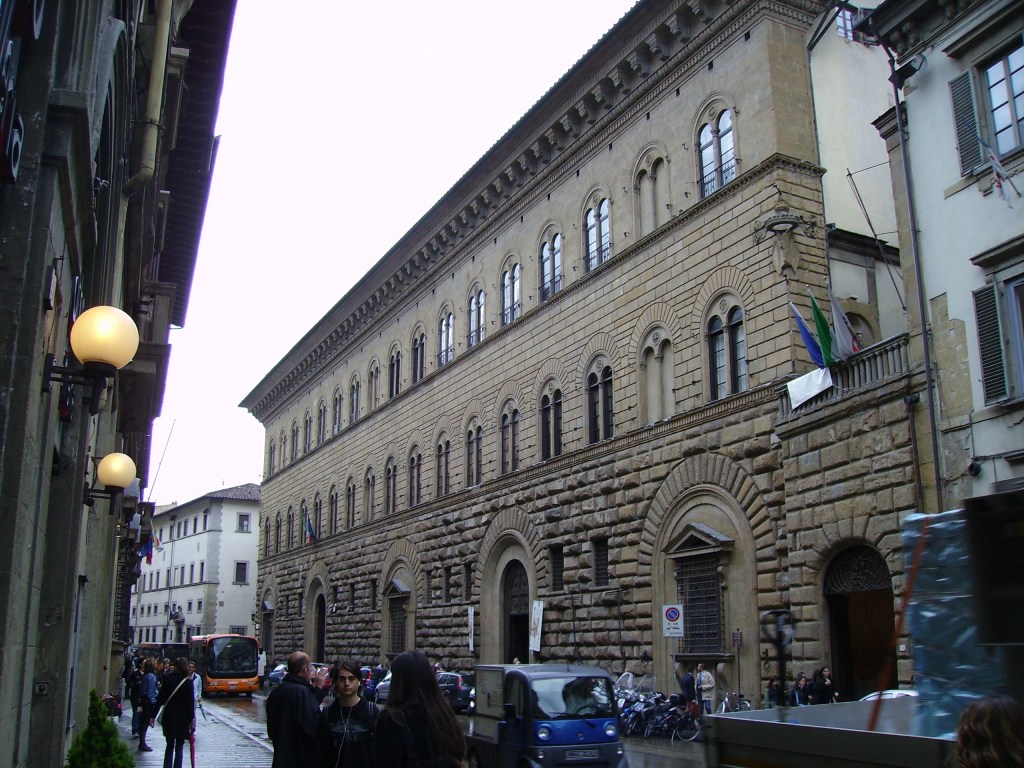
The exterior of the Palazzo Medici-Riccardi. Source: Yair Haklai, Wikicommons.
The interior of the Chapel of the Magi within the Palazzo Medici-Riccardi. Source: theflorentine.net.
A portrait of Francesco Sforza, Duke of Milan, former condottieri, and a key ally of Cosimo de’ Medici, by Bonifacio Bembo (c. 1460). He insisted on being painted wearing his battered and worn old campaigning hat.

Transcript

So, with that, let’s start by talking about the idea of an invisible throne and why Cosimo after his return from exile can be said to have one. By the time the Council of Florence was over, if not sooner, foreign leaders wrote to and talked about Cosimo de’ Medici as if he were the de facto ruler of Florence. This is rather remarkable because, unlike other Italian rulers, Cosimo never called himself or was called signore. Nor did he ever receive some kind of aristocratic title or was voted an office like dictator-for-life cementing his power. In fact, in the decades between Cosimo’s triumphant return and his death, for the most part commentators within Florence write and talk as if the republic was chugging along like always. Cosimo actually pushed only one major reform to the government, which we’ll get to this episode. Just by pulling the levers provided for him by the Florentine constitution and by his patronage network, Cosimo made himself the all but unchallenged ruler of one of the richest regions of Europe. Cosimo’s regime was for the most part so subtle and was managed so indirectly that even now modern historians have trouble determining exactly what decisions made by the official political leaders of Florence were actually their initiative or if they were acting entirely on behalf of Cosimo.

Categories
season two

Episode 16: How Cosimo United the Orthodox and Catholic Churches

With a combination of patience and political maneuvering, Cosimo turns the tables on his enemies and returns to Florence in triumph. His first major act is to host an attempt to reunify the long-divided Greek and Latin churches. It has rather mixed results, but it does make something clear to the rulers of Europe: Cosimo is no longer just a banker.  

An image believed to be the Byzantine Emperor John VIII, taken from a cycle of frescoes by Benozzo Gozzoli depicting the Magi’s visit to the infant Jesus Christ but with the likenesses of various participants in the Council of Florence (c. 1459). Source: Magi Chapel, Palazzo Medici Riccardi.
Pisanello’s sketches of the Byzantine delegation at the Council of Florence (c. 1439-1449).
One-Time
Monthly
Yearly

Make a one-time donation

Make a monthly donation

Make a yearly donation

Choose an amount

$5.00
$15.00
$100.00
$5.00
$15.00
$100.00
$5.00
$15.00
$100.00

Or enter a custom amount

$

Your contribution is appreciated.

Your contribution is appreciated.

Your contribution is appreciated.

DonateDonate monthlyDonate yearly

Transcript

Rinaldo may not have gotten away with killing his greatest threat, Cosimo de’ Medici, but he had seemingly neutralized him by exiling him and his biggest supporters in the fall of 1433. With two of the leading populist families, the Medici and the Alberti, cut down, the conservative regime was secure. At least, for the time being.

Categories
season two

Episode 15: Preemptive Strike

As soon as he inherits his father’s place as head of the rich, international Medici Bank, Cosimo gets a target on his back in a Florence where politics are increasingly molded by the sponsorship of the rich and not by the guilds. The minute he steps on the public arena, not only is Cosimo’s political career is in danger, but his very life. 

Posthumous portrait of Cosimo de’ Medici by Bronzino (c. 1567). Source: La Galleria degli Uffizi, Florence.
Another posthumous portrait of Cosimo (c. 1519) by Jacopo Pontormo. Source: La Galleria degli Uffizi, Florence.
Posthumous portrait of Contessina de’ Bardi de’ Medici (c. 1567) by Bronzino. Pitti Palace, Florence.

Transcript

Giovanni di Bicci has, largely because of his connections to one of several rival popes, become a wealthy banker. Although drawn into politics by just the mere fact of his wealth and by his family’s reputation as supporters of the populist cause, Giovanni largely stayed out of politics. So much so, in fact, that no one was sure if he sided with the conservative or the populist cause. As a result, Giovanni had a great deal of political capital when he intervened to stop the conservatives, at the time led by Rinaldo degli Albizzi, from disenfranchising members of the minor guilds and replacing them with nobles and members of the major guilds. Also, he decisively supported a major tax reform that replaced the city’s sales and poll taxes with the Catasto, a system in which the property and revenues of the city’s citizens were surveyed and taxed based on citizens’ wealth and income.