Categories
season one

Episode 12: The Founder of the Dynasty

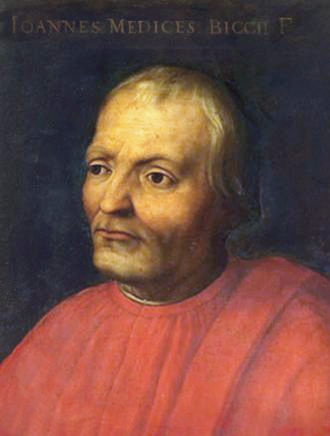
Portrait of Giovanni di Bicci de’ Medici (c. 1563) by Cristofano dell’Altissimo. Source: Palazzo-medici.it.

We close out Season 1, “The Early Medici”, with a look at the life and death of Giovanni di Bicci de’ Medici, whose descendants would become the branch of the family we usually mean when we talk about the Medici. Not only is he the first prominent member of the family, however, he also founded the dynasty in the sense that he started the tradition of sponsoring forward-thinking artists, writers, and architects and in how his apparent reluctance to be a public figure actually inspired a formula for political success that would carry his descendants to greater heights than even his more ambitious forebears could have imagined. 

Support us on Patreon, through Venmo at @ Chad-Denton-15, or through a donation below.

One-Time
Monthly
Yearly

Make a one-time donation

Make a monthly donation

Make a yearly donation

Choose an amount

¤5.00
¤15.00
¤100.00
¤5.00
¤15.00
¤100.00
¤5.00
¤15.00
¤100.00

Or enter a custom amount

¤

Your contribution is appreciated.

Your contribution is appreciated.

Your contribution is appreciated.

DonateDonate monthlyDonate yearly

Transcript

While I talked about how Giovanni de Bicci dei Medici reaped the benefits from his relationship with the sketchy soldier turned rival pope John XXIII, the rest of the Medici family was not doing so well. The family remained committed to the populist cause. Unfortunately, the conservatives also remained firmly in power since the fall of Salvestro de’ Medici. As a result, various Medici along with members of other populist families were persecuted by the government, either barred from political office or exiled from the city. So, while we can’t know what his true political beliefs were, by making himself a low-key ally of the conservatives, Vieri de’ Medici was truly and literally saving himself and his family. Giovanni de Bicci would not follow in his cousin and fairy godfather’s footsteps. However, he would find his own savvy way of surviving the political whirlwind.
Categories
season one

Episode 11: Sin and Profit

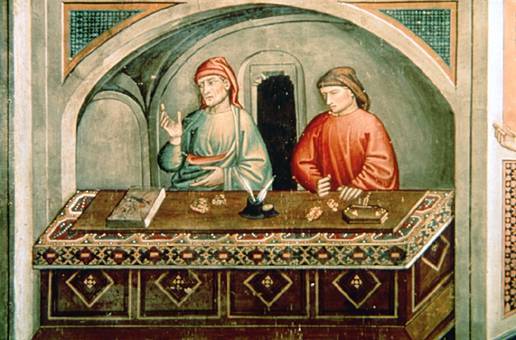
A portrait of bankers at a traditional banking table. Source unknown.

We take a step back from the life of Giovanni di Bicci dei Medici to look at banking, commerce, and religious and legal attitudes about usury and luxury in Renaissance Florence. How did the Medici and other Florentine dynasties prosper in banking when loans with interest were considered a grave sin and a form of theft? 

Transcript

I decided to take a brief break from telling the story of Giovanni di Bicci’s life to give a little context to exactly how the Medici made their money. Let’s talk capitalism. Or proto-capitalism.

Categories
season one

Episode 10: The Duke’s Wife and God’s Banker

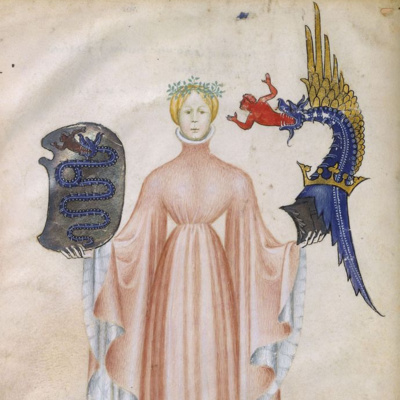
A miniature depicting Valentina Visconti, Duchesse d’Orléans, with the symbols of Milan and the Visconti family, from a copy of Cicero’s De natura deorum, c. 1400. Source: anne-marie.eu.

Around the dawn of the fifteenth century, two developments unfolded that would sooner or later change the future of the Medici family forever. In one, Valentina Visconti enters a miserable marriage with a French royal. In the other, Giovanni de Bicci de’ Medici takes advantage of Europe being split between two and even three rival popes by (allegedly!) bankrolling the church career of a former soldier who hobnobbed with pirates and robbers that eventually sees him become Pope.

Transcript

This time, I’m going to have to zoom out a bit. I do try to keep this from turning into the northern Italy or the History of Florence podcast. But we’re at a point where two events that initially had absolutely nothing to do with the Medici would have ramifications that would completely shape the family’s future.

Categories
season one

Episode 9: Revolution

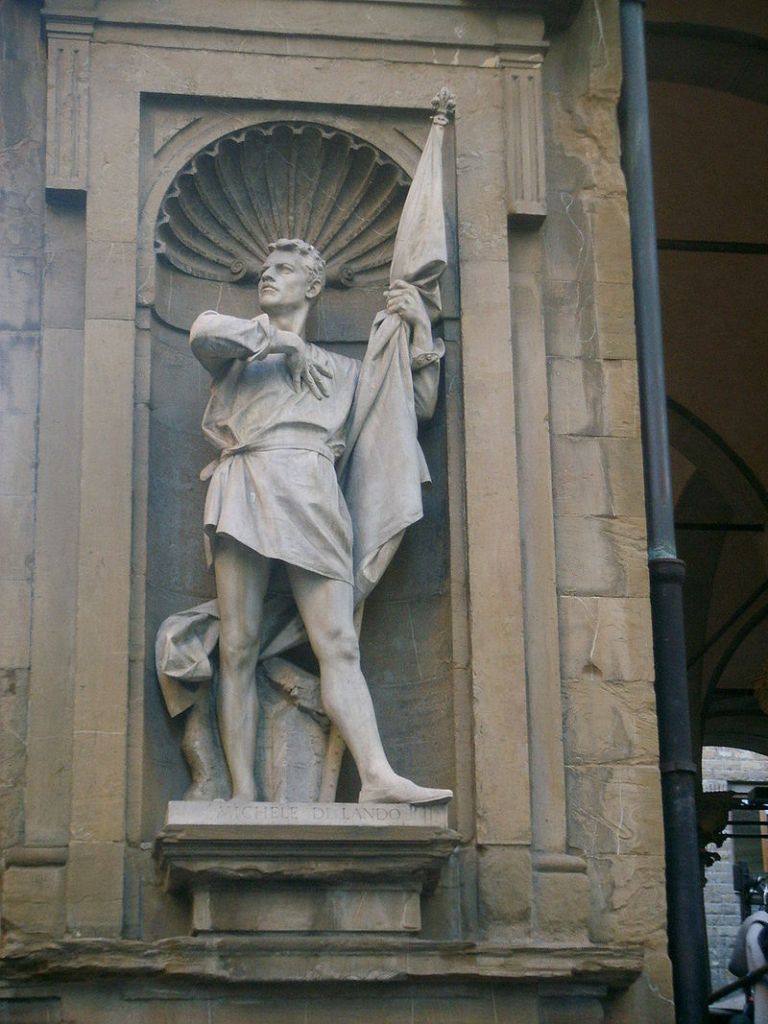
A statue of Michele di Lando in the Loggia del Mercato Nuovo. Source: Saliko via Wikimedia Commons.

After Salvestro de’ Medici helps stoke the flames of revolution, violence breaks out on the streets of Florence and a wool-comber is installed in the highest office of the republic. But who will really benefit from this proletariat revolt in the long term?

Transcript

Let’s start this episode with an exercise of imagination. Close your eyes, unless you’re driving or walking, in which case please don’t close your eyes, and try to imagine what it was like to be a poor laborer, earning a pittance from Florence’s cloth industry, sometime in the years following the Black Death.

Categories
season one

Episode 8: Unholy War

The papal palace at Avignon. Source: about-france.com.

In a time of simmering class tensions and growing exploitation of the poor, Salvestro de’ Medici turns against his conservative comrades and declares he’s on the side of the downtrodden. On his political agenda? Backing an all-out war against the Pope.

Transcript

As you probably expect from living in the 21st century, all those wages spiking up and workers getting the power to seek employment with different employers didn’t sit well with the rich. So, in the years following the original outbreak of the Black Death, there was a conservative retrenchment.

Categories
season one

Episode 7: Apocalypse

In the spring of 1348, the Black Death reaches Florence, devastating its population but also clearing new avenues for the non-rich. In the aftermath, a moderately affluent landowner, Salvestro de’ Medici, embarks on a political career. Just how far can Salvestro make it, between siding with the conservative establishment against his own family’s populist sympathies and the antics of his violently unstable brothers?

Titled The Holy Trinity (c. 1427), this is a fresco by Masaccio that lies in the Santa Maria Novella in Florence. The realistic depiction of human remains is characteristic of the art trends that emerged during the half century following the Black Death.
The routes taken by the Black Death around the West. From D. Cesana, O.J. Benedictow, and R. Bianucci, The Origin and Early Spread of the Black Death in Italy from here.

Transcript

Let’s start the story of one of the most catastrophic and decisive events in the history of Florence and the Medici family about 4,000 miles away from Florence, at a small cottage on the shores of Lake Issyk-Kul [Izek-Kul] in modern-day Kyrgyzstan [Kergizstan]. There lived a woman named Magnu-Kelka and her husband Kutluk. We know very little about them except for two things, thanks to their grave inscriptions. They were Nestorian Christians, a sect of Christianity that developed in Syria and spread as far eastward as China. The other thing we know is that they died in 1339, very early victims of what we know as the Black Death.

Categories
season one

Episode 6: King Walt

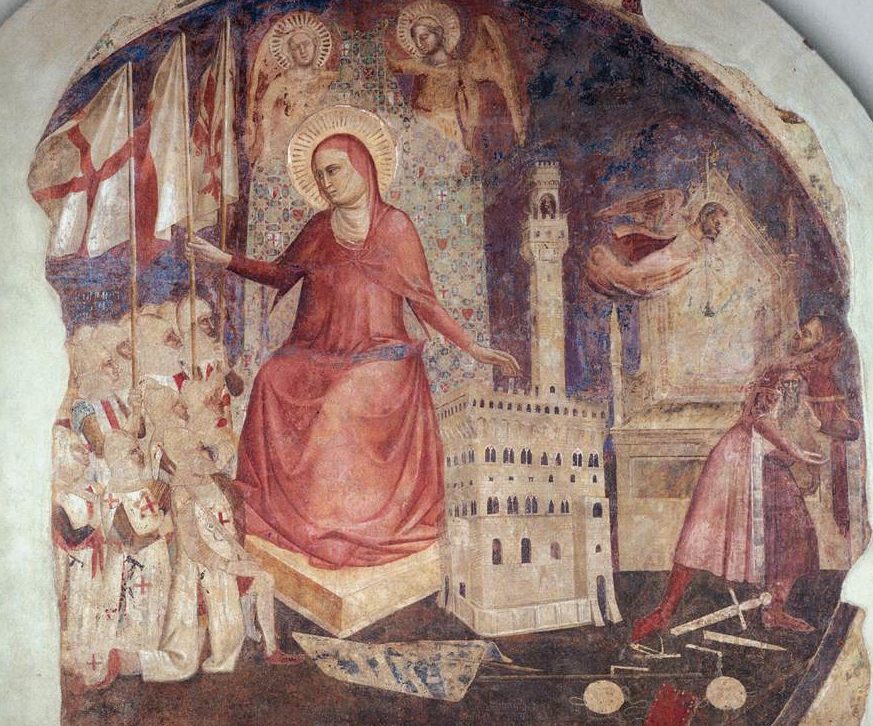
A fresco of St. Anne and the expulsion of Walter of Brienne, today in the Palazzo Vecchio.

Facing famine, plague, an unending war, and an economic recession, the Florentines resort to handing the keys over to a French nobleman with a glamorous but mostly empty title. Meanwhile the Medici, although still lurking in the shadows from our point of view, manage to establish themselves as populists during the chaos and violence to come.

Transcript

So I’ll fess up. The title of this episode is a bit of a flight of fancy. There never was a King Walter of Tuscany, although not from a lack of trying on Walter’s part. Walter started out as a signore of Florence, but he made a big push to become the lord of Florence. Quite possibly, his goal was to establish his own hereditary domain in Tuscany. Instead, Walter was sent packing, and Florence would never again experiment with inviting some foreigner to become signore.

Categories
season one

Episode 5: Boom Town

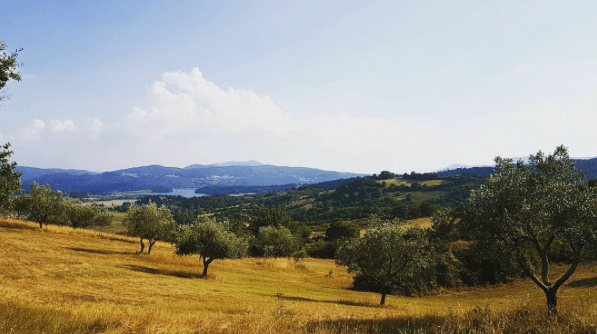
A picture of the Mugello Valley in Tuscany. Source: Christian Lorenz

Sometime before the dawn of the fourteenth century, a family named the Medici moved from a small village in the Mugello Valley in the Apennines to the bustling city of Florence. Eventually, they became successful bankers and one member was elected to the republic’s top office. They also jumped right into the city’s latest violent class and factional civil war. 

Transcript

Once upon a time, there was a courageous knight named Averardo. He fought well for Emperor Charlemagne, freeing Italy from the tyranny of the Lombards. While traveling through the Mugello Valley, he caught word of a giant who was terrorizing the people who lived there. Averardo challenged this Goliath to one-on-one combat. The giant tried to brain Averardo with his mace, but he lifted his golden shield at the pivotal moment, holding the shield so strongly that the mace shattered against it. However, it left the shield dented with the iron balls off the mace. Even with his shield damaged, however, Averardo was able to overpower and kill the cruel giant. Impressed by his feats, Charlemagne himself granted Averardo the right to use the dented shield, iron balls and all, as his family insignia. With that, Averardo graciously accepted the invitation of the people he liberated to settle in the valley. There, his descendants became known as the Medici family.