
Cosimo de’ Medici quickly established a regime that operated within Florence’s constitution but gave Cosimo an almost unchallenged power over the state. Unfortunately, Cosimo’s government was a delicate structure, and the pandemonium of Italian Renaissance politics threatened to bring it all tumbling down.


Transcript
So, with that, let’s start by talking about the idea of an invisible throne and why Cosimo after his return from exile can be said to have one. By the time the Council of Florence was over, if not sooner, foreign leaders wrote to and talked about Cosimo de’ Medici as if he were the de facto ruler of Florence. This is rather remarkable because, unlike other Italian rulers, Cosimo never called himself or was called signore. Nor did he ever receive some kind of aristocratic title or was voted an office like dictator-for-life cementing his power. In fact, in the decades between Cosimo’s triumphant return and his death, for the most part commentators within Florence write and talk as if the republic was chugging along like always. Cosimo actually pushed only one major reform to the government, which we’ll get to this episode. Just by pulling the levers provided for him by the Florentine constitution and by his patronage network, Cosimo made himself the all but unchallenged ruler of one of the richest regions of Europe. Cosimo’s regime was for the most part so subtle and was managed so indirectly that even now modern historians have trouble determining exactly what decisions made by the official political leaders of Florence were actually their initiative or if they were acting entirely on behalf of Cosimo.
I’m not sure if I’d agree, but I think there is a case to be made that the day Cosimo returned to Florence was the beginning of the end of the republic. But it’s not like the words of a certain space queen about republics dying to thunderous applause.
If anything, in the case of Florence and Cosimo, it was more like their republic died with a sound of “Huh, that’s kind of weird. Oh well.”
Of course, no one can gain power without allies, and Cosimo did have plenty of them at the top. Even though, tragically, he was deprived of two key supporters he could trust early on. The first was his cousin Averardo, who died before their exile ended. Averardo’s only son, Giuliano, also passed away shortly after his father’s death. Then Cosimo’s beloved brother Lorenzo died, apparently suddenly, at the age of 45 in 1440, just about a year after he helped negotiate the relocation of the Council of Florence to, well, Florence. He left behind a widow, the noblewoman Piccarda Bueri, and a ten-year-old son, Pierfrancesco. Cosimo took them both in and gave Pierfrancesco an upbringing along his own sons. But at least Cosimo still had powerful allies – the prominent oligarch Agnolo Acciaiuoli, the Alberti family, his numerous contacts in foreign governments and in the papacy, and, of course, his army of clients.
I mentioned last time how the power of not just Cosimo but all the great Florentine oligarchs depended on the system of patronage and clientage. However, how exactly did having an army of clients help Cosimo rule, and how much did he rely on patronage? Well, for starters, patronage wasn’t just something Cosimo did on the side with his banking and political activities. It was a full-time job. The modern historian Anthony Melho found that almost 70% of Cosimo’s surviving letters involve requests for patronage from Florentine citizens or his banking clients from abroad, ranging from asking for a small loan to begging Cosimo that he intercede with the Pope. And it’s important to note that Cosimo’s network reached much further than the upper echelons of the government. His clients also dominated many of the district committees called the gonfalons. Originally founded just to organize the city militias, the members of the gonfalons became the ones who determined the political eligibility of local residents, kept track of forced loans and the distribution of tax benefits, and judged which citizens should be punished and have their property confiscated for tax avoidance. In a way, control of the gonfalons was just as important as control of the republic’s executive and legislative bodies, and Cosimo had that too.
However, if anything, Cosimo had more influence over foreign policy thanks to the international importance his bank gave him. Foreign diplomats didn’t just meet with members of the Signoria, but met and discussed politics with Cosimo personally in his own home. One of Cosimo’s many friends in the arts, the poet Ludovico Carbone, leaves behind a rather touching account of one such meeting:
“Cosimo de’ Medici, who by reason of his riches, his power, and his prudence no less, who directed and governed this city of Florence for a long time, as if he were its lord, once had to negotiate with certain ambassadors from Lucca. The audience was held in his own house, according to custom, and while he was in discussion with them, a small child, his grandson, came up to him with some sticks and a little knife for Cosimo to make him a whistle. Cosimo signified that the discussion was adjourned, devoted himself to the child and made him the whistle, telling him to run away and play. The ambassadors, somewhat offended, turned to Cosimo, saying, “Indeed, Sir Cosimo, we cannot but be surprised at your behavior. We have come to you on behalf of our commune to treat of grave matters and you desert us to devote yourself to a child.’ Cosimo, with a laugh, flung his arms around their shoulders, and replied, ‘O my brothers and my lords, are you not also fathers? Know you nothing of the love for children and grandchildren? You are surprised that I should have made the whistle? It is as well that he didn’t ask me to play it because I would have done that too.”
The identity of the grandson isn’t made clear, but of course I like to think it was the future Lorenzo the Magnificent.
In any case, Cosimo was the proud papa of a growing family. His sons Giovanni and Piero were both married to Florentine noblewomen, Ginevra Alessandri and Lucrezia Tornabuoni. I’ll talk more about Lucrezia particularly later, but these were women brought up under humanist ideals and served as patrons of artists, writers, and scholars in their own right. As for the Medici sons, Giovanni is described as Cosimo’s biographer G. Gutkind as “a sensuous, vivacious, gifted, and cheerful young man who appreciated refinements of life, enjoyed the company of charming women, was unsparing in the satisfaction of his senses…” On the other hand, Piero was a born banker. Even his genuine appreciation of art was really based on his appreciation for art’s potential monetary value. No wonder, then, that while Cosimo had both sons work as managers in the bank early on, he groomed Piero to one day run the entire Medici bank while Giovanni was meant to one day succeed Cosimo in managing the Medici’s political operations. Piero and Lucrezia had a large family of four children along with Piero’s illegitimate daughter, Maria, who in Italian custom was raised alongside her legitimate siblings. Givenra and Giovanni had only one child, Cosimino or “Little Cosimo”, who sadly died at an early age.
All members of the family followed Cosimo’s example in being generous to artists and scholars and, of course, to the Church. Cosimo himself meticulously recorded all of his donations and contributions to church buildings in a ledger titled “God’s account.” Among these holy benefactions was a total overhaul of the convent of San Marco, which got a new church, cloisters, a library, a refectory, and an altar piece that, of course, proudly displayed frescoes of Cosmas and Damian. Also Cosimo commissioned the Renaissance great Donatello to make two sculptures. One was a sculpture of King David triumphing over Goliath, which I covered before as the first freestanding nude statue since antiquity in Europe, and a sculpture depicting Judith and Holofernes. Another famous Old Testament story, Holofernes was an Assyrian general leading an assault on Israel, who was tricked and beheaded by a Jewish woman, Judith. Both the accounts of Judith versus Holofernes and David versus Goliath were well-known narratives taken up as symbolic of freedom and civic virtue in the Renaissance. Even while personally dominating Florentine politics, Cosimo was still careful to take up the visual language of liberty and independence. Then there was, as mentioned, his interest in Greek philosophy, and how much he backed the efforts of Bessarion, Plethon, and Marsilio Facino to teach Greek literature and philosophy to Italian humanists and translate Greek works. Besides the establishment of the Platonic Academy in Florence which served as less of a formal university and more a high-profile discussion forum for humanists interested in all things ancient Greek, there was Cosimo’s sponsorship that enabled Marsilio Facino’s translation into Latin of Plato’s complete works.
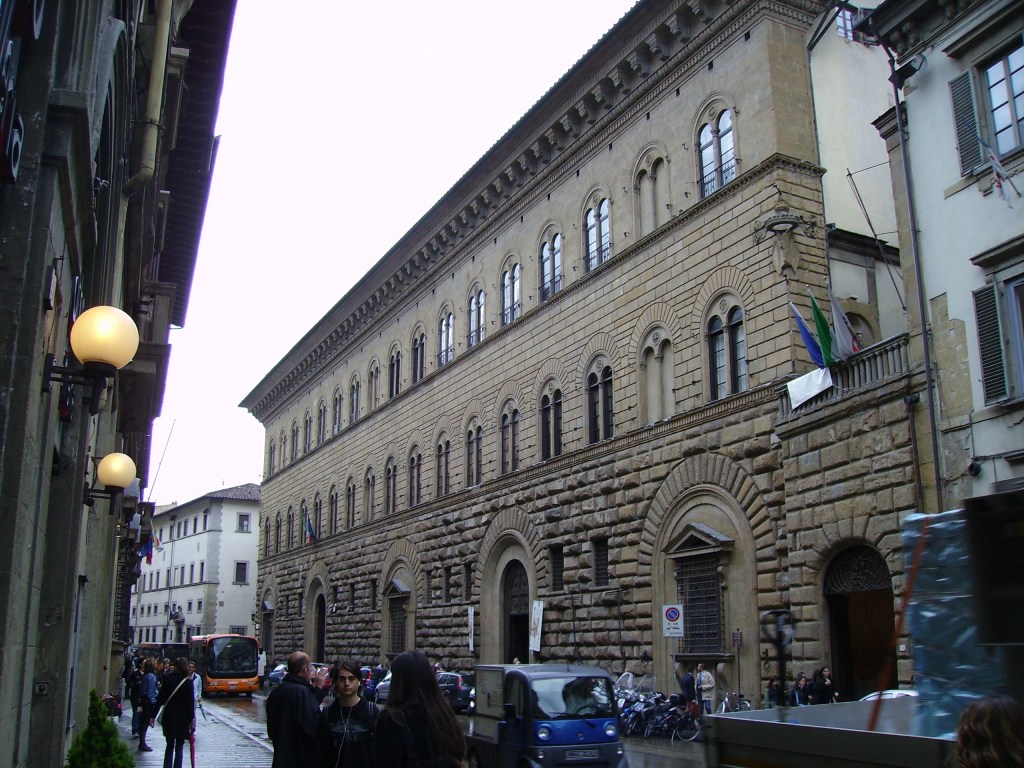
Along with reintroducing Greek philosophy to the West, Cosimo’s two biggest contributions, in my view, were neither church renovations or sculptures, but two buildings. I touched on it before, but Cosimo made his own personal library the basis for Florence’s first public library, the Laurentian Library at San Lorenzo. The library still operates today. Also, Cosimo commissioned the architect Michelozzo to expand his family’s villa, with Cosimo even purchasing neighboring buildings which were annexed to the site. Construction began in 1444, but took almost a lifetime to finish. The building was finally finished in 1484 after both Cosimo and Michelozzo’s deaths. The expanded villa became the building known today as the Palazzo Medici-Riccardi. Inside is a chapel painted by Bonozzo Gozzoli, with frescoes illustrating the Journey of the Magi to visit the infant Jesus Christ with the likenesses of the Medici family and various participants in the Council of Florence. The palazzo still serves as the site of a museum and even the administrative center of Florence’s metropolitan government.
Although Cosimo was lavish in his support of his writer, artist, and architect friends, he did not introduce any reforms benefiting the urban working class. Cosimo was basically no Salvestro. The most he would do was that he would not seek to disenfranchise members of the minor guilds or restrict their rights like the old conservative regime would. Instead, Cosimo presented an image of himself not as a populist revolutionary but as just the first among citizens. Still he could not or would not discourage comparisons between him and another man who presented a modest PR image of himself and who achieved absolute power by manipulating existing political systems, Emperor Augustus of ancient Rome. Cosimo was careful to court the upper class of Florence, who started referring to themselves as the ottimati. The term itself was another symptom of people’s growing reverence for the ancient world, especially Cicero. Ottimati was lifted directly from Cicero’s own Latin term, “optimates”, literally meaning “the best” and referring to the long-established aristocracy. It was a delicate balancing act, though, as Cosimo also worked to court the favor of members of the rising middle class. It was this class that Cosimo entrusted the most with political posts and diplomatic assignments, since they would be entirely dependent on the favor of the Medici, unlike the great families of Florence who all had their own client networks and independent wealth. The trick was to rely on the new middle class without alienating or provoking the jealousy of the ottimati, something even a politician as talented as Cosimo could not always entirely pull off.
To quote John Najemy’s description of the new order Cosimo created: “It took the ottimati a long time to admit what foreigners could see more clearly, namely, that they were all gradually being reduced to the status of clients in a hegemonic patronage system: an entire class made dependent on the Medici for offices and voices in the regime, for financial favors and fiscal relief, advantageous marriages, beneficial positions in trade and banking, preferred treatment in Rome, lucrative ecclesiastical appointments, places of honor in civic rituals, and, not least, for protection of their social prestige and wealth from the popolo and the Catasto, the reformed tax system.”
It was still, though, all in all a dangerous balancing act, and the first real test faced by Cosimo’s house of cards came out of foreign affairs. As often happened, the foreign policy crisis was sparked by a question of succession. Duke Filippo Maria of Milan was getting old and his only heir was Bianca Maria Visconti, his illegitimate daughter. Since at the time even in ideal circumstances the idea of female succession, especially of an illegitimate child, was questionable, Filippo Maria turned to a young and extremely talented condottieri originally from the Romagna, Francesco Sforza. Sforza had been in a contract fighting for Milan and, like a true condottieri, occasionally he still took assignments fighting against Milan. Nonetheless, it seems that Filippo Maria had at least for a time singled out Francesco Sforza as the next Duke of Milan. He arranged for Francesco to marry Bianca Maria and may have signed a secret pact with him, nominating him as his successor to the duchy if he didn’t have any sons.
Since at least 1434, Cosimo and Francesco Sforza had also become friends and made some sort of agreement with Cosimo promising to support Sforza’s claim to the duchy of Milan. Judging from how loyal Cosimo stayed to Sforza, he had at least some personal liking for the general, but it was also pure pragmatism. After all, as long as Francesco’s claim to the duchy was shaky, Cosimo refrained from making any kind of formal alliance with Francesco. Although Cosimo owed his entire political existence to the Republic of Venice, he was also coolly aware that a strong Venice without serious rivals in northern Italy was not in Florence’s best long-term interests. Worse, if Milan imploded because of the lack of a clear successor after Filippo Maria finally died, Venice would have no more obstacles to just striding across all of northern Italy.
For this reason, despite his long, personal relationship with Venice, Cosimo threw his weight behind Francesco Sforza after Duke Filippo passed away on August 13, 1447. Duke Filippo had thrown a wrench into everyone’s plans when he instead bequeathed the duchy to King Alfonso. Instead a group of leading citizens suddenly declared the restoration of the Republic of Milan, which had not technically existed in over 200 years. This republic, given the rather optimistic name the Ambrosian Republic, was right away thrown into war as different foreign powers clamored to get their or their allies’ hands on the rich and powerful duchy of Milan. Venice hoped to annex most if not all of the duchy. Cosimo, however, betrayed his old-time allies the Venetians and instead helped fund Francesco Sforza’s war effort. With such decisive backing, Francesco Sforza took the city of Milan itself by the spring of 1450, although the war boiled on. Cosimo’s break with Venice remained permanent and was apparently personal. At least it was personal according to a remark Cosimo made to a Milanese diplomat, in response to Venetian efforts to get Milan at one point to switch sides and align with them. “Nicodemo, have you ever seen such sorry liars as these Venetians?”
Another knotty succession problem that would totally change the Italian landscape just so happened to unfold at exactly the same time. On February 2, 1434, Queen Giovanna II of Naples died. She had no children or close relatives. The two most likely heirs were King Alfonso V of Aragon (which is today in eastern Spain) and Sicily, who still had a very old claim to the kingdom from back when the kingdoms of Sicily and Naples were still unified, and Duke Rene of Anjou, Giovanna’s cousin. After years of uncertainty and conflict, Giovanna finally named Rene her successor, but of course the matter didn’t end there as the major powers of Italy split down the middle supporting one of the two rivals. The papacy and Venice backed the new king of Naples, Rene, but Milan helped keep Alfonso’s claim alive. By 1442, King Alfonso’s forces had driven Rene out of Naples and back to France. The problems of Naples and Milan quickly intertwined with depressing inevitability. With Francesco Sforza firmly in control of Milan, Venice reluctantly gave up hope of conquering the duchy and instead tried to install their ally, King Alfonso, as Duke of Milan in addition to King of Naples. Naturally, Rene of Anjou led an army from France to back Francesco Sforza in exchange for a promise that he would help Rene regain Naples. Cosimo had Florence join the war on the side of Francesco Sforza and Rene of Anjou, partially because he did not want either King Alfonso or Venice to become too powerful in Italy, but also because he hoped Florence would finally get control over the city of Lucca in the bargain.
The modern historian Gene Brucker once wrote that “Cosimo de’ Medici’s genius as a political leader lay in his superb sense of limits.” This is true, but it was at this point Cosimo made a rare misestimation of his own limits. War takes taxes, and during this particular war taxes were higher than ever before. The Venetian ambassador to Florence gleefully reported on April 9, 1454, “The citizens have raised a great clamor about the new taxes and, as never before, have uttered abusive words against Cosimo and others.” The same day the Venetian ambassador made this report, the war over Milan and Naples finally ended with the Treaty of Lodi, which forced Venice to recognize Francesco Sforza as the rightful Duke of Milan and left Naples in the hands of King Alfonso. In a classic silver lining, the fall of Constantinople at the hands of the Ottoman Empire and the fact that Italy was the obvious next target for the Turks had frightened all the Italian powers into a lasting peace for once. However, for all his navigation around the complicated and constantly shifting Italian alliances, Cosimo did not manage to get his hooks into Lucca.
Even with peace, the blow dealt to the Florentine economy by the war and the scars left behind by high taxes led to troubling signs. Even though he admired Cosimo, the chronicler Giovanni Cavalcani railed against those who “decide who is to be chosen for high offices even before the names are drawn in public” and remarked bitterly that the Palazzo Medici “will make the Colosseum in Rome look futile.” Cavalcani was far from alone in his discontent. One night, Cosimo’s doorstep was found covered with blood, which Cavalcani thought had to be the work of the Butcher’s Guild.
The omens were troubling enough that Cosimo decided to take a rare chance and played for the first and only time of his political career a risky card, namely constitutional reform. Specifically, Cosimo wanted to establish a permanent council that would decide on who would be allowed to become candidates for high offices. Unfortunately, even with his many allies in government, the measure was defeated. Cosimo had to wait for a chance. That chance finally came in July of 1458, when one of his most loyal lieutenants, Luca Pitti, was elected gonfalionier. Cosimo moved to call a general assembly to vote on his reform. On August 11, the bell rung and male citizens over the age of 14 gathered at the Piazzo della Signoria. However, they crowded together under the watchful eyes of armed mercenaries, sent to Florence courtesy of Cosimo’s pal, Francesco Sforza. As soon as an audible number of voices but hardly the majority cried out their assent from the crowd, the officials immediately declared that the motion had passed and that the general assembly was over.
This new council was the Cento or the Council of One Hundred. And it just so happened to be filled with Medici loyalists. One of their first acts was to purge about 1,500 citizens from the electoral rolls. But hey, Florence was still a republic and as the struggle to bring the Cento into existence proved Cosimo’s whims could still be defied or at least delayed by the government occasionally. And there really was no reason not to expect that Cosimo’s unseemly monopoly over politics would prove to be another unpleasant blip in the history of the republic, like Salvestro de’ Medici’s regime or the Albizzi rule over Florence.
At the time the Cento was created, Cosimo was getting on in years. Neither of his sons in the best of health either. So what were the odds that this whole thing would last, exactly? Becoming the ruler of a city was one thing, but choosing who to pass it on to and having that decision stick even after you’re in your grave was something else thing entirely.
 The Medici Podcast