
After Salvestro de’ Medici helps stoke the flames of revolution, violence breaks out on the streets of Florence and a wool-comber is installed in the highest office of the republic. But who will really benefit from this proletariat revolt in the long term?
Transcript
Let’s start this episode with an exercise of imagination. Close your eyes, unless you’re driving or walking, in which case please don’t close your eyes, and try to imagine what it was like to be a poor laborer, earning a pittance from Florence’s cloth industry, sometime in the years following the Black Death.
You might have come from a poor peasant family running a tiny farm, enticed by rumors of higher wages. And at first, compared to life in the country, things do look like an improvement. However, the hours you spend slaving over the hot vat in which dyes for clothing are made from plants. The room you work in has only a tiny window facing a dirty, busy street, and it’s so dark your eyes get strained just halfway through your shift. Unknown to you or any doctor at the time, your coughing fits are probably the result of growing lung damage, caused by inhaling microscopic fibers and toxic fumes.
But knowing that much, you hope it’s not a serious illness, because being sick for more than a day could mean losing your job. But the odds aren’t bad you might show up at the workshop and be told that there’s no work for you anymore any day now. If that happens you know you won’t be able to find another job for weeks, if not months. And yet, every single time you started a new gig as a dyer, you had to agree to a contract that you wouldn’t look for a new job while employed. Despite that, the workshop manager could say there’s no more work for you or force you to leave for any reason without any notice. Worse, while the wages looked nice the first couple of months in Florence, you eventually discovered the money barely covered the expense of life in the big city. Just renting out the small apartment that you had to share with a family of five takes up much of your pay. It didn’t help that your landlord was the very same person who offered you more than half of your jobs, so he knows exactly how much he can squeeze your paycheck. You found out that much when you had to take a loan from him the last time you were unemployed, and he threatened to use the power of the law to take your bed and your few meager possessions when you were late with just one payment.
You were so angry you almost cried when you learned from a friend who grew up in the city that your wages were kept low by law, especially because you knew there was nothing you or anyone else could do to change that. As just a menial worker who helps dye clothes you don’t qualify to join even the minor guilds, so you’ll never be chosen for political office or have any say at all in the laws that shape your life or the taxes you still have to pay. Your only support is an informal fund kept up by some of the other unskilled workers in the dye manfacturies, but the most that will do is maybe get you some medicine if you get sick or pay for your funeral if you die. Forming your own guild or any kind of real workers’ association is not just out of the question, but illegal. Meanwhile, your landlord and employers, and the cloth merchants and manufacturers are getting richer, all the while you’re one illness or a few months of unemployment away from having to go back on your knees to your family in the country or becoming a beggar on the streets.
How angry would you be?
I mentioned last time how the politics of the War of Eight Saints exposed the gulf between the conservatives, who clung to the Guelf tradition of supporting the papacy’s territorial power, and the populists, who wanted to break with Florence’s military support of the Papal States. But the real split in Florentine politics was caused by the desire of the major guilds to maintain their power, the exclusion of menial workers from political representation, and the government’s efforts to roll back the economic benefits to workers caused by the Black Death. This was why the appointment of the conservative-turned-populist firebrand Salvestro de’ Medici as gonfalionere worried conservatives and empowered populists.
As part of his program of reform, Salvestro de’ Medici proposed a measure that would have overturned the very same law he helped pass in his conservative days, which eased the Ordinances of Justice and allowed nobles into various political offices. During a heated session, the conservatives among the priors and the advisory councils managed to defeat Salvestro’s measure. According to one chronicler, Salvestro stood before the representatives and announced, “Wise people of the council, I wanted to cleanse this city of the wicked tyranny of powerful men, but I am not allowed to do so because my companions and the colleges will not consent to it. And as I am not obeyed in my desire to do good, I consider myself no longer prior or gonfalioniere. I therefore intend to go home. Choose another gonfalioniere in my place and do it with God’s grace.”
Chaos immediately erupted. One official tried to strangle one of the leading conservatives, Carlo Strozzi, and had to be pulled off Carlo by his colleagues. A supporter of Salvestro, Benedetto degli Alberti, ran to the window and shouted down to passerby, “Viva il popolo! Viva la libertà!”
Between this and probably accurate rumors that conservatives had mulled over launching a violent coup, a mob of largely working-class people gathered outside the Palazza della Signoria, shouting, “Viva il popolo!” The government reacted by arming guild members and shutting down all the shops. But this only stoked the flames, rather literally. Within days, a mob marched to the houses of leading conservatives, looting them and then burning them down, and breaking into prisons and releasing political prisoners. Salvestro and the populist priors seized the opportunity to exile most of the conservative leaders, restore the old Ordinances of Justice, and overturn the law barring anyone labelled a Ghibelline from political office. If Salvestro and his victorious allies all hoped that this defused the anger of the people, they were very much wrong.
By July, Salvestro’s term was over and he was replaced as Gonfaloniere by Luigi Guicciardini.
The new government tried to promote an atmosphere of compromise and reconciliation. However, even after the fall of the conservatives that June very little had been done to address the real problem, that the wool and dye workers were the largest group of laborers in Florence, slaving away for Florence’s most prosperous industry, but they had no guild to represent them in government. They thought of themselves as a group and called themselves the ciompi, an Italianization of the French word compere, which meant buddy or pal. It was significantly the word that, during the reign of the Duke of Athens, Walter of Brienne, his French soldiers used when chatting with the lower classes of Florence, bringing us back to how the regime of the Duke of Athens was at least in part a populist reaction that at least some of the working classes looked back to fondly. Anyway, the June revolts had taught the ciompi that they were a group with a powerful voice, even if the government denied them any peaceful and official representation. Also stories were circulating that the new government’s attitude was just a ruse, and in reality they were planning to hire a mercenary force to help arrest or even massacre the participants in the revolt.
At night, members of the popolo minuto were holding secret meetings, discussing plans to force the government to give them a guild of their own. Members of the upper classes were helping with the conspiracy, including Salvestro de’ Medici himself. All these details were exposed to the Signoria when one of the conspirators was arrested and tortured. Salvestro was brought in, but he smoothly told them that they had been lied to and all the conspirators were just lowly laborers and artisans, turning his interrogators’ class biases against them and possibly saving himself from exile or worse.
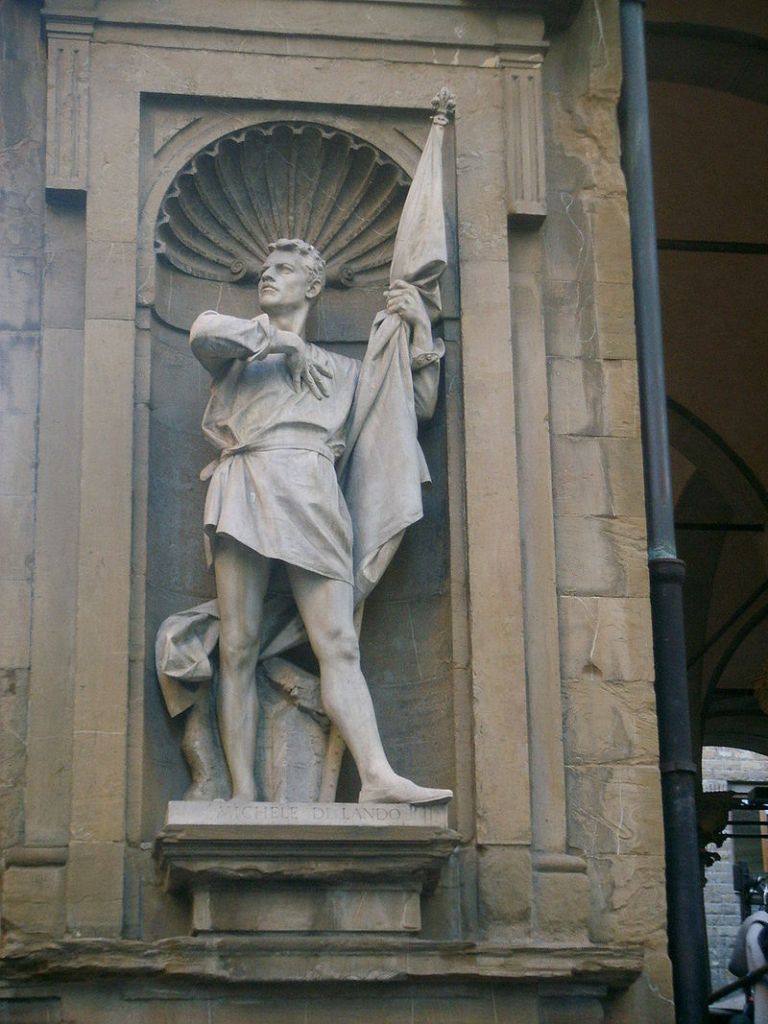
Forewarned, the Signoria stationed a small military force in the Palazzo Vechio to quell any uprising, but it was insufficient, and at any rate it is possible that many soldiers sympathized with the ciompi. Huge, organized crowds of ciompi appeared unopposed before the Palazzo della Signoria demanding the right to form a guild and thus be eligible for selection to political offices. They trapped the priors in their own government building, burned down the Palazzo dell’Arte della Lana, where the wool merchants’ guild had their offices, and hanged the police officer who previously had one of their own tortured. The Signoria were forced to flee. Taking the Palazzo della Signoria, the Ciompi acclaimed a wool-comber by the name of Michele di Lando as gonfalioniere. The new gonfalioniere stood in the hall of the palace in a torn short, bare legs, and sandals, holding the flag of the republic. He chose four priors from the minuto populo, two from the major guilds, and two from the minor guilds, and also chose new men to fill the legislatures. The revolutionary new Signoria on the spot voted to create three new guilds – one for dye workers, one for tailors, and and a guild that would represent all the popolo minute.
However, there was discontent among the ranks. Some wanted further reforms or actual reprisals against their employers or were angered that Michele di Lando was acting without consulting the wider mob that brought him to power in the first place, an echo maybe of the old idea of a general assembly. One group of ciompi even set up a rival revolutionary government in the Piazza Santa Maria Novella and sent messages back demanding a power-sharing arrangement between the two new revolutionary governments.
The two factions were at a stalemate until the leader of the rival Ciompi government, Luca di Totto da Panzano, whipped up the crowd into looting and burning the homes of his political enemies. His own supporters then turned against him, driving him out of Florence.
However, there was a growing sense among the Ciompi that Di Lando was betraying them, especially once Di Lando brandished a sword, and, leaping on a horse, began to lead a force to clear any rival Ciompi out of the streets. Many Ciompi who resisted Di Lando’s ascension to power were killed in the spree of violence, and di Lando either did nothing to stop it or even consented to using violence to end the unrest. On the other hand, Machiavelli, in his History of Florence, hailed Di Lando as one of the greatest Florentines to ever live, and argued bitterly that in the end he was betrayed by both his Ciompi comrades and the elites of Florence much to the cost of Florentine people.
Whatever the case may be, Di Lando actually held office for the customary two months. However, the minute he stepped down, the backlash was quick and thorough. The government that succeeded Di Lando was populist, but it also turned against what was left of the Ciompi influence in government. With the consent of the Ciompi’s old ally Salvestro de’ Medici, the government dissolved the guild of the popolo minute while allowing the two more moderate guilds of the cloth dyers and the tailors to remain. Michael di Lando was banished, disappearing from Florence and the pages of history. So what was arguably the first industrial, proletarian revolution in history ended with a whimper.
The real winner in all this was Salvestro de’ Medici. Because the leaders of the succeeding governments were mostly his lackeys, Salvestro effectively became the de facto dictator of Florence from 1378 to 1382, even though or perhaps because he was widely known to have supported the revolt in its early stages. In his memoirs, Salvestro’s cousin Foglino had bemoaned that the Medici had lost respect, and yearned for the days when “It used to be said, ‘You are like one of the Medici,’ and everyone feared them.” Those days were perhaps back and better than ever, but they did not last long.
The problem was that Salvestro and the populists overplayed their hand. During the days of di Lando’s administration and Salvestro’s unofficial dictatorship, the government kept imprisoning or exiling conservative leaders and even had Piero degli Albizzi arrested and beheaded. However, the conservatives rallied around a new leader, Piero’s son Meso and came back with a vengeance. Forming a coalition of nobles, landowners, and rich business owners, they sweeped the government in January 1382. Salvestro was not unfairly labeled a tyrant and exiled to Modena. But in a sign that his popularity still endured, his exile was eventually lifted and he was allowed to return to Florence where he died peacefully in his own home in 1388.
One of the men in Meso’s reconstituted conservative clique was Salvestro’s own cousin, the banker Vieri de’ Medici. However, the future of the family did not belong to Vieri, but to two impoverished boys Vieri took in who would set the family on a path that would take them much further than even Salvestro’s career as a beloved demagogue.
 The Medici Podcast