Even as a small child, Lorenzo had been thrust into the role of the public face of the Medici regime. Now an adult, Lorenzo’s own marriage to a Roman noblewoman from a clan claiming the Emperor Augustus and Julius Caesar as ancestors is a chance for the Medici to ascend even higher. Meanwhile, Piero is finally succumbing to his gout, just when both the domestic and foreign situations are starting to fall apart.
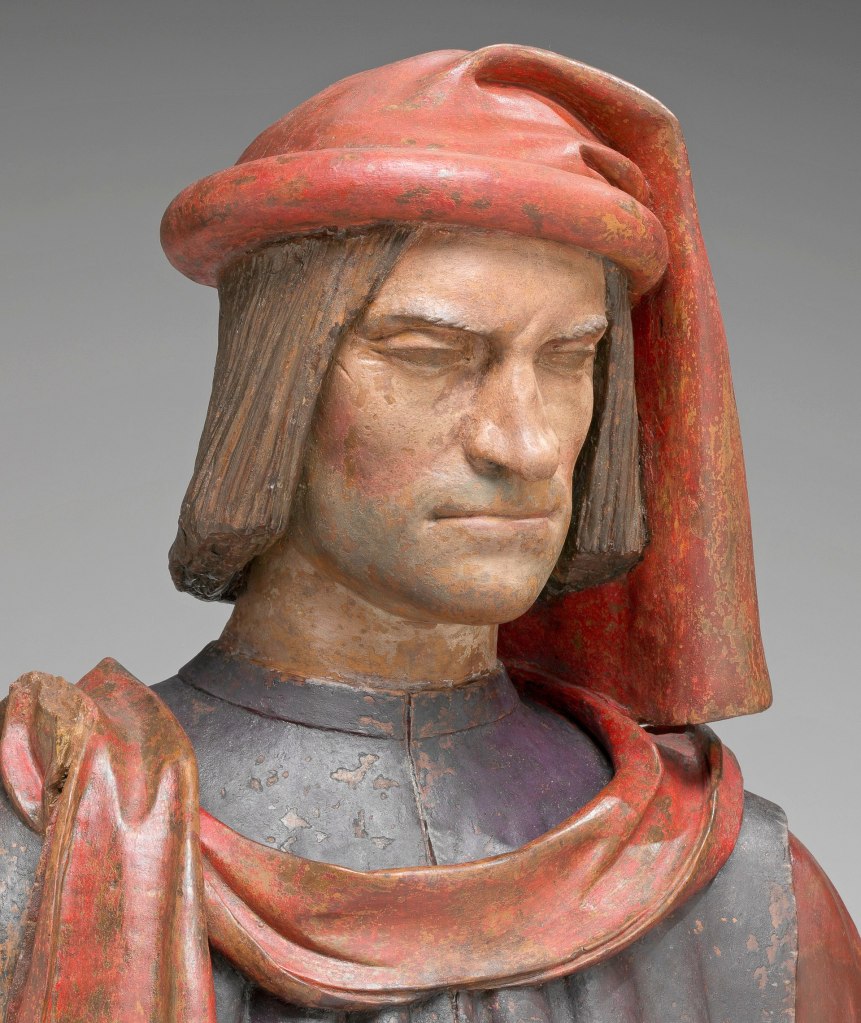
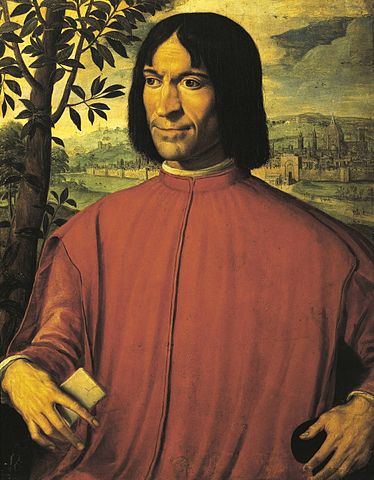
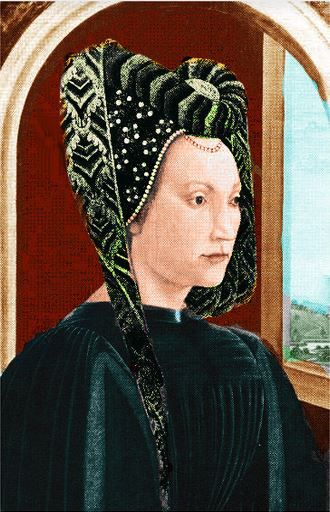
“The Counterattack of Michelotto di Cotignola” (c. 1455), one of Paolo di Dono’s three paintings commemorating the Florentine victory over Siena at the Battle of San Romano in 1423, commissioned by Piero de’ Medici. Source: The Louvre, Paris. Boticelli’s Adoration of the Magi (1475 or 1476), which includes a depiction of the 16-year-old Lorenzo de’ Medici on the far left. Source: Uffizi Gallery, Florence. A posthumous terracotta bust of Lorenzo de’ Medici, which was likely based on a 1478 wax sculpture by Andrea del Verrocchio and Orsino Benintendi. Date unknown. Source: National Gallery of Art, Washington DC. Girolamo Machietti’s posthumous portrait of Lorenzo de’ Medici. Date unknown. Source: Palazzo Pitti, Florence. A portrait likely of Clarice Orsini by Domenico Ghirlandaio (1490s). Source: National Gallery of Ireland, Dublin.
Transcript
Well, I know “Rising Sun” is probably one of the most obvious word plays you can make in this case, but it really is just…too relevant. Because Lorenzo di Piero di’ Medici was exactly that. From a very early age he was seen as the future of the family, so much so that his poor father Piero, through no fault of his own, was seen as little more than a placeholder, whose most important job was to live long enough for Lorenzo to reach adulthood.
Piero de’ Medici seems to be enjoying a smooth transition to power, but soon enough a rival political party takes shape on the high ground just across the river from the Palazzo de’ Medici. When legal measures fail to dislodge the Medici, the so-called “Party of the Hill” proves itself more than willing to resort to more drastic measures. Meanwhile we get a better look at Piero, the math professor of the Renaissance, and his wife Lucrezia, wife/mother/patron/businesswoman/writer.
The Palazzo Pitti, which was built by banker-politician Luca Pitti to rival the Palazzo de’ Medici which lied just across the River Arno. Since the palace sat on high ground, it inspired the name given to Luca’s anti-Medici political party, the Party of the Hill. Today, it houses the largest museum complex in Florence. Source: Ed Webster.A portrait of Luca Pitti, date and painter unknown. Source: Kursk State Art Gallery, Kursk Oblast, Russian Federation. A portrait of Lucrezia de’ Medici, néeTornabuoni, by Domenico Ghirlandaio (c. 1475). Source: National Gallery of Art, Washington DC. A bust of Piero de’ Medici at the Bargello in Florence. Source: Yair Haklai.
Transcript
Something I didn’t really get into was that, while Cosimo was able to cling tightly to power since the general assembly he called under the steely gaze of armed troops, discontent had been simmering in the last years of his unofficial reign. Many of Cosimo’s top lieutenants who helped ensure the government would carry out his wishes, especially Agnolo Acciaiuoli, Luca Pitti, and Dietisalvi Neroni, all became increasingly critical of the Medici and their tactic of pre-selecting candidates for office, even though they did not dare do anything to act upon their criticisms or voice them too loudly.




 The Medici Podcast