Categories
season three

Episode 42: The Orphan

A new Medici is born amidst tragedy, Pope Leo struggles with the threats posed by France, Spain, and the Holy Roman and Ottoman empires and a deadly conspiracy close to home, and an obscure monk and university lecturer in Germany starts to inspire a bit of controversy. 

A portrait possibly of Madeleine de La Tour d’Auvergne, the mother of Catherine de’ Medici and wife of Lorenzo “the Younger.” Date unknown. Source: Uffizi Gallery.

Transcript

The last we saw Pope Leo X he had just betrayed his mentor and predecessor, Pope Julius, by ousting Julius’ nephew Francesco Maria from the duchy of Urbino and giving the duchy instead to Leo’s own nephew Lorenzo. But a few modern historians and Leo’s contemporaries agreed that he had also betrayed Julius by not doing enough to, as Julius would say, drive the barbarians out of Italy. But honestly while taking Urbino from its rightful duke was an undisputable blunder, I don’t think Leo can really be blamed for the rest of his foreign policy. He was stuck between a French rock and an imperial hard place, especially now that Spain and the Holy Roman Empire was practically ruled by the same family.
Categories
season three

Episode 41: The Prince

Pope Leo X goes through his own “annus mirabilis.” Meanwhile the next generation of Medici men come into their own: the wannabe aristocrat, Lorenzo “the Younger”, and the juvenile delinquent turned freelance mercenary, Giovanni of the Black Bands. 

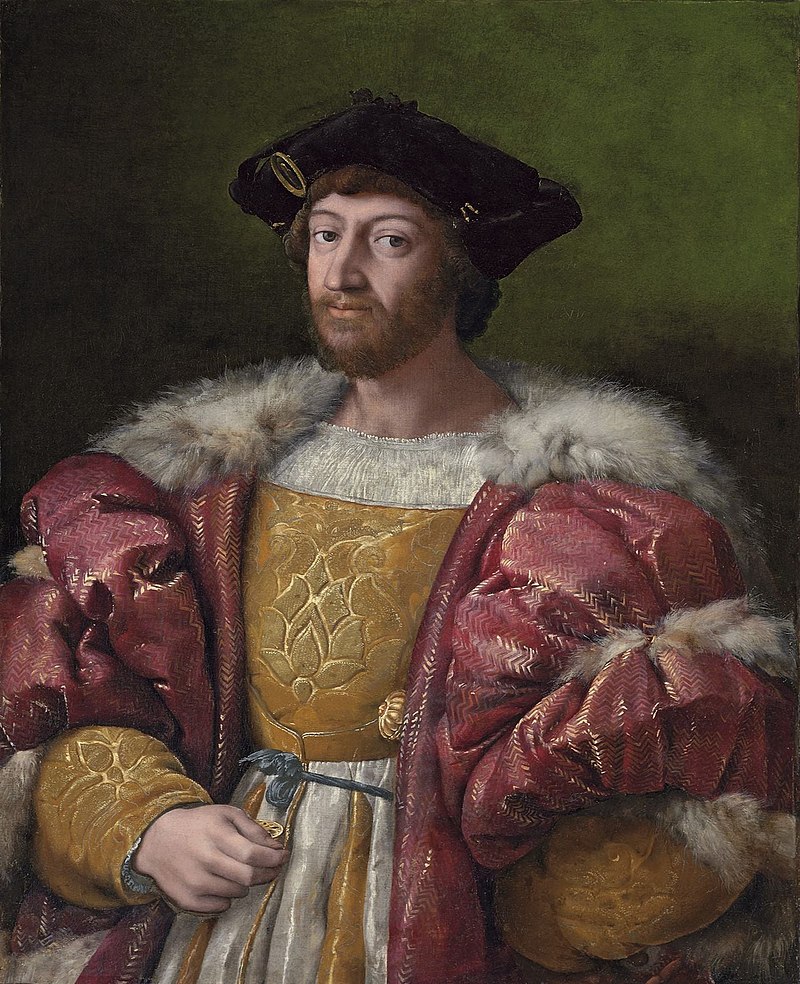
A portrait of Lorenzo di Piero de’ Medici, Duke of Urbino, by Raphael (1518). Note the ostentatious dress in the style of a French nobleman in contrast to the more modest patrician clothing worn by his grandfather Lorenzo the Magnificent and his uncle Giuliano. Source: Private collection.
A portrait depicting Giovanni “of the Black Bands” painted after his death by Francesco de’ Rossi (1548). Source: Soprintendenza Speciale Per Il Polo Museale Fiorentino.

Transcript

1516 was a very bad year for Leo X. To paraphrase Queen Elizabeth II of England centuries later, 1516 was Leo’s annus mirabilis. His brother Giuliano died in March, which was not only a personal loss but a political one for the family, since he seems he might have been the most politically talented and popular member of the family since his father Lorenzo the Magnificent. Then, that summer, a monk named Bonaventura had declared himself the true, “Angelic Pope”, excommunicated the Pope and all his cardinals, and warned that the Ottoman Turks would invade Italy before converting to Christianity thanks to the King of France.