Categories
season two

Episode 24: Bloodshed

The Pope, his nephew, an archbishop, and a mercenary decide Lorenzo de’ Medici and his brother Giuliano have to die. Unfortunately, the conspiracy develops some hiccups, namely having to send a couple of clergy instead of a mercenary to take down Lorenzo…
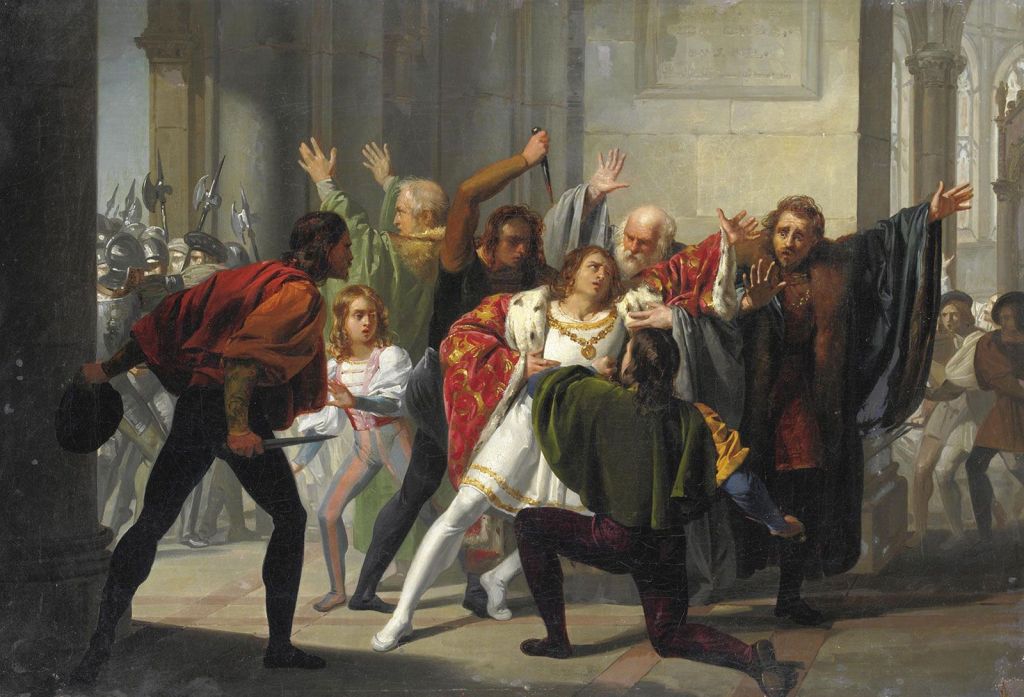
Stefano Ussi’s painting imagining the assassination of Giuliano de’ Medici (although note that Giuliano was supposed to have been kneeling when he was killed) (date unknown). Source: Private collection.
Leonardo da Vinci’s sketch of Bernardo Bandini, one of the executed conspirators. Date: 1479.

Transcript

On a late summer day in 1477, a battle-hardened mercenary, Giovan Batista, Count of Montesecco, was ushered into the private chambers of the Pope himself. Already flanking the Pope were his nephew, Count Girolamo Riario, and Francesco Salviati, the Archbishop of Pisa. Count Girolamo still blamed Lorenzo de’ Medici for not helping his uncle acquire territories for him in the Romagna. The Archbishop was barred from assuming his rightful post. In the heart of the spiritual center of Christendom, the three had come to discuss sparking a rebellion, and maybe even murder. Giovan had met with the archbishop and Girolamo a couple of times before in order to discuss overthrowing the Medici-dominated government in Florence along with the assassination of Lorenzo de’ Medici and his brother Giuliano. Giovan was skeptical of the whole scheme’s chances of success from the start, or at least that’s what he told the men interrogating him in Florence after the fact. In any case, he believed the whole thing was just a hair-brained plot dreamed up by Girolamo and the archbishop behind the Pope’s back. Now, however, here they were, talking about overthrowing the Medici in the presence of the Pope himself.

Categories
season two

Episode 22: Triumphs and Missteps

Not long after coming to power, Lorenzo de’ Medici has to fend off enemies at home and abroad. Unfortunately, in the course of protecting Florence from a crisis that could spiral out of control, Lorenzo sets the stage for a humanitarian disaster. But how much was he really to blame?

A contemporaneous portrait of Lorenzo’s brother, Giuliano de’ Medici, by Sandro Botticelli. Circa 1478. Source: Gemäldegalerie Berlin.

Transcript

Speaking of Lorenzo, let’s catch up with him a few days after his father’s death. The members of the Medici party among Florence’s ruling class met in the hundreds and sent a delegation led by Tomasso Soderini to him, asking him to take up the mantle of his father and grandfather as the first citizen and unofficial leader of Florence. This was a degree of recognition even Lorenzo’s father Piero didn’t receive. In Lorenzo’s own words:

“Their proposal was naturally against my youthful instincts, and, considering that the burden and danger were great, I consented to it unwillingly. But I did so in order to protect our friends and property, since it fares ill in Florence with anyone who is rich but does not have any share in government.”