Categories
season two

Episode 26: The Private Life and Patronage of Lorenzo de’ Medici

The Lorenzo we see from his voluminous letters is a man who had a short temper and bouts of depression, but was also capable of tremendous compassion and generosity. Unfortunately, his relationships with his own wife and sons were perhaps less than ideal.

Transcript

So you may have noticed I focused on Lorenzo’s activities as a politician, and not as a patron. This is despite the fact that Lorenzo is the rare historically celebrated leader who is actually better known for his activities in the cultural sphere than his political career. Now that we hit a point in our story where Lorenzo is basking in his victories over Pope Sixtus and is for the first time in a long time secure, I want to hit pause and look at Lorenzo as a family man and then as the head of a vast patronage network that made Florence one of the cultural capitals of Europe.

Categories
season two

Episode 25: Into The Lion’s Den

To try to stop a war Florence is badly losing and take some steam out of the Pope’s vendetta against him, Lorenzo does something few politicians had done before or since: put himself directly in enemy territory. 

King Ferrante of Naples as one of the Magi who visit the infant Jesus Christ in Marco Cardisco’s Adoration of the Magi. Date unknown. Source: Civic Museum of Castel Nuovo, Naples.

Transcript

Lorenzo had survived the assassination, but he had lost his brother. It should be admitted that judging from the evidence Lorenzo’s relationship with his younger brother Giuliano wasn’t the close partnership their grandfather Cosimo had with his own brother. Lorenzo was suspicious of his brother, while Giuliano apparently thought at least for a time that Lorenzo was standing in the way of his own ambitions. If Giuliano had lived, it is possible that he and Lorenzo might have gone the route of many siblings born into power, with Giuliano becoming a living focal point of resistance against his older brother’s regime. Even so, Lorenzo deeply mourned his brother. We know this not just through anything Lorenzo wrote or was reported to have said. With Lorenzo’s prestigious, almost non-stop correspondence, we have a gap of five whole days after his brother’s death.

Categories
season two

Episode 24: Bloodshed

The Pope, his nephew, an archbishop, and a mercenary decide Lorenzo de’ Medici and his brother Giuliano have to die. Unfortunately, the conspiracy develops some hiccups, namely having to send a couple of clergy instead of a mercenary to take down Lorenzo…

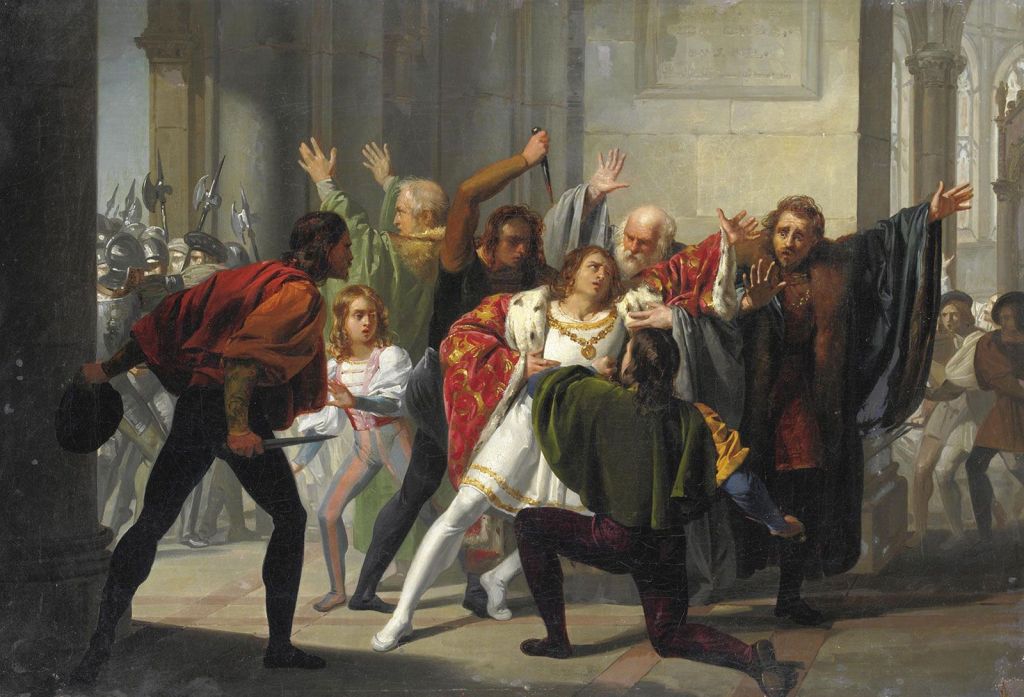
Stefano Ussi’s painting imagining the assassination of Giuliano de’ Medici (although note that Giuliano was supposed to have been kneeling when he was killed) (date unknown). Source: Private collection.
Leonardo da Vinci’s sketch of Bernardo Bandini, one of the executed conspirators. Date: 1479.

Transcript

On a late summer day in 1477, a battle-hardened mercenary, Giovan Batista, Count of Montesecco, was ushered into the private chambers of the Pope himself. Already flanking the Pope were his nephew, Count Girolamo Riario, and Francesco Salviati, the Archbishop of Pisa. Count Girolamo still blamed Lorenzo de’ Medici for not helping his uncle acquire territories for him in the Romagna. The Archbishop was barred from assuming his rightful post. In the heart of the spiritual center of Christendom, the three had come to discuss sparking a rebellion, and maybe even murder. Giovan had met with the archbishop and Girolamo a couple of times before in order to discuss overthrowing the Medici-dominated government in Florence along with the assassination of Lorenzo de’ Medici and his brother Giuliano. Giovan was skeptical of the whole scheme’s chances of success from the start, or at least that’s what he told the men interrogating him in Florence after the fact. In any case, he believed the whole thing was just a hair-brained plot dreamed up by Girolamo and the archbishop behind the Pope’s back. Now, however, here they were, talking about overthrowing the Medici in the presence of the Pope himself.

Categories
season two

Episode 23: The Calm Before The Storm

Lorenzo resorts to unsavory methods in order to keep the Medici bank afloat. In the meantime, his path crosses with the man who would prove to be his most relentless enemy: Christ’s representative on Earth himself. 

A fresco depicting Sixtus IV and some of the della Rovere-Riario family by Melozzo da Forli (c. 1477). Source: Vatican Museum.

Transcript

On July 19, 1476, Pierfrancesco passed away. He was the renegade Medici that his contemporaries described as a “bit of a backwoodsman” and who never showed much real interest in business, politics, or art, although his contemporaries did compliment him on his good manners. With his death, family history repeated. Just as happened when his own father, Cosimo’s brother Lorenzo, died, Pierfrancesco’s two sons were left sitting on a fortune and shares in the Medici bank, but too young legally to be independent. So Lorenzo took in Pierfrancesco’s sons, 14-year-old Lorenzo and 9-year-old Giovanni, and had them raised along his own children, just like how Cosimo had Pierfrancesco raised in his own household. And yes, I know, it’s so inconvenient that Pierfrancesco also named his son Lorenzo.

Categories
season two

Episode 22: Triumphs and Missteps

Not long after coming to power, Lorenzo de’ Medici has to fend off enemies at home and abroad. Unfortunately, in the course of protecting Florence from a crisis that could spiral out of control, Lorenzo sets the stage for a humanitarian disaster. But how much was he really to blame?

A contemporaneous portrait of Lorenzo’s brother, Giuliano de’ Medici, by Sandro Botticelli. Circa 1478. Source: Gemäldegalerie Berlin.

Transcript

Speaking of Lorenzo, let’s catch up with him a few days after his father’s death. The members of the Medici party among Florence’s ruling class met in the hundreds and sent a delegation led by Tomasso Soderini to him, asking him to take up the mantle of his father and grandfather as the first citizen and unofficial leader of Florence. This was a degree of recognition even Lorenzo’s father Piero didn’t receive. In Lorenzo’s own words:

“Their proposal was naturally against my youthful instincts, and, considering that the burden and danger were great, I consented to it unwillingly. But I did so in order to protect our friends and property, since it fares ill in Florence with anyone who is rich but does not have any share in government.”

Categories
season two

Episode 21: The Rising Son

Even as a small child, Lorenzo had been thrust into the role of the public face of the Medici regime. Now an adult, Lorenzo’s own marriage to a Roman noblewoman from a clan claiming the Emperor Augustus and Julius Caesar as ancestors is a chance for the Medici to ascend even higher. Meanwhile, Piero is finally succumbing to his gout, just when both the domestic and foreign situations are starting to fall apart. 

“The Counterattack of Michelotto di Cotignola” (c. 1455), one of Paolo di Dono’s three paintings commemorating the Florentine victory over Siena at the Battle of San Romano in 1423, commissioned by Piero de’ Medici. Source: The Louvre, Paris.
Boticelli’s Adoration of the Magi (1475 or 1476), which includes a depiction of the 16-year-old Lorenzo de’ Medici on the far left. Source: Uffizi Gallery, Florence.
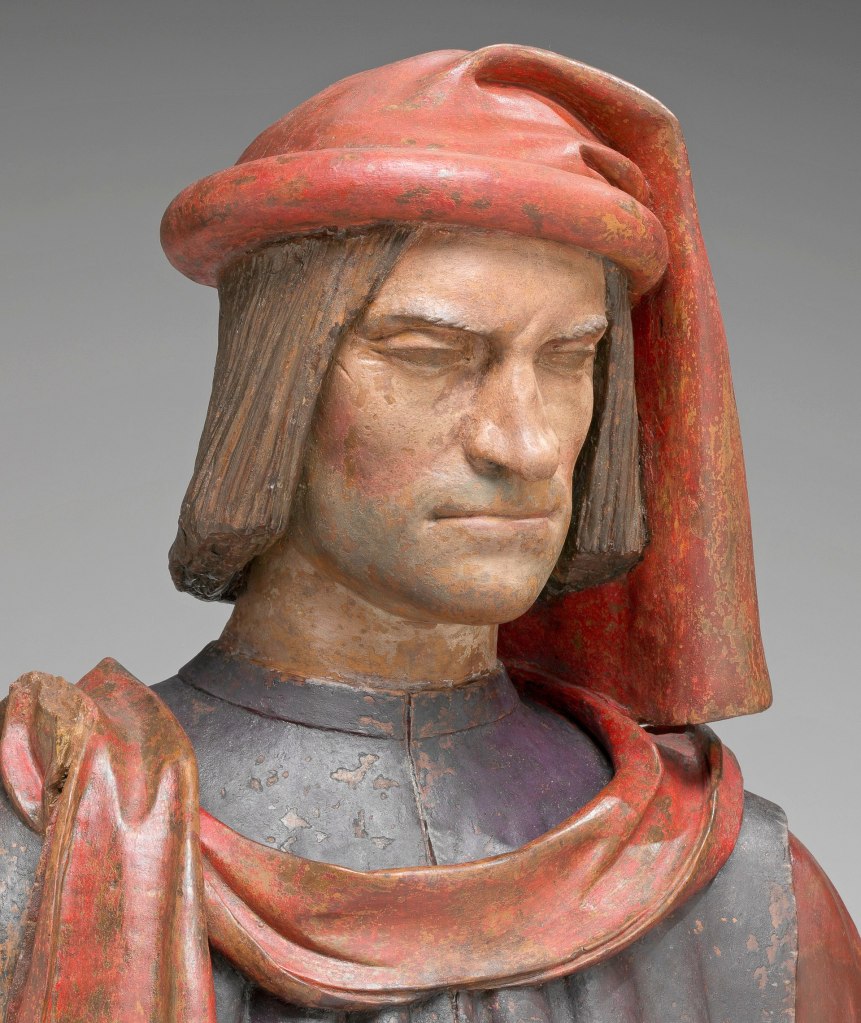
A posthumous terracotta bust of Lorenzo de’ Medici, which was likely based on a 1478 wax sculpture by Andrea del Verrocchio and Orsino Benintendi. Date unknown. Source: National Gallery of Art, Washington DC.
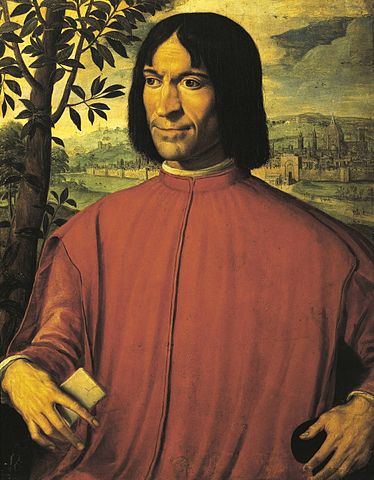
Girolamo Machietti’s posthumous portrait of Lorenzo de’ Medici. Date unknown. Source: Palazzo Pitti, Florence.
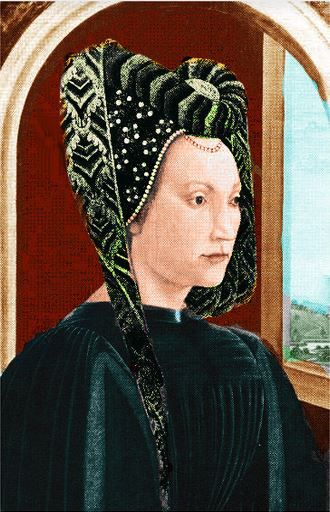
A portrait likely of Clarice Orsini by Domenico Ghirlandaio (1490s). Source: National Gallery of Ireland, Dublin.

Transcript

Well, I know “Rising Sun” is probably one of the most obvious word plays you can make in this case, but it really is just…too relevant. Because Lorenzo di Piero di’ Medici was exactly that. From a very early age he was seen as the future of the family, so much so that his poor father Piero, through no fault of his own, was seen as little more than a placeholder, whose most important job was to live long enough for Lorenzo to reach adulthood.

Categories
season two

Episode 20: Conspiracy or Countercoup?

Piero de’ Medici narrowly escaped death or abduction. But did everything happen as Piero and his son Lorenzo said? And just how will the Party of the Hill survive when they apparently bet everything on one scheme? 

One-Time
Monthly
Yearly

Make a one-time donation

Make a monthly donation

Make a yearly donation

Choose an amount

$5.00
$15.00
$100.00
$5.00
$15.00
$100.00
$5.00
$15.00
$100.00

Or enter a custom amount

$

Your contribution is appreciated.

Your contribution is appreciated.

Your contribution is appreciated.

DonateDonate monthlyDonate yearly

Transcript

Last time, we saw Piero narrowly dodge a possible abduction or assassination attempt. Only the fact that his son Lorenzo wasn’t recognized and was able to get back to Florence using the backroads foiled the plot. Or was that actually what happened? A silk merchant and staunch critic of the Medici regime, Marco Parenti, left behind an interesting memoir that was discovered, having laid forgotten in the archives, by historian Mark Phillips in the 1970s.

Categories
season two

Episode 19: Hill Versus Plain

Piero de’ Medici seems to be enjoying a smooth transition to power, but soon enough a rival political party takes shape on the high ground just across the river from the Palazzo de’ Medici. When legal measures fail to dislodge the Medici, the so-called “Party of the Hill” proves itself more than willing to resort to more drastic measures. Meanwhile we get a better look at Piero, the math professor of the Renaissance, and his wife Lucrezia, wife/mother/patron/businesswoman/writer.

The Palazzo Pitti, which was built by banker-politician Luca Pitti to rival the Palazzo de’ Medici which lied just across the River Arno. Since the palace sat on high ground, it inspired the name given to Luca’s anti-Medici political party, the Party of the Hill. Today, it houses the largest museum complex in Florence. Source: Ed Webster.
A portrait of Luca Pitti, date and painter unknown. Source: Kursk State Art Gallery, Kursk Oblast, Russian Federation.
A portrait of Lucrezia de’ Medici, née Tornabuoni, by Domenico Ghirlandaio (c. 1475). Source: National Gallery of Art, Washington DC.
A bust of Piero de’ Medici at the Bargello in Florence. Source: Yair Haklai.

Transcript

Something I didn’t really get into was that, while Cosimo was able to cling tightly to power since the general assembly he called under the steely gaze of armed troops, discontent had been simmering in the last years of his unofficial reign. Many of Cosimo’s top lieutenants who helped ensure the government would carry out his wishes, especially Agnolo Acciaiuoli, Luca Pitti, and Dietisalvi Neroni, all became increasingly critical of the Medici and their tactic of pre-selecting candidates for office, even though they did not dare do anything to act upon their criticisms or voice them too loudly.

Categories
season two

Episode 18: Succession

At the height of his political power, Cosimo de’ Medici is being overwhelmed with illness and personal tragedy. Who will succeed him to his invisible, nameless throne? His son Piero, who unfortunately is a middle-aged man so sick no one thinks he will live for much longer.

Transcript

As far as we know, it was smooth sailing for Cosimo after the general assembly of 1458. The old lists of enfranchised lists that had been put together under the Albizzi were burned. Through Cosimo’s new council, the Cento, not only were hundreds of citizens disenfranchised but new lists of citizens were drawn up to be placed in the electoral bags. And although the republic still operated the same way it had since the Ordinances of Justice were enacted, few if any important decisions were made without Cosimo’s input. In his memoirs Pope Pius II observed that after the general assembly “Cosimo was refused nothing. He was regarded as the arbiter of war and peace, the regulator of law; not so much a citizen as the master of his city. Political councils were held at his house; the magistrates he nominated were elected; he was king in all but name and state.”

Categories
season two

Episode 17: The Invisible Throne

Cosimo de’ Medici quickly established a regime that operated within Florence’s constitution but gave Cosimo an almost unchallenged power over the state. Unfortunately, Cosimo’s government was a delicate structure, and the pandemonium of Italian Renaissance politics threatened to bring it all tumbling down. 

The exterior of the Palazzo Medici-Riccardi. Source: Yair Haklai, Wikicommons.
The interior of the Chapel of the Magi within the Palazzo Medici-Riccardi. Source: theflorentine.net.
A portrait of Francesco Sforza, Duke of Milan, former condottieri, and a key ally of Cosimo de’ Medici, by Bonifacio Bembo (c. 1460). He insisted on being painted wearing his battered and worn old campaigning hat.

Transcript

So, with that, let’s start by talking about the idea of an invisible throne and why Cosimo after his return from exile can be said to have one. By the time the Council of Florence was over, if not sooner, foreign leaders wrote to and talked about Cosimo de’ Medici as if he were the de facto ruler of Florence. This is rather remarkable because, unlike other Italian rulers, Cosimo never called himself or was called signore. Nor did he ever receive some kind of aristocratic title or was voted an office like dictator-for-life cementing his power. In fact, in the decades between Cosimo’s triumphant return and his death, for the most part commentators within Florence write and talk as if the republic was chugging along like always. Cosimo actually pushed only one major reform to the government, which we’ll get to this episode. Just by pulling the levers provided for him by the Florentine constitution and by his patronage network, Cosimo made himself the all but unchallenged ruler of one of the richest regions of Europe. Cosimo’s regime was for the most part so subtle and was managed so indirectly that even now modern historians have trouble determining exactly what decisions made by the official political leaders of Florence were actually their initiative or if they were acting entirely on behalf of Cosimo.