Categories
season two

Episode 31: The Flood Comes

Piero doesn’t get to enjoy being the de facto lord of Florence for long before he has to deal with an impending French invasion of Italy. He decides to imitate his father’s boldest move, which would surely work…won’t it?
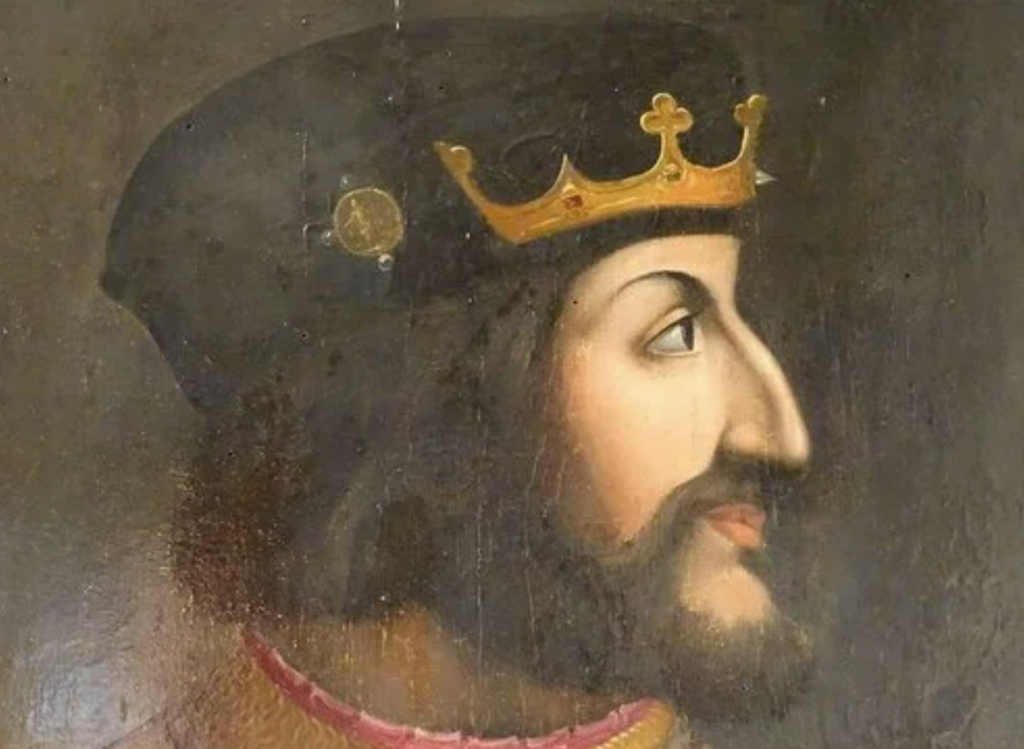
A portrait of King Charles VIII of France. Artist unknown. Uffizi Galleries, Florence.

Transcript

The birth of the future King Charles VIII of France was even more celebrated than that of a normal heir. His father, King Louis XI of France, had two daughters, but by that time it would have been impossible even for their domineering father to have them accepted as his successors. Under what was called the Salic Law, daughters could not inherit the French throne. This law took its name from the Salian Franks, the Germanic people that first established the kingdom of France and gave it its name. In truth, the Salic Law just took its name from an old sixth century law that regulated property inheritance and had nothing to do with royal succession. But in the early fourteenth century it was a convenient excuse for King Felipe V to claim the throne instead of his elder brother’s daughter Jeanne. The excuse became even more convenient when King Edward III of England used the claim to the French throne he inherited through his mother to justify his invasion of France. By Louis XI’s time, the Salic Law was firmly locked in place. So without a son the crown would pass over his hated cousin and rival, Louis d’Orleans. However, since the day he was born to the happy parents Louis XI and his queen Charlotte of Savoy, Charles VIII was sickly. No wonder Louis XI was so afraid for his son’s survival that he kept him isolated and micromanaged his son’s governors.

Categories
season two

Episode 30: Piero the Brief

The fourth Medici to come to power as “unofficial lord” of Florence is Lorenzo the Magnificent’s son, Piero. Although a strapping, handsome, and popular young man, forces within the regime are already working against him. But the real threat is starting to stir many miles outside of Florence…

A portrait of Piero II “the Brief” de’ Medici by Gherardo di Giovanni del Fora. Date: 1494. Source: National Library of Naples.

Transcript

Piero de Medici or Piero II if you want to be specific was the oldest of Lorenzo the Magnificent’s sons who lived past infancy, born on February 15, 1472. This is a bit of a spoiler but I should mention he’s also remembered by history with the sobriquets “the Unfortunate” or “The Brief”, as you probably noticed in this episode’s title. There was never really any question that Lorenzo’s place on the invisible throne of the Medici would be filled by his eldest son Piero. After Lorenzo’s death only a single vote in the Council of Seventy, out of all the legislative councils in the government, went against a bill that would have Piero inherit everything from Lorenzo, including his political responsibilities. This was despite the fact that Piero was too young for political office according to Florentine law.

Categories
season two

Episode 29: After Me, The Deluge

We step back from the Medici to look at Europe as a whole circa 1492. The balance of power is shifting and that means, for the Medici and Italy as a whole, the flood is coming. 

A map of Europe circa 1500 (although it should be noted modern Spain was still administratively divided between the kingdoms of Aragon and Castile). Source: The University of Oregon.

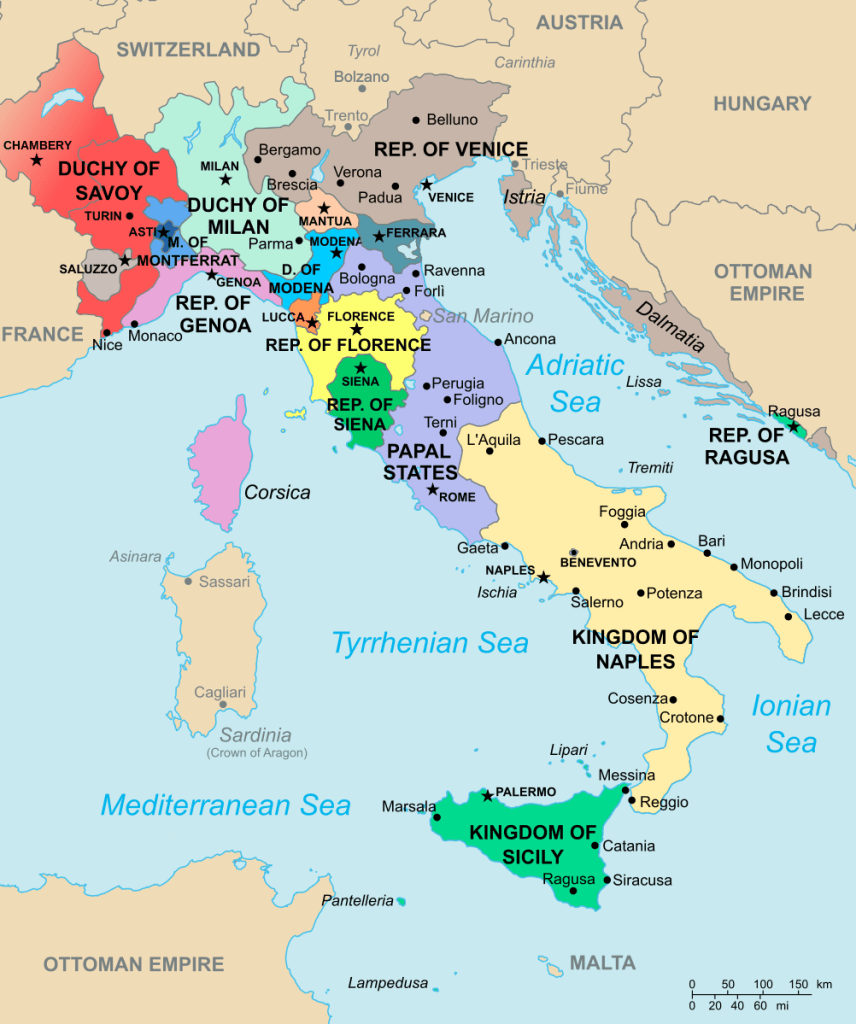
A map of Italy in 1494. Source: Shadowxfox.

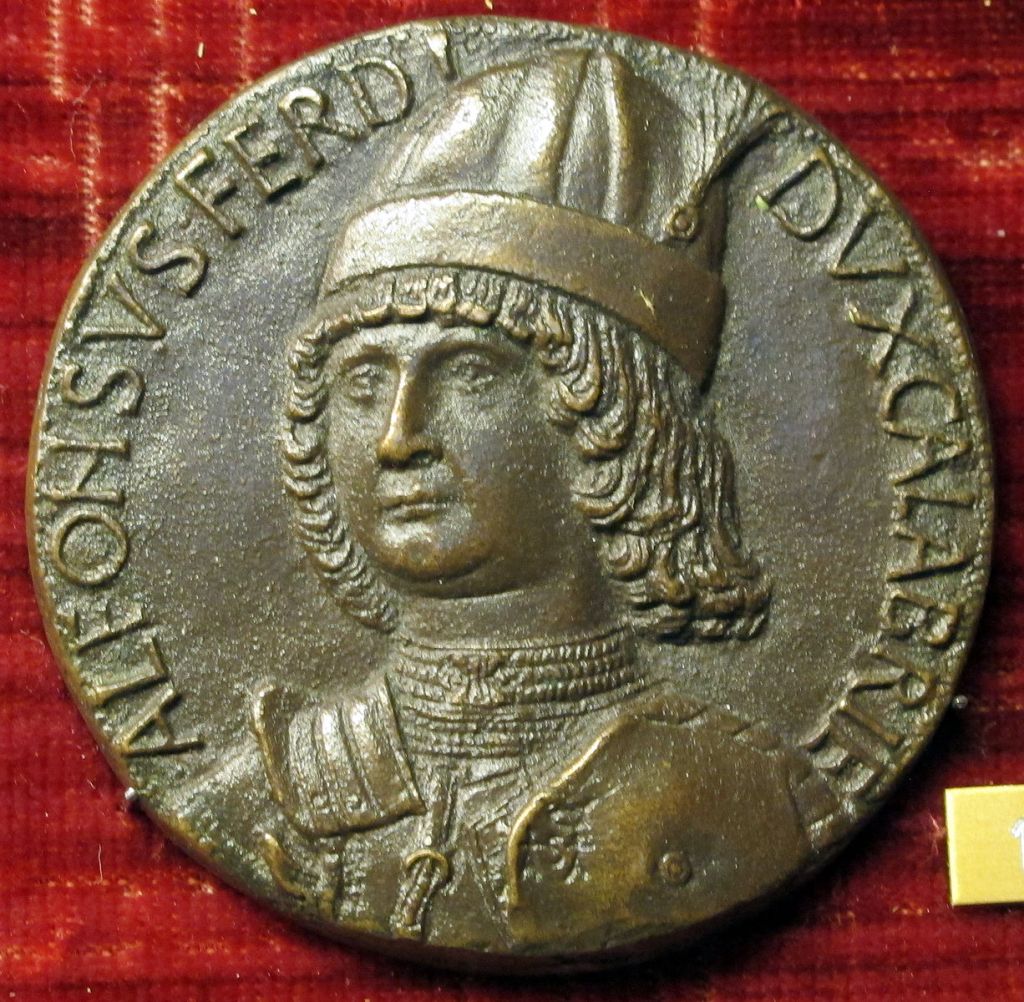
A medal depicting the future King Alfonso II of Naples by Andrea Guazzalotti. Date: 1481. Source: Sailko.
A 19th century painting depicting the surrender of Emir Muhammad XII of Granada to Queen Isabel I of Castile and Fernando II of Aragon, by Francisco Pradillo y Ortiz. Date: 1882. Source: Senate of Spain Collection, Madrid.
An anonymous portrait of Mary of Burgundy, painted sometime during her life. Her decision to marry Maximilian von Hapsburg would change the course of European history and arguably set the stage for a long series of conflicts up to World War II. Artist and exact date unknown. Source: Private collection.
A portrait of King Louis XI of France, nicknamed “The Universal Spider” because his cunning and ruthless foreign policy helped make France a great power again, free of the threats once posed by the English and the Burgundians. The artist is Jacob de Littemont. Date: 1469. Source: Private collection.
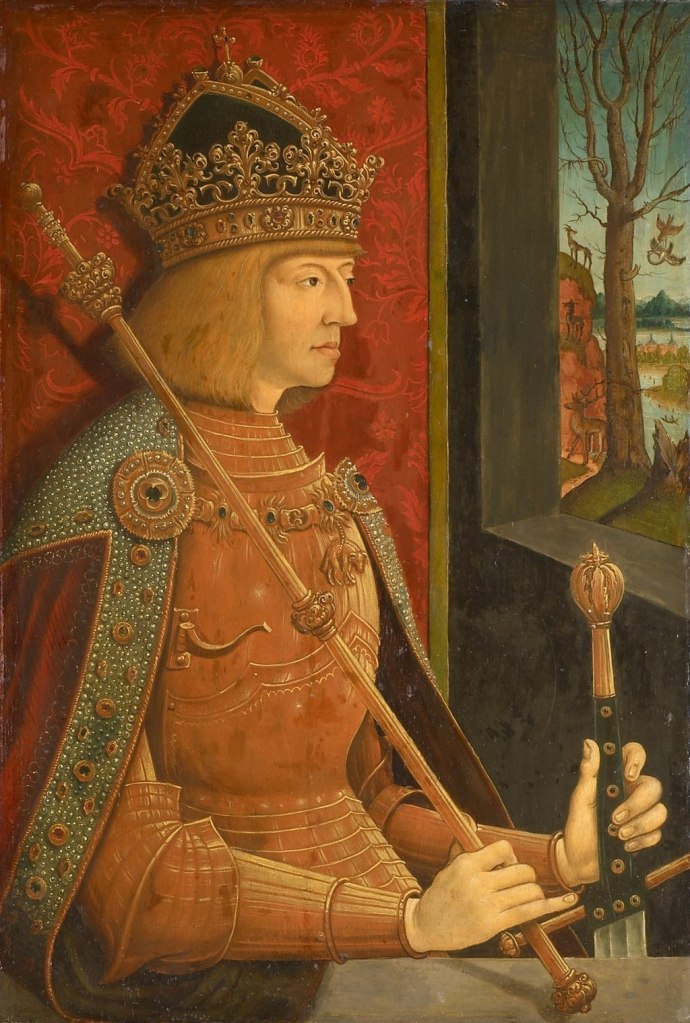
A portrait of Maximilian von Hapsburg, Holy Roman Emperor, Duke of Austria, and co-duke of Burgundy through his wife Mary of Burgundy. The artist is Bernhard Strigel. Date: ca. 1500. Source: Kunsthistorisches Museum, Vienna.

Transcript

Apres moi, le deluge. This means “after me, the Deluge.” Depending on who you ask, the saying was spoken by King Louis XIV of France on his deathbed, by Louis XIV’s great-grandson and successor Louis XV, or by Madame de Pompadour, Louis XV’s mistress. There’s some debate over what it means, too, but the way I learned about the phrase was that it was Louis XIV predicting some disaster befalling France after his death, a disaster like maybe the French Revolution. One can certainly believe Louis XIV was enough of an egotist to think the whole show would fall apart after he left the stage, but the main problem with this interpretation is that there were over seven decades until the Revolution started. Honestly, it would have been much more apropos if Lorenzo de’ Medici said it or the Italian equivalent, which I think would be “dopo di me, il diluvio”, while he was dying.

Categories
season two

Episode 28: The End of the Golden Age

The golden age of the Medici’s unofficial lordship over Florence is drawing to an end with Lorenzo’s death. Here we look back over Lorenzo’s legacy as the patron, the politician, and even the embezzler and the human being. Also, what exactly was Lorenzo’s contribution to the course of not only Florentine but European history as a whole? 

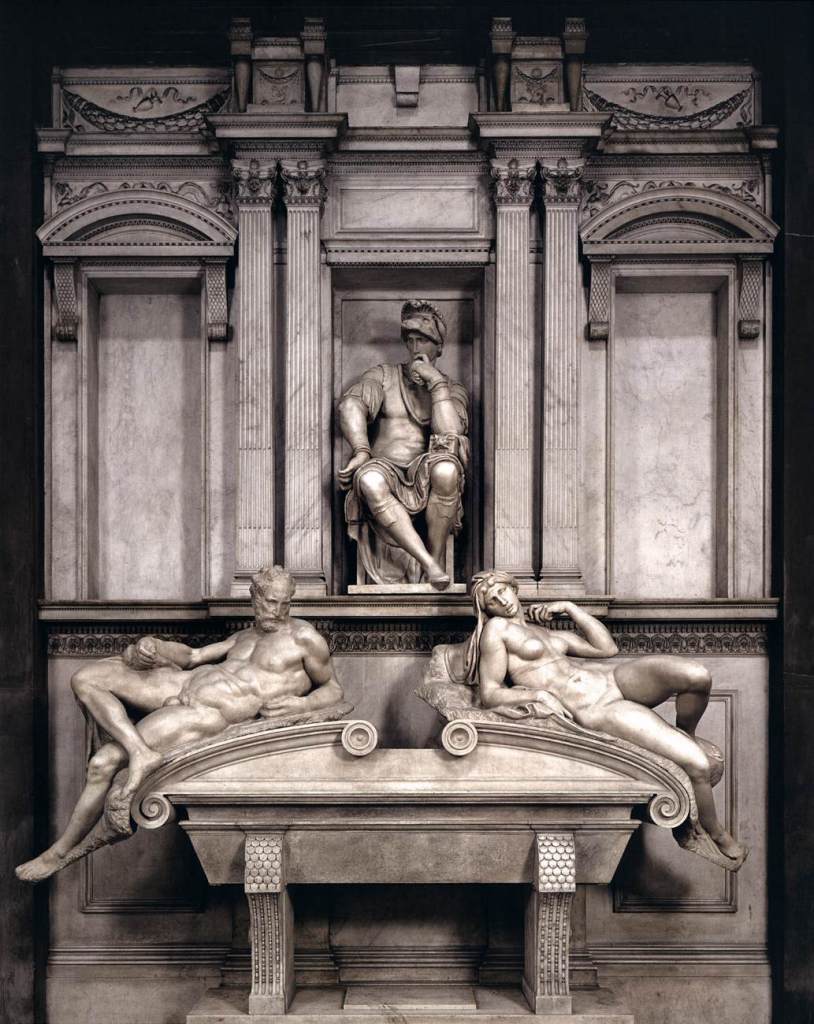
The tomb of Lorenzo de’ Medici, his brother Giuliano, and other members of the family in the New Sacristy in Florence. Lorenzo and Giuliano’s remains were reinterred there in 1532. The statuary at the tomb was carved by Michelangelo and commissioned by Pope Leo X (Giovanni de’ Medici).

Transcript

Last time, we talked about the Medici bank being in free fall. And Lorenzo himself was well aware of the bank’s problems. Once, he wrote to the signorie himself, explaining his last tax report to the government: “In making out this report, I shall not follow the same procedure as my father in 1469 because there is a great difference between that time and the present with the consequence that I have suffered many losses in several of my undertakings, as is well-known not only to Your Lordships but to the entire world.”

Categories
season two

Episode 27: The Decline and Fall of the Medici Bank

Lorenzo is at the height of his power and security. However, just behind the scenes, the family bank that caused the Medici to come into power in the first place is slowly but steadily falling apart, thanks to the Ottomans, a squabble between English royals, and, most of all, the ugly realities of politics. 

Transcript

Now when we last left Lorenzo the Magnificent, he was basking in what I think is safe to say was his greatest triumph, coming back to Florence from Naples with an end to a catastrophic war following behind him. Plus with some more tweaking of the Florentine Constitution and the creation of a new government body, the Council of Seventy, the Medici’s hold on power was secure – well, at least as secure as it could ever be.

Categories
season two

Episode 26: The Private Life and Patronage of Lorenzo de’ Medici

The Lorenzo we see from his voluminous letters is a man who had a short temper and bouts of depression, but was also capable of tremendous compassion and generosity. Unfortunately, his relationships with his own wife and sons were perhaps less than ideal.

Transcript

So you may have noticed I focused on Lorenzo’s activities as a politician, and not as a patron. This is despite the fact that Lorenzo is the rare historically celebrated leader who is actually better known for his activities in the cultural sphere than his political career. Now that we hit a point in our story where Lorenzo is basking in his victories over Pope Sixtus and is for the first time in a long time secure, I want to hit pause and look at Lorenzo as a family man and then as the head of a vast patronage network that made Florence one of the cultural capitals of Europe.

Categories
season two

Episode 25: Into The Lion’s Den

To try to stop a war Florence is badly losing and take some steam out of the Pope’s vendetta against him, Lorenzo does something few politicians had done before or since: put himself directly in enemy territory. 

King Ferrante of Naples as one of the Magi who visit the infant Jesus Christ in Marco Cardisco’s Adoration of the Magi. Date unknown. Source: Civic Museum of Castel Nuovo, Naples.

Transcript

Lorenzo had survived the assassination, but he had lost his brother. It should be admitted that judging from the evidence Lorenzo’s relationship with his younger brother Giuliano wasn’t the close partnership their grandfather Cosimo had with his own brother. Lorenzo was suspicious of his brother, while Giuliano apparently thought at least for a time that Lorenzo was standing in the way of his own ambitions. If Giuliano had lived, it is possible that he and Lorenzo might have gone the route of many siblings born into power, with Giuliano becoming a living focal point of resistance against his older brother’s regime. Even so, Lorenzo deeply mourned his brother. We know this not just through anything Lorenzo wrote or was reported to have said. With Lorenzo’s prestigious, almost non-stop correspondence, we have a gap of five whole days after his brother’s death.

Categories
season two

Episode 24: Bloodshed

The Pope, his nephew, an archbishop, and a mercenary decide Lorenzo de’ Medici and his brother Giuliano have to die. Unfortunately, the conspiracy develops some hiccups, namely having to send a couple of clergy instead of a mercenary to take down Lorenzo…

Stefano Ussi’s painting imagining the assassination of Giuliano de’ Medici (although note that Giuliano was supposed to have been kneeling when he was killed) (date unknown). Source: Private collection.
Leonardo da Vinci’s sketch of Bernardo Bandini, one of the executed conspirators. Date: 1479.

Transcript

On a late summer day in 1477, a battle-hardened mercenary, Giovan Batista, Count of Montesecco, was ushered into the private chambers of the Pope himself. Already flanking the Pope were his nephew, Count Girolamo Riario, and Francesco Salviati, the Archbishop of Pisa. Count Girolamo still blamed Lorenzo de’ Medici for not helping his uncle acquire territories for him in the Romagna. The Archbishop was barred from assuming his rightful post. In the heart of the spiritual center of Christendom, the three had come to discuss sparking a rebellion, and maybe even murder. Giovan had met with the archbishop and Girolamo a couple of times before in order to discuss overthrowing the Medici-dominated government in Florence along with the assassination of Lorenzo de’ Medici and his brother Giuliano. Giovan was skeptical of the whole scheme’s chances of success from the start, or at least that’s what he told the men interrogating him in Florence after the fact. In any case, he believed the whole thing was just a hair-brained plot dreamed up by Girolamo and the archbishop behind the Pope’s back. Now, however, here they were, talking about overthrowing the Medici in the presence of the Pope himself.

Categories
season two

Episode 23: The Calm Before The Storm

Lorenzo resorts to unsavory methods in order to keep the Medici bank afloat. In the meantime, his path crosses with the man who would prove to be his most relentless enemy: Christ’s representative on Earth himself. 

A fresco depicting Sixtus IV and some of the della Rovere-Riario family by Melozzo da Forli (c. 1477). Source: Vatican Museum.

Transcript

On July 19, 1476, Pierfrancesco passed away. He was the renegade Medici that his contemporaries described as a “bit of a backwoodsman” and who never showed much real interest in business, politics, or art, although his contemporaries did compliment him on his good manners. With his death, family history repeated. Just as happened when his own father, Cosimo’s brother Lorenzo, died, Pierfrancesco’s two sons were left sitting on a fortune and shares in the Medici bank, but too young legally to be independent. So Lorenzo took in Pierfrancesco’s sons, 14-year-old Lorenzo and 9-year-old Giovanni, and had them raised along his own children, just like how Cosimo had Pierfrancesco raised in his own household. And yes, I know, it’s so inconvenient that Pierfrancesco also named his son Lorenzo.

Categories
season two

Episode 22: Triumphs and Missteps

Not long after coming to power, Lorenzo de’ Medici has to fend off enemies at home and abroad. Unfortunately, in the course of protecting Florence from a crisis that could spiral out of control, Lorenzo sets the stage for a humanitarian disaster. But how much was he really to blame?

A contemporaneous portrait of Lorenzo’s brother, Giuliano de’ Medici, by Sandro Botticelli. Circa 1478. Source: Gemäldegalerie Berlin.

Transcript

Speaking of Lorenzo, let’s catch up with him a few days after his father’s death. The members of the Medici party among Florence’s ruling class met in the hundreds and sent a delegation led by Tomasso Soderini to him, asking him to take up the mantle of his father and grandfather as the first citizen and unofficial leader of Florence. This was a degree of recognition even Lorenzo’s father Piero didn’t receive. In Lorenzo’s own words:

“Their proposal was naturally against my youthful instincts, and, considering that the burden and danger were great, I consented to it unwillingly. But I did so in order to protect our friends and property, since it fares ill in Florence with anyone who is rich but does not have any share in government.”