
The unlikely partnership between the bookish, affable Giovanni de’ Medici and the rough-and-tumble Pope Julius II will finally bring the Medici back to power and set the stage for Giovanni’s turn as Pope Leo X, which would prove to be one of the most consequential papal reigns in history for reasons no one could have predicted.

A contemporaneous portrait of Giuliano della Rovere, Pope Julius II, by Raphael (1511). Despite their very different personalities, Pope Julius was Giovanni de’ Medici’s mentor and biggest benefactor, playing an essential role in the Medici’s restoration. Source: The National Gallery, London.
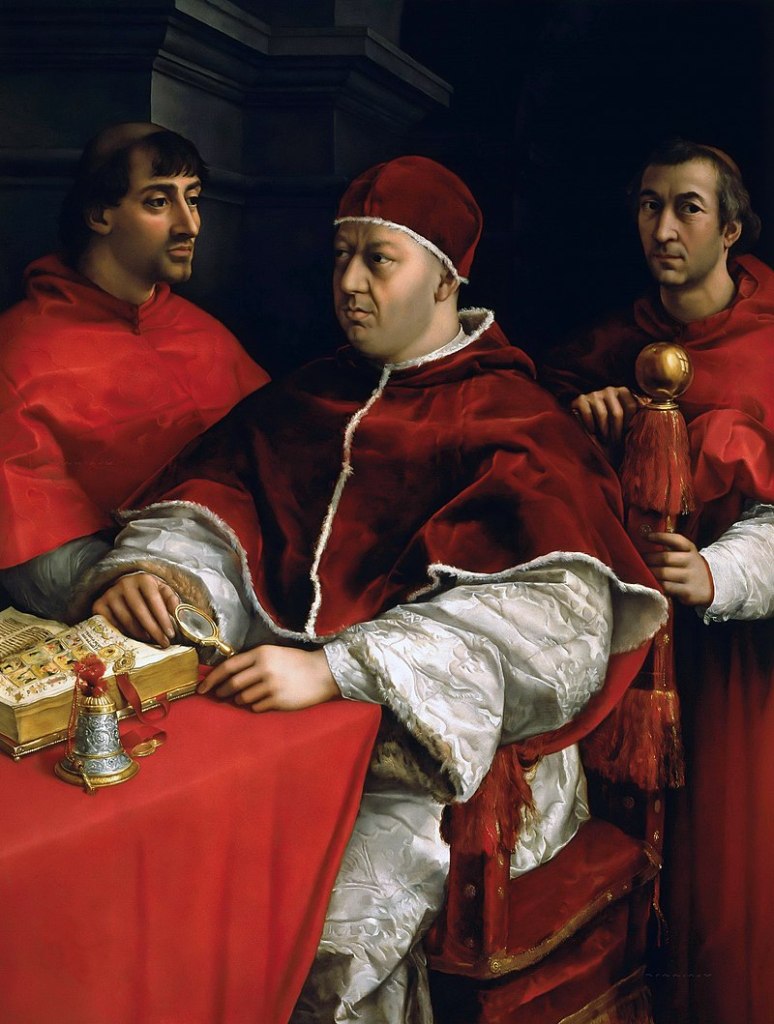
Raphael’s portrait of Pope Leo X with his cousins, Giulio de’ Medici (the future Pope Clement VII) and Luigi de’ Rossi, who were both cardinals (1518). Source: Uffizi Gallery, Florence.

Sketches of Hanno the Elephant by Giulio Romano (c. 1515). Hanno proved to be the most popular attraction at Leo X’s coronation and essentially became the Pope’s pet.
Transcript
According to a story, when Lucrezia was about to give birth to her son Giovanni, she had a dream that she gave birth to a lion. You don’t have to be all that skeptical to suspect this account is probably apocryphal. Still, there’s a tinge of truth in that Giovanni de’ Medici did end up becoming the hero that saved the future of the family. That much his father, Lorenzo the Magnificent, glimpsed when he boasted that making Giovanni a cardinal was his greatest achievement.
From the start, Giovanni was singled out as an unusually intelligent child, even among the Medici brood who were given the best tutors Florence had to offer. When he was very young, Giovanni wanted to join the Knights Hospitallier, an order of knights straight from the age of the crusaders who still held on to the Greek island of Rhodes off the coast of Asia Minor. But the adults in his life had a less glamorous and dangerous way to serve God in mind. Instead, when he was just eight years old, his head was partially shaved, signifying that he was dedicated to life in the clergy. As a personal favor to his father, King Louis XI of France gave Giovanni charge of the abbey of Fontdouce in western France. He also would have appointed little Gioovanni as Archbishop of Aix, if someone had not reminded the king that the current archbishop was inconveniently still alive. But neither Giovanni nor his father had reason to complain since the king showered Giovanni with other church offices and lands that gave Giovanni a healthy and holy revenue stream. But the real triumph in Lorenzo’s eyes was when Pope Innocent VIII made Giovanni a cardinal at the age of thirteen. Giovanni became a cardinal before he even finished his formal education. He continued being tutored and was sent to the University of Pisa to study canon law.
The impression one gets, and what we still see in many histories of the Renaissance papacy and the Reformation, is that Giovanni was just cynically installed in the Church and used the machinery of the Church just to ensure his and his family’s access to wealth and power. And to a certain extent that’s true. One of the reasons Lorenzo the Magnificent was ecstatic that he got his son into the upper echelons of the Church was that it provided the Medici with another means of getting influence and prominence. But it’s important to note there wasn’t a contradiction between the cold, raw realities of church politics and genuine piety. And all the sources agree that Giovanni de’ Medici was genuinely pious, even going above and beyond. He dutifully attended Mass, abstained from meat three times a week, and took the responsibility of charity toward the poor very seriously. When he became Pope, he revived the practice of fully bathing and kissing the feet of the poor, something his predecessor Julius II refused to do. Nor is there any suspicion that he ever violated his vow of celibacy. It’s just Giovanni was also a humanist scholar like his father through and through. Even before he became Pope he was an avid patron of writers, scholars, and artists and helped reform the University of Rome, which had never fully recovered from the papacy moving to Avignon and the Great Schism a century ago. Particularly Leo X was a constant supporter of the artist Raphael, and after he became Pope he made Raphael his secretary of antiquities. Also he backed two of his father’s favorite scholars, Demetrius Chalcondyles and Marsilius Ficinus, who both played crucial roles in bringing ancient Greek literature to western and central Europe. Leo was especially interested in Greek and Roman antiquity and sponsored the first published collection of ancient Roman inscriptions. But above anything else, Giovanni de’ Medici loved music. He even scandalized a couple of his contemporaries by daring to act as if musicians deserved patronage as much as scholars. In his youth he was an enthusiastic and talented chorus singer himself, and as a cardinal he was known for hosting concerts in his home with singers and musicians from as far away as Spain and northern Germany. His interests in Greek antiquity and music combined when he was Pope and became possibly the first Pope in centuries to have Greek hymns sung in the Vatican.
Still, from his youth Giovanni had habits his father disapproved of. When Giovanni wasn’t fasting, he enjoyed extravagant meals, and he had a taste for luxuries. Also he liked to stay up late and slept in. Sadly, in an example of the massive discrimination night owls like Giovanni and myself have faced for centuries, this was one habit of his that often went criticized. One of his tutors complained in a letter to Giovanni’s parents, “He will not get out of bed in the morning. And he will sit up late at night. I am most concerned, since these irregular habits are likely to injure his health.”
Giovanni’s little peccadillos had been with him since he was young, if this letter from Lorenzo the Magnificent to Giovanni when he was a teenage cardinal is any indication: “During the past year I have been much comforted to see that, without being told to do so, you have often of your own accord gone to confession and to Holy Communion. I do not think there is a better way of keeping in God’s grace than to make this a regular practice. I know only too well that in going to live in Rome, which is a sink of iniquity, you will find it hard to follow this advice because there will be many there who will try to corrupt you and incite you to vice, and because your promotion to the cardinalate at your early age arouses much envy…You must, therefore, oppose temptation all the more firmly…It is at the same time necessary that you should not incur a reputation for hypocrisy, and in conversation not to affect either austerity or undue seriousness. You will understand all this better when you are older…You are well aware how important is the example you ought to show to others as a cardinal, and that the world would be a better place if all cardinals were what they ought to be, because if they were so there would always be a good Pope and consequently a more peaceful world… You are the youngest cardinal, not only in the Sacred College of today but at any time in the past. Therefore, when you are in assembly with other cardinals, you must be the most unassuming, and the most humble…Try to live with regularity…Silk and jewels are seldom suitable to those in your station. Much better to collect antiquities and beautiful books, and to maintain a learned and well regulated household rather than a grand one… Eat plain food and take plenty of exercise.”
The last point is one that probably stung. From apparently a very early age, Giovanni was overweight, in contrast to his athletic father and older brother. Giovanni was a fanatical hunter, but his weight continued to be a problem, to the point that in his later years he had two servants whose duties included helping him get out of bed in the morning.
Giovanni may not have inherited his father’s build, but he definitely had Lorenzo the Magnificent’s flair for diplomacy but without his father and older brother’s short temper. From early in his career and even after he became Pope he was known to be affable, likable, and charismatic.
After he and his family were driven out of Florence, Giovanni went with his brother to Venice, but he eventually ended up in Rome. Unfortunately, Rome stopped being a safe haven once it came time to vote for Pope and Giovanni had as his mentor the Borgias’ most relentless enemy, Giuliano della Rovere. As a cardinal, he cast his vote against Rodrigo Borgia, but unfortunately he became Pope regardless. Knowing the new Pope Alexander’s vindictive nature and about the impending French invasion of Italy, eventually Giovanni prudently left Italy and travelled around Bavaria, France, and the Netherlands.
Once Alexander VI shifted alliances and found Piero de’ Medici to be a useful pawn if not exactly an ally, Giovanni returned to Rome. He was there when Alexander VI died and was followed by Pope Pius III, who was elected just as a compromise candidate to appease both the Borgias and their enemies, but he lived for only twenty six days, possibly the victim of an infection from a leg surgery he underwent shortly after his election. Already by the time of his death the star of Cesare Borgia was fading fast. So his family’s nemesis, Giuliano della Rovere, became Pope Julus II.
I like Christopher Hibbert’s description of Julius II, so I’ll quote it here in its entirety: ““a tall, handsome, rough, talkative, syphilitic, irascible man. He was much given to boasting of his poor childhood – when he had sailed with cargoes of onions down the Ligurian coast – of his lack of scholarship and of his taste for the life of a soldier. ‘I am no schoolman,’ he said once when asked to suggest a suitable emblem for a statue of him being made by Michelangelo. ‘Put a sword in my hand, not a book.’” Julius II was notorious for two things. One were the allegations that he had male lovers, among them Federico Gonzaga, the Duke of Mantua. The other was that he was a Pope who led armies into battle personally, once bellowing, “We will see who has the bigger balls, the King of France or the Pope!”
It’s a testimony to Giovanni de Medici’s diplomatic skills that he managed to be his quiet, reserved, and scholarly self and still be friends with the rough and unstable pontiff. It helped that Giovanni was also close friends with the Pope’s favorite nephew, Galeotto, so much so that after Galeotto’s death contemporaries mentioned Giovanni couldn’t even mention him without tearing up. One wonders what Lorenzo the Magnificent would have thought of his son getting on such great terms with the family of his archenemy, Sixtus IV.
In any case, even his critical father Lorenzo the Magnificent couldn’t fault how well Giovanni managed life at the papal court under Pope Julius II. While his brother Piero tried to ride the currents of the Italian Wars back to Florence, Giovanni took the subtler approach of using his connections at the Vatican to do favors for the great families of Florence, much like how his family used the Medici bank to weave alliances with power brokers both inside and outside Florence. After Piero’s sudden death at the Battle of Garigliano, his widow Alfonsina returned to Florence and lobbied for the family, most notably by arranging a marriage between her daughter Clarice and the wealthy banker Filippo Strozzi. Between Alfonsina and Giovanni’s efforts and frankly the demise of the unpopular Piero, Medici support was slowly growing.
There was one other factor that was working in the Medici’s favor: foreign affairs. Piero Soderini’s government in Florence remained steadfastly pro-French, and really Florence may very well have been the one nation in Italy that didn’t switch sides at some point during this stage of the Italian Wars. At first, this worked out well, since King Louis XII awarded Florence for its support in his conquest of Milan by invading Pisa and returning it to Florentine control. Unfortunately, being a good, reliable friend didn’t work out for Florence in the end, mostly because of one man: Pope Julius II.
At first, Pope Julius’ main concern was dealing with the Venice. Taking advantage of the chaos following the downfall of Cesare Borgia, the Republic of Venice expanded its territories in northern Italy, including propping up several noblemen from the Romagna who lost their territories to the Borgias as their vassals. Venice’s encroachment on the papacy’s territories in the Romagna was hardly a matter a pope like Julius could just leave to God. He managed to rally together the king of France, the Holy Roman Emperor Maximilian, King Fernando of Aragon and Naples, and the Duke of Ferrara in an alliance called the League of Cambrai. It was marshalled against Venice, which held lands claimed by all the parties. But once the Venetians were humbled, Pope Julius II realized just how much these foreign powers threatened Italy. So with the rallying cry, “Drive the barbarians out of Italy!”, Julius II turned on his one-time benefactor King Louis. By October of 1511, he founded a new league, the Holy League, which included his recent enemy Venice, Spain, England, the Holy Roman Empire, and the Swiss Confederation, and this time the end goal was to force the French to let go of Milan.
As anyone who has played the history-simulation video game Europa Universalis IV could tell you, France could hold its own even against the rest of western and central Europe. It helped that King Louis had at his disposal an excellent general, the 23-year-old Count Gaston of Foix. He scored a massive victory at the city of Ravenna, capturing the city in such a dramatic faction that cities and towns around the Romagna immediately surrendered to the French. However, it would prove to be a victory that would cost the French the war. Their prodigal general Gaston was killed in the fighting, struck off his horse by a random gunshot and then stabbed to death in the melee by Spanish troops.
To his credit, Giovanni de Medici was present at the battle as a papal envoy. Even when it was clear that the battle was lost, he remained on the battlefield, giving last rites to the dying from both sides. It was there that the French took him prisoner and sent him to Milan, where he charmed his own captives. He was also commended for taking the magnanimous gesture of absolving the French soldiers of the sin of going to war against the Pope.
The death of Gaston de Foix proved to be a catastrophe, starting a domino effect that saw the French begin to lose the war as they were attacked at literally all sides by the papal alliance, the Spanish, and the English navy. Less than two months after their triumph at Ravenna, the French found themselves driven back over the Alps. By then, the former duke of Milan, Ludovico Sforza, was dead. He was captured by the French and at first treated like an honored prisoner, but after he made a failed escape attempt he was thrown in a dungeon where he was denied all amenities, even books, and he sickened and died by May of 1508. It was a fittingly Shakespearean end to the duke who likely came to power by murdering his nephew. So once they had Milan, the Holy League installed his nineteen-year-old son Massimiliano as its new duke.
Once he was freed, Giovanni continued working behind the scenes to ingratiate himself and his family to the Florentine elite. He did have one obstacle, Piero Soderini’s brother, Cardinal Francesco. After Giovanni tried to score points by convincing his uncle Rinaldo Orsini to resign as Archbishop of Florence so he could be replaced by a native Florentine, Francesco was the main source of opposition. He vied for the post of archbishop himself. On the subject of Giovanni’s candidate for archbishop, his cousin Cosimo de’ Pazzi, Francesco loudly quipped that at least the Pazzi was a family that had always fought tyrants, a pointed and very obvious reference to the Pazzi Conspiracy that killed Giovanni’s uncle Giuliano. No wonder one of the few flashes of anger we get from Giovanni come from when he heard that his cousin Pierfrancesco di Lorenzo de’ Medici was in talks to marry a Soderini bride. Giovanni was reported to have literally torn up the betrothal contract.
But any ambitions Cardinal Francesco for his own family replacing the Medici as the first family of Florence were doomed the second Pope Julius set his sights on Florence. Once the Holy League took Milan, Florence was diplomatically isolated, the only pro-French presence left in Italy. The joint papal-Spanish army stood at the borders of Tuscany. The Spanish commander, Ramon de Cardona, the Viceroy of Naples, offered to talk terms with the signoria of Florence, asking for the Florentines to provide his soldiers with food while negotiations took place. But Piero Soderini blundered by hesitating to fulfill this request, and in the meantime the Spanish forces took their frustrations out on the town of Prato. An ambassador from Ferrara who was present at Prato during the time wrote to a friend:
“These Spaniards made such a massacre and butchery the like of which I have never seen, so that all the streets, houses, and churches themselves were full of the dead, and all of the women have fled to some monasteries and churches where the most miserable laments and pleas that it is possible could be heard. The whole place is put to the sack. I have stayed [here] eight days and neither my stomach nor my spirit is good on account of what I have seen and heard. I would very willingly not stay here.”
Giovanni de’ Medici was also present, and he tried in vain to stop the massacre. He only managed to talk down a few soldiers from terrorizing a group of locals. It was said Giovanni was haunted by memories of the Prato massacre on his deathbed. What could have easily been a bloodless restoration for the Medici was instead off to a morbid and horrific start.
Still, though, the Florentines blamed Piero Soderini’s indecision above anything else for the tragedy. His government crumbled, and in the end he fled to Dalmatia, part of modern-day Croatia and then under the control of the Ottoman Empire. The signoria voted to accept the Holy League’s terms, which included the restoration of the Medici. After 18 years, on August 31, 1512, Giovanni and his younger brother Giuliano returned to Florence to a cheering crowd. One observer noted, “To the people it appeared as though the time of Lorenzo the Magnificent had returned.” This ended up being true in more ways than one. Under the watchful eyes of Spanish and papal soldiers, a general assembly was held, even though such assemblies had been declared unconstitutional by Savonarola’s regime. All the political reforms carried out in the times of Savonarola and Piero Soderini were done away with, including the Great Council. The Florentine constitution went back to the way it was in 1494, but with a couple of significant tweaks. The Balia, which started out as temporary councils that were formed to carry out exceptional duties like overseeing war efforts or implementing new laws, became a permanent body, given broad powers, and, of course, loaded with Medici partisans. The Balia could now suspend laws, helped choose candidates for office, and granted citizenship. The historian Cecil Roth writes that through the balia “the Media retained permanent control over every operation of government.”
This wasn’t enough, though; Giovanni wanted to make it clear, especially to those who had hated Savonarola, that those days were over. Festivals that had been banned since the time of Savonarola were returned, and numerous entertainments and celebrations were planned. Still, not everyone was on board with the new regime. Inspired by stories of the Roman Republic, Pietro Paolo Boscoli plotted to assassinate Giovanni and Giuliano de’ Medici. His conspiracy supposedly even included Machiavelli, who was put under torture and released after three hellish weeks. That aside, the government unofficially headed by Cardinal Giovanni and his brother Giuliano proved popular, especially since it brought Florence the long-term peace it had lost since King Charles VIII marched into Italy almost two decades ago.
Having succeeded in ridding Italy of the French, Julius II was working on plans to wrest Naples away from the Spanish, but he died before he could set them in motion. Giovanni was chosen to succeed him. Even his old rival, Cardinal Francesco, voted for him because Giovanni had promised to lift his family’s exile. Hearing the news of his election, he left Florence for Rome, riding the same white horse he rode during the Battle of Ravenna. His brother Giuliano was left behind to manage Florence. Giovanni chose as his papal name Leo X, confiding to the cardinals that he had decided on the name many years ago while he was just daydreaming about being elected Pope. It’s unclear why he chose that particular name. It might have been a reference to that dream of giving birth to a lion his mother Lucrezia supposedly had or a patriotic nod to Florence where the lion is one of the symbols of the city. Leo X’s biographer, William Roscoe, points out that Giovanni had chosen a name with classical significance, like his predecessors Alexander VI and Julius II.
The new Leo X already had a reputation for being a friend to scholars. So on his ascension one Roman inscription read, “Once Venus rul’d ; next Mars usurp’d the throne, Now Pallas calls these favour’d seats her own. ” These were less than subtle references to the notoriously lustful Alexander VI and the warlike Julius II, followed by a verse comparing Leo X to the goddess of wisdom Athena. True to the reputation of the Medici, the festivities were extravagant, but the real show-stopper was the menagerie of exotic animals sent by King Manuel of Portugal, who wanted to take the opportunity to show off his country’s new global colonial empire. The undoubted star of the show was a white elephant named Hanno, who delighted the Pope and his dignitaries when he took some water with his trunk and showered the Pope with it. Pope Leo’s secretary Sadoleto wrote, “It was the elephant which excited the greatest astonishment to the whole world, as much from the memories it evoked of the ancient past, for the arrival of similar beast was fairly frequent in the days of ancient Rome… One is almost tempted to put faith in the assertion of the idolators who pretend that a certain affinity exists between these animals and mankind. The sight of this quadruped provides us with the greatest amusement and has become for our people an object of extraordinary wonder.” The new Pope would keep Hanno as a pet and allowed the people of Rome to visit every Sunday. To quote Silvio Bedini, who wrote a book about Hanno titled The Pope’s Elephant, “The pontiff often visited the elephant in its enclosure, intrigued by the high degree of intelligence demonstrated by the young beast, and its playful antics never ceased to delight him. The beast would genuflect when the people appeared, open its mouth and trumphet loudly, it was reported, and would appear to cry like a woman and shed tears.”
Allegedly the new Pope Leo turned to his brother Giuliano and said, “God has given us the papacy, let us enjoy it.” Usually this quote is presented as a reflection of the decadence of the Renaissance papacy, but for me it’s more relatable than that. After all, he and his family were hounded out of their hometown, his brother was killed trying to change that, and their bank, the family business, had gone bankrupt. Who could blame them for enjoying a turn of fortune that not only brought them home and back in power, but made one of their own the Pope himself?
 The Medici Podcast