
Still in exile, Piero de’ Medici throws himself on the mercy of the new king of France and Cesare Borgia. But will they prove to be reliable friends?

“Bayard on the Bridge of Garigliano”, a painting depicting the Battle of Garigliano (December 29, 1503) by Félix Henri Emmanuel Philippoteaux (1840). Source: Palais de Versailles.
Transcript
While Savonarola rose to power, Piero remained in Venice, gambling away what little money he got from loans off of Medici sympathizers or made working for Venice as an army captain. But still, Piero remained optimistic. He believed, especially after Savonarola’s downfall, that either the Pope, the Duke of Milan, or the Doge of Venice would force Florence to allow him to return home. And he still insisted to his allies that he would “return not as a lord, but as a citizen.” What would happen after that…well, personally I suspect Piero didn’t give that much thought beyond his first night where he would, as he put it, enjoy some grapes back in the Palazzo Medici. Unfortunately, Venice and Florence signed a peace treaty on April 1499 which secured the release of Piero’s brother Cardinal Giovanni, who had been captured and imprisoned. However, the clauses of the treaty did not include any provision for the Medici’s return to Florence.
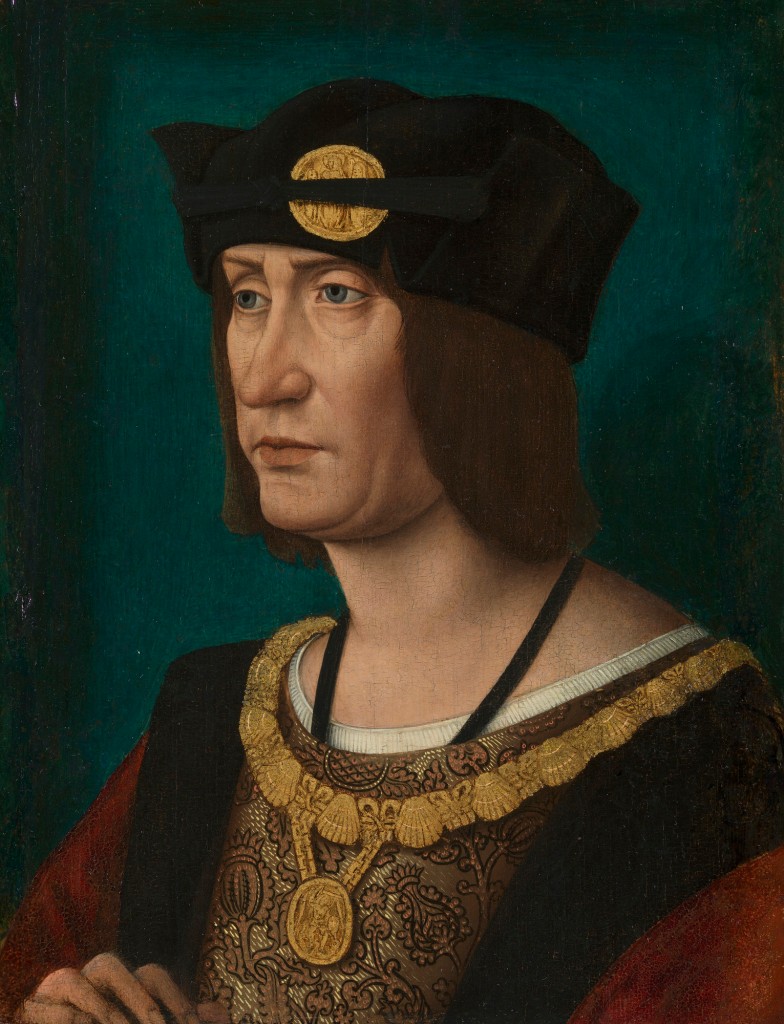
But Piero’s hopes were especially given a boost by one man, the new king of France. The abrupt death of Charles VIII and the fact he had no son meant the French crown went to his cousin, who became Louis XII. You might remember many episodes ago I called attention to Valentina Visconti, who came from the family that originally ruled the duchy of Milan and was married off to a member of the French royal family, the Duke of Orleans. Louis XII happened to be the Duke and Valentina’s direct descendent and their descendent through a legitimate marriage, at that. As such, according to the usual rules of royal inheritance Louis had a better claim to the duchy of Milan than the Sforzas, whose claim was based on Francesco Sforza’s marriage to an illegitimate daughter of the last Visconti duke. This meant Louis had both his own claim to Milan and his cousin’s claim to the kingdom of Naples, and he meant to cash in. Louis was not expected to be king and, in fact, Charles VIII’s father did everything in his power to keep Louis on the sidelines. But Louis was sly and ambitious, and his political acumen and personal strength were tested by joining a rebellion against the monarchy and winding up in a prison for about three years for his trouble.
I’m not going to even try to make you follow the constantly switching factions in the Italian Wars. I’ll leave that to Mike Corradi’s excellent History of Italy podcast when the time comes. I’ll just try to focus on Florence’s role. Alexander VI personally doubted whether or not the Florentines would ever welcome Piero back, much less put him back into power, but thanks in no small part to the influence of his brother Cardinal Giovanni he remained in the papacy’s good graces. But Pope Alexander still kept Piero at an arm’s length. This began to change once Louis became king. Louis played up to the Pope’s ambitions for his son Cesare, and Pope Alexander and Louis eventually negotiated an agreement. Cesare Borgia would be given a French estate and noble title, the Duke of Valentinois, and married to Charlotte d’Albret, a member of one of the most prominent aristocratic dynasties in France. Even more importantly, Louis promised to give military support to Cesare’s ambitions to make a kingdom out of the Romagna. In exchange, the Pope recognized Louis’ hereditary claims to both Naples and Milan. By September of 1499, Louis invaded Milan. Already facing unrest due to high taxation to pay for the earlier war defending Pisa from Florentine reconquest, Duke Ludovico Sforza escaped to Austria. Knowing not to alienate his ally the Pope, Louis XII gave Cesare an army of 6,000 soldiers to do with as he wished.
Cesare and Piero had known each other as adolescents. As events would prove, though, perhaps their friendship was not as steady as Piero thought. But for now, Piero and several of his Orsini in-laws agreed to fight in Cesare’s army. In return, Cesare would force Florence to lift the exile and restore the family’s properties. Cesare’s army captured territories in the Romagna, including the cities held by rampaged through the countryside while Piero prudently stayed put past the Tuscan border, so at least no one could accuse him of joining in attacks on his own compatriots. Florence was exhausted and broke after having to fight off both Milan and Venice for Pisa, so they were eager to talk terms with Cesare. However, either because they realized Piero would cause Florence to be less likely to become their ally, they were unimpressed with Piero’s capabilities, or both, Louis XII and Cesare dropped any mention of Piero and his family from the negotiations. Instead, Cesare was content with receiving a large payment from the Signoria. Apparently support for the Medici was not as strong as Piero was led to believe by his allies at home or by his sister Lucrezia Salviati. A scholar from Bologna, Sabbadino degli Arienti, quipped ‘The Florentines are cured and have no further need of doctors (medici).’
Things actually became worse for Piero. When they joined a conspiracy to kill him among his own army captains, Cesare had the Orsini men serving under him killed. This severed any lingering last hope Piero had that Cesare would According to Parenti, Piero felt “crushed and totally done in.” And in a possible case of physical health reflecting mental health, he began to develop a recurring fever. Piero left to live with his wife’s relations in Naples while his brother Cardinal Giovanni went to France. Despite Giovanni’s efforts, Louis XII eventually signed a treaty with the current government of Florence, to prevent them from seeking the protection of his enemy, the Holy Roman Emperor Maximilian.
If Piero had any reason to still be optimistic in those dark years of 1500 and 1501, it was that Florence hadn’t been doing well since the fall of Savonarola. Factional tensions continued between two groups we can broadly call the established elites, the ottimati, and the populari, who represented the middle class, the nouveau riche, and the laborers – well, theoretically the laborers. There were of course still divisions within these groups – the pro-Medici, the anti-Medici, and those who still believed in Savonaroal’s vision of a republican theocracy. But it was the unending fights between the populari and the ottimati that practically paralyzed the government. Even though Florence was chronically broke due to the wars and the recession, the Great Council, which was dominated by the popolari, couldn’t pass any bills for raising property taxes or even just carrying out assessments for potential tax revenue. Instead the ottimati pulled the levers of government in favor of voluntary loans to the government by the wealthy, which of course the rich liked because they could profit off the interest at the public’s expense. Guicciardini sums up the effect of all this nicely. It was ““hard to imagine a city more dilapidated or worse governed.”
By 1502, the situation was dire enough the Signoria decided on a few constitutional reforms, the most drastic of which was appointing a gonfaloniere for life. Of course, to us this sounds like a dictatorship, but by Renaissance republican standards it wasn’t quite that dire. Venice’s chief executive, the Doge, had a lifelong appointment, although by this point in history he had significantly less power than Florence’s gonfaloniere. Still, it was serious enough of a change it inspired a fierce debate across the government. Proponents argued that a lifelong gonfaloniere would not be distracted by his own ambitions if he already achieved a lifetime position at the height of the government. And at least in the case of the person they did choose to be gonfaloniere for life, Piero Soderini, they were right.
Piero Soderini was carefully picked out. He was from the ottimati, but he was also a career diplomat who had been away from Florence too often and too long to have taken part in any political squabbles or factions, even the Savonarolan conflict. Granted, Guicciardini makes Soderini’s rule sounds like a disaster. But Guicciardini was sympathetic to the ottimati, and once in power Soderini proved to be a class traitor much like Franklin Delano Roosevelt or, to use an example closer to home, the great medieval Florentine reformer Giano della Bella. Soderini exercised more power than Cosimo de’ Medici or Lorenzo the Magnificent ever did. He had a say in every debate and a fingerprint on every major bill that passed. Among other reforms he shepherded through, he passed a cap on marriage dowries and made Florence’s great public bank, the Monte de Pieta, more accessible and profitable for the middle class. Further, he refused to consent to the ottimati’s desire to dissolve the Great Council and replace it with a Venetian-style senate open only to the elite. Above all, Soderini broke the gridlock and saved Florence from an economic meltdown.
Soderini’s success was a lesson. The Florentine republic simply could no longer work well or perhaps even at all without a strong captain at the helm. The Great Council had only worked well when its agenda was dominated by Savonarola’s lapdog Francesco Valori. Now the government needed Soderini. Back in the good old days, the guild system had apparently been a mechanism that kept the elites in check and let the middle and the artisan classes assert themselves in politics. With the guilds having declined, though, the entire political structure of Florence had lost its balance…at least, without a powerful executive. At least in the long term, this lesson would not be forgotten in Florence.
As for Piero, he tried one more time to get into Louis XII’s good graces. Louis had retaken the Kingdom of Naples, but Queen Isabel and King Fernando in Spain launched a counterinvasion to reclaim Naples. Piero fought in the French army. Late on the night of December 27, 1503, Spanish and French forces met at the Garigliano River, which was swollen from recent rainfall. It was a decisive victory that completely scattered the French army. Piero, the one-time golden boy of Florence, fell into the river during the mad dash to escape the victorious Spanish army and drowned. He was only thirty-one years old. His remains were buried in the Abbey of Monte Cassino near Rome – or at least they were thought to be his remains. Either way, even in death Piero would never return to Florence.
He and his wife Alfonsina had two children, Lorenzo and Clarice. Both children were still very young, but even if Lorenzo was older, the position of patriarch of the family would have went to their uncle Cardinal Giovanni, the only male Medici left in a real position of power. As for the war that had claimed Piero’s life, it would end with a total Spanish victory and King Fernando deciding to once again unite Naples with his domains rather than putting his cousin, the deposed King Federigo of Naples, back on the throne. And with a couple of brief exceptions, Milan would never again be independent. It was the end of an era, and the beginning of a time when much of Italy would be controlled, directly or indirectly, by foreign states. Guicciardini really wasn’t exaggerating when he called Piero’s career and death “the beginnings of the ruin of Italy.”
 The Medici Podcast