
Around the dawn of the fifteenth century, two developments unfolded that would sooner or later change the future of the Medici family forever. In one, Valentina Visconti enters a miserable marriage with a French royal. In the other, Giovanni de Bicci de’ Medici takes advantage of Europe being split between two and even three rival popes by (allegedly!) bankrolling the church career of a former soldier who hobnobbed with pirates and robbers that eventually sees him become Pope.
Transcript
This time, I’m going to have to zoom out a bit. I do try to keep this from turning into the northern Italy or the History of Florence podcast. But we’re at a point where two events that initially had absolutely nothing to do with the Medici would have ramifications that would completely shape the family’s future.
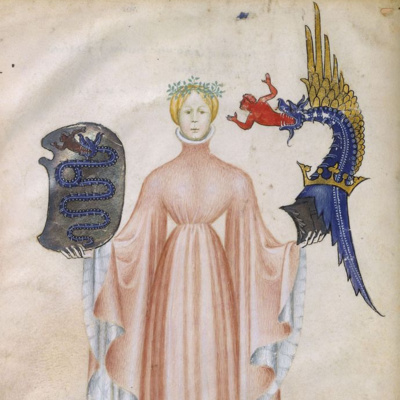
Let’s start with the event that would have a much less obvious impact, at least for now. In Milan, we have a June wedding in 1389. Well, it wasn’t really a wedding because it had been done months earlier by proxy, with both the spouses-to-be saying their vows before a priest and foreign dignitaries. Instead of a nice dinner party and a reception, the bride Valentina Visconti had what I dare suspect was a traumatic day. She was being sent off to a foreign country to spend the rest of her life under the power of a man she never met. Even her father, Duke Gian Galeazzo of Milan, who always doted on her, did not show up to comfort her during her departure. He found the prospect of facing his daughter before being sent away over the Alps too much to bear.
Valentina was extremely well-educated even by the standards of the nobility, fluent in Italian, Latin, French, and German, and throughout her life she would sponsor the work of poets. Her own clan, the Visconti, were also at the peak of their power. Her family had ruled Milan as signories for over seventy years by her lifepoint, but Gian Galeazzo was the first Duke of Milan, having literally bought the title from the German king Wenceslaus. But joining the ranks of Europe’s titled monarchs wasn’t enough. Gian Galeazzo wanted to piece together the old kingdom of northern Italy, and he and the Visconti arguably came the closest to doing just that out of all their rivals, but to finish the job, he knew he needed foreign support.
That support was supposed to come from Valentina’s groom, Louis, Duke of Tourraine (although he’s much better known by his later title, Duke of Orleans, so for the sake of convenience I’ll just refer to him as Louis d’Orleans). He was the paternal uncle of King Charles VI of France and, like so many heirs to spare in the French royal family, he made a career out of making deals with foreign rulers and butting into armed conflicts to try to get a kingdom of his own. In Louis’ case, this was the Kingdom of Adria. Named after the Adriatic Sea, Adria was a hypothetical land the Pope promised to carve out of papal territories in northeastern Italy in exchange for Louis siding with the pope in Avignon against the pope in Rome. More on the “too many popes” thing in a bit. Louis also had a claim on the kingdom of Naples, so to help him grab at least one little slice of Italy he married Valentina Visconti to cement a marriage with Duke Gian Galeazzo.
But there was a little bit of apprehension. The whole reason Valentina couldn’t leave for her waiting husband’s arms was because Gian Galeazzo was waiting to see if his new wife, his cousin Caterina, would give birth to a male heir. Not having to worry about handing over a daughter with a claim to his duchy over to the French, Gian Galeazzo kindly informed the French that he could now send Valentina over the border now that all the *ahem* “security issues” were gone.
Even by the standards of royal marriages that were performed long-distance and were designed just to help fulfill short-term military objectives, the marriage was a disaster. It was not just because neither Louis d’Orleans and Gian Galeazzo got their Italian kingdoms. It was also because Louis d’Orleans treated his wife like an obnoxious roommate, just one you occasionally had children with. No doubt it didn’t help that Louis d’Orleans was a Lothario whose favorite lover was none other than the Queen of France, his nephew’s wife, Isabeau of Bavaria. Nor did it help that Isabeau and Valentina quickly became bitter rivals. When King Charles VI had some kind of breakdown, after which he suffered intense hallucinations and violent outbursts, Isabeau spread the rumor that Charles VI’s madness was a symptom of a poison given to him by Valentina, who wanted him to die or be deposed so she could become the Queen of France. The rumors spread so widely that Valentina found her home under attack by one of history’s greatest and most recurring actors, an angry Parisian mob. For the sake of her *ahem* safety, her husband sent her away from Paris. She never returned, and instead died at the age of 37 in 1408 at her husband’s main estate, the Chateau de Blois. Despite Louis’ preference for his nephew’s wife, the couple did have four children, At least Valentina may have gotten some satisfaction from not only outliving her husband by about a year, but learning that he was brutally stabbed to death on the streets of Paris by agents of his cousin and rival, John the Fearless, Duke of Burgundy.
So what does this have to do with our story? Well, the marriage would in the end not just affect the unhappy couple. See, Gian Galeazzo, when he refused to send Valentina away as soon as possible, was completely justified. Tucked away in the marriage agreement between France and Milan was a clause that in the absence of any living legitimate male Visconti, Valentina would become the heiress to the duchy, with the implication that her claim would pass on to any children she and Louis might have.
No one could have possibly known this at the time, and it was hardly inevitable, but in the centuries to come, this one marriage agreement would be one step in the path toward the end of Italian independence.
But for now, Italy and Europe had been facing a crisis of political and spiritual dimensions. Pope Urban VI, the humble and genuinely devout Neapolitan who brought the papacy back to Rome, turned out to be a bust. For one thing, no doubt in response to the reputation for extravagance the papal court got in Avignon, he cut down drastically on expenditures, even forcing all cardinals to have only one course and one main dish at lunch and dinner. Historian Stefan Weiss observes, quote, “One can now understand why some of the cardinals thought he had suddenly gone mad.”
But, to be fair to the cardinals, Urban also had a habit of screaming at cardinals who enraged him. At least once, a cardinal had to restrain him from hitting another cardinal. Even one of his most vocal supporters, the mystic Catherine of Siena, had to write to him, urging him to take her advice. “Go about your work with moderation and benevolence and a tranquil heart. For the love of Jesus Crucified, Holy Father, soften a little the sudden movements of your temper.” Sadly, even her sanctified words didn’t stick with the short-tempered pope.
The very summer of the year he was elected, 1378, the French cardinals started leaving Rome, claiming that the heat of the Roman summer was unbearable. As it turned out, all the cardinals leaving Rome were just moving to the town of Anagni, not far southeast of Rome. There, on August 9, the French cardinals declared that the election of Urban VI was made under duress, which, to be fair, it was but it hardly the first papal election carried out under the watch of an enraged mob. In any case, they argued that, in this instance, it made Urban’s papacy invalid. So Urban was to be considered excommunicated and they would hold another, legitimate conclave to choose a legitimate pope.
Luckily, they had a friendly sponsor right there: Queen Joanna of Naples. At first she was a huge supporter of Urban; he was formerly one of her subjects, after all. But, as it turns out, the guy who beat up cardinals who disagreed with him also had a bad habit of alienating monarchs. So it didn’t take long for Joanna to decide it was better for her and her kingdom to have a Pope away in Avignon rather than as a next-door neighbor. She invited the anti-Urban cardinals to hold their conclave in her city of Fondi. There, they elected another Frenchman and a cousin of the French royal family, Robert of Geneva, as Pope Clement VII. From Naples, Pope Clement VII and his cardinals made their way over the sea back to Avignon. The days of the Avignon papacy had returned, except this time, there was also a Pope in Rome claiming he was the true Pope. The Great Schism of the Catholic Church had begun and wouldn’t be resolved for almost forty years.
I personally like Catherine of Siena’s reaction to the news, which comes out of a letter she wrote to Pope Urban: ““In my opinion, these devils incarnate have not elected a Christ on earth, but have brought into being an antichrist against you, who are Christ on Earth.”
And honestly, there was a lot of ambivalence at first, even from the French. There had been rival popes many times before, but backing one newly minted pope against a duly elected and anointed pope was a risky maneuver especially if this new pope didn’t happen to have a Holy Roman Emperor in his corner.
Thankfully for his haters, Urban VI did his cause no favors. For instance, Urban VI went after Joanna I, reopening an old charge that she was the mastermind behind the assassination of her first husband, Andre of Hungary, and using it as an excuse to replace her with her cousin, Charles of Durazzo, who eventually had her strangled to death. Urban then suddenly turned on Charles when he dragged his feet on a promise to give Urban’s nephew a title and land in his kingdom. Urban also came close to losing the support of the King of England when he nearly had the one English cardinal at the papal court tortured along with five other cardinals on suspicion of secretly supporting Clement VII.
Soon enough, just about every king, prince, duke, and republic in Europe of any importance had picked sides and, after some switching sides, stuck with their preferred papal court for decades. But, of course, the leaders of Europe all deeply searched their hearts and consulted ecclesiastical authorities as to which of these two men were truly Jesus Christ’s representative on Earth. Just kidding; who backed which Pope completely broke down according to political alliances and rivalries. For example, England backed the Pope in Rome just because their enemy France was behind the Pope in Avignon, and the Spanish kingdom of Castile threw its weight behind Avignon because England was at the time scheming to invade Castile and put an English royal, John of Gaunt, on the throne.
So, in one corner with the Pope in Rome was England, Bohemia, the Holy Roman Emperors and maybe a majority of the German princes, Hungary, Poland, Lithuania, the Scandinavian kingdoms, the Republic of Venice, and Portugal.
On the other side of the ring, we had France, Burgundy, Brittany, Scotland, Castile, Aragon, Navarre, Savoy, Milan, Florence, Bologna, Naples, Sicily, Cyprus, and the Knights of Rhodes behind the Pope in Avignon.
But as easy it is for us jaded moderns to view the whole thing as just another political conflict, it was much more than that to many people alive at the time. To quote Barbara W. Tuchman in her book, A Distant Mirror: The Calamitous 14th Century:
“When each Pope excommunicated the followers of the other, who could be sure of salvation? Every Christian found himself under penalty of damnation by one or the other Pope, with no way of being sure that the one he obeyed was the genuine one. People might be told that the sacraments of their priest were not valid because he had been ordained by the ‘other Pope’, or that the holy oil for baptism was not sanctified because it had been blessed by a schismatic bishop. In disputed regions, double bishops might be appointed, each holding mass and proclaiming the ritual of the other a sacrilege.”
It is almost certainly not a coincidence that the two great heretical movements of the Middle Ages that both challenged the principles of papal authority, the Lollards of England and the Hussites of Bohemia, both came out of the era of Great Schism.
A more wordly side effect of the Great Schism was that both popes and their respective clergies were always strapped for cash. Both popes could only count on the religious tithes coming in from the countries controlled by their supporters. Nor could ether Pope claim control of the full territories of the papacy. It didn’t help that both papal courts went overboard on spending on pomp and ceremony, since no one could look at a Pope who couldn’t even pay for a decent procession and think he was the vicar of Christ. So churches across Europe were closed due to lack of funds, and priests, monks, and nuns were reduced to selling crosses and relics to stay afloat. And, most importantly for our story, the Popes relied on loans from international bankers more than ever before.
International banks like that of Vieri di Cambio de’ Medici. Now we’ve met Vieri before. Along with his brother Giovanni, they were the only ones among the well-off Medici cousins to not switch from business and finance to landowning and real estate in response to the economic chaos of their times. Over time, Vieri became wealthier than his landowning cousins. And this wealth wasn’t wasted, at least as far as Vieri’s sense of family obligation was concerned.
Vieri had another cousin, Bicci, who was at least by his standards and those of other branches of the family, positively impoverished. He only had a few shops around Florence renting their properties from him and a small farm out in the countryside. Bicci was claimed by a resurgence of the plague in the spring of 1363, and afterward his widow Jacopa and her nine children moved in Cousin Foligno. Vieri did his part too by offering Bicci’s two eldest sons, Francesco and Giovanni, apprenticeships with his bank. Within just a few years, they were made junior partners in the bank.
In the meantime, Vieri after the death of his first wife had married a second and much younger woman, Bice Strozzi. This woman gave him heirs, two sons named Nicola and Cambio. Luckily for Cousin Bicci’s sons, Vieri did not leave them out in the cold in order to favor his biological children. After all, he was by then sixty-eight years old and had wasn’t optimistic enough to think that his sons would be old enough to run his bank when he died. So Vieri divided the Medici Bank into three separate businesses, selling one to Francesco, another to Giovanni, and the third to a nephew of his, Antonio, but that office soon closed.
Once he returned from banking, Vieri went into politics, which excited the hopes of populists who wanted him to take over his cousin Salvestro’s legacy. However, unlike the rest of his family, Vieri was loyal to Maso degli Albizzi, although whether he did so out of genuine ideological conviction or because he didn’t want to make waves that could threaten his family’s business is unclear. Either way, one contemporary noted, quote, “If Vieri had been more ambitious, he could have made himself prince of the city.” Events would quickly prove, though, that Vieri was probably right. When other Medici got involved in a failed assassination plot against the conservative leader Maso degli Albizzi, every single member of the Medici family was barred from political office…but exemptions were granted to Vieri, his two sons, and his relatives and colleagues Francesco and Giovanni because of his loyalty to the regime. Vieri finally died on September 14, 1395, leaving a fortune to his sons.
In a way, though, Vieri’s true heir was his former apprentice Giovanni di Bicci, who after the death of his older brother Francesco in 1402 was poised to make the Medici Bank even more of a success than it was in Vieri’s day. There’s no reason to think that Giovanni di Bicci wasn’t a savvy businessman, but it’s also obvious he owed a lot of his success to an opportunity of a lifetime, a friendship that he struck up in 1403 when the signoria of Florence appointed him as ambassador to Bologna, then under the control of papal governor Cardinal Baldassare Cossa.
Cossa had come from even more humble beginnings than Giovanni di Bicci. He had two brothers executed for being pirates and he himself started adulthood as a soldier with rather mysterious ties to local bandits. But he did go to study law at the University of Bologna and then joined the Church. We don’t know how exactly the former soldier turned ambitious clergyman met the banker who was plucked by his family out of relative poverty, but already by 1404, about a year after first meeting, Giovanni records in his ledger making a hefty loan of 8,937 florins to Cossa. Meanwhile Cossa was already addressing Giovanni in letters as his “very dear friend.”
They were indeed very dear to each other. As Cossa rose through the ranks of the Church, he allegedly profited personally from introducing clergy in debt to his good friend Giovanni di Bicci and other moneylenders. One hostile source even alleged that Cossa was only appointed cardinal because Giovanni de’ Medici greased all the right palms. If true, it was a brilliant investment. There had been a misguided attempt to end the Great Schism by electing a new pope and forcing the two old popes to step down that backfired once, unbelievably, the two popes refused to resign. This all resulted in a third Pope based in northern Italy, Alexander V, who after his death in 1410 was succeeded by Cardinal Cossa, who took the name John XXIII.
The new Pope John XXIII did not forget Giovanni, who became the official banker of the papacy. When Pope John had to fight a war against the kingdom of Naples, it was to Giovanni he had to turn to in order to help pay for the war and the 95,000 florin-peace indemnity he had to pay after losing. The good times, such as they were, only lasted for about three years. A papal council, the Council of Constance, which was set up to finally resolve the whole mess, declared all three popes deposed. John XXIII responded rather the way you’d think someone who rubbed elbows with pirates and bandits would: he disguised himself as a postman and fled the city. He wound up a prisoner in southern Germany, but Giovanni bailed him out. He may have also played a role in John XXIII smoothing things over with the Church and getting a new job as Cardinal-Bishop of Frascati.
The Great Schism was indeed over. Pope Gregory XII in Rome quietly resigned as soon as possible, the Avignon Pope Benedict XIII fled to Spain refusing to give up but by the time of his death the only country that still recognized him as Pope was Aragon so it didn’t matter anyway, and as we saw John XXIII was promptly neutralized. That left room for the most recently elected pope, Martin V, to be recognized as the sole genuine article. And this new pope preferred to do his banking with someone other than the Medici. The sacrilegious cash cow that was the Great Schism was gone forever.
But honestly it didn’t even matter by that point. Giovanni’s brief tenure as the Pope’s banker or, well, a Pope’s banker had made him a lot of money, making him wealthier even than his benefactor Vieri’s sons who were sitting on their father’s fortune. But perhaps for Giovanni the real sign of how far he had gotten from the boy who had to be taken in by cousins was his role in giving a bronze statue to Florence’s banking guild. The statue was of Saint Matthew, the traditional patron saint for bankers and moneylanders. Giovanni could brag and point to the fact that he contributed the most to the construction of the statue, more than any of Florence’s other, older banking dynasties.
At last, a Medici had cracked the ranks of Florence’s rich. But now, Giovanni probably asked himself, where should he go now? And, by the way, didn’t making all that money from loans make him a sinner in God’s eyes?
 The Medici Podcast