
With Florence free of foreign interference (for once), a medieval “class traitor” spearheaded reforms that severely weakened the nobility’s grip on the government and gave a lot of formal power to the city’s merchant and artisan guilds. In this episode, I delve into the nuts and bolts of how this guild regime operated. Also, I talk about whether or not we can talk about Florence as part of an “Italian nation”, even though a unified Italian nation state was still about 600 years from being born.
Transcript
So the last time we checked in on the Florentines, they were finally free of the foreign control of the Holy Roman Emperors and Charles of Anjou. The feud between the Guelphs and the Ghibellines was finally over by 1267, with the Ghibelline cause lost for good with the downfall of the Hohenstauffen dynasty of Holy Roman Emperors. Well, at least, lost for good in retrospect. Not surprisingly, by 1300, the Guelphs split into two brand-new factions, the White Guelphs, who opposed papal influence, and the Black Guelphs, who supported the Pope, which provided a new excuse for infighting among the nobility.
But that was all later. The era following the Sicilian Vespers and the downfall of Charles of Anjou was generally a peaceful one for Florence. Well, except for the fact that the wars with Pisa continued. Still, the ongoing warfare did nothing to stop the city’s growing wealth or, for that matter, the economic expansion of the entire region. And as always happens when a society gets rich, the class tensions flare up and grumbling for reform starts in certain quarters.
It was precisely these tensions between the haves and the have-nots that led to the decline of the commune. Now I’ll probably do a tangent episode on republicanism in late medieval and Renaissance Italy, but before I go much further, it is important to make it clear that when we talk about politics in this era we have to stop thinking like it’s the 21st century and assume that everyone is secretly yearning for our concepts of freedom and liberty and representation. This can be hard to do because the Italian public education system and even some English language scholarship still look at this era in terms of republican freedom versus autocratic tyranny. But this isn’t how people at the time would have looked at it.
Of course, political beliefs weren’t monolithic, and people had debates over politics back then, too. Also mainstream political thought was never frozen. While I’ve been hurtling down the centuries in this series so far, it’s important to keep in mind we’re talking about generations of people and decades of change. So, during this time I’ve been talking about, there were shifts in mainstream thought. So take what I’m about to say as a generalization. However, it is true that much of political thought by this time was based on a thirteen-century Latin translation of Aristotle. Political governments were thought of along a spectrum, rather than hard categories like monarchy or republic or dictatorship. A government could be considered part oligarchy and part democracy, for instance. Nor was any form of government considered better or more natural than another. There were political theorists who argued that republics were the best form of government for city-states and monarchy was better for governments that ruled vast territories. However, it was very different than today’s post-French Revolution mindset when you have to go way off the beaten track to find people who think representative democracy isn’t the ideal form of government. You had outliers like the thirteenth-century historian Ptolemy of Lucca who argued that republics were better than monarchies because republics inspired civic virtue among its people. But overall it was assumed that different peoples had different forms of government that suited them best, but there was nothing inherently wrong with a hereditary monarchy or an oligarchical republic. What mattered was if the government was virtuous in the sense that it ruled wisely and well. Any government’s legitimacy came from whether or not it worked justly, and not the form of the government and definitely not whether or not it offered political representation to the majority of its citizens or subjects.
All this is just to say that we 21st-century people shouldn’t assume that the people outside the elite wanted what we’d call liberty and democracy. In fact, over the course of the many centuries before the French Revolution, some writers advocated for a strong, powerful monarchy to serve as a check on the local power of nobles. Similarly, Italians in the period didn’t care as much about republicanism as a principle in of itself as they did about being free from the endless vendettas of the nobility and their hogging of special rights and privileges. So it shouldn’t be a surprised that, as the popolo started asserting itself more and more across northern Italy, the result was the rise of the signores, autocratic rulers who often established their small dynastic monarchies. It was these rulers that the growing middle classes turned to in order to put the nobility in their place, not republican government.
Like the rise of the communes themselves, the rise of the signores happened in a domino effect across northern and central Italy in the thirteenth century. In 1240, Milan saw the Della Torre family taking power before they were overthrown and replaced by the Visconti. Verona was taken over by the Della Scalas. In Padua it was the Da Carraras, Treviso it was the Da Caminos, Ferrara the d’Estes, the Bonacolsi and then the Gonzagas in Mantua, the Montefeltro in Urbino, and the Malatesta in Rimini. By the end of the 1200s, there were only five strictly republican states left: Venice, Genoa, Siena, Lucca, and, well, Florence.
Why Florence didn’t fall under the sway of a signore is something I haven’t found a clear theory from a history about, and it’s probably a question that couldn’t be answered easily. And, as we’ll see, Florence did get its very own signore, just later than everyone else. Florence was certainly going through the same problems between the nobility and the middle classes as the rest of northern and central Italy, at least according to Leonardo Bruni’s History of Florence:
“The nobility, which up to that time had been the leading force in the city, had never acted as an equal partner with respect to the People. Superior in wealth and arrogant in manner, its haughtiness was unsuited to a free city, and it could be restrained from committing unjust acts only with the greatest difficulty. Supported by their vast cleinteles and assisted by their numerous family connections, they reduced the weak to a state resembling honorable servitude. Many were the men of modest fortune whom they attacked physically; and many were despoiled of their goods or expelled from their estates. Although the city tried from time to time to punish these offenses, the nobility were upheld by the shameless favoritism of their relations, and men shrank from denouncing their unjust acts, fearing the power of their families and dreading wounds and death more than the loss of their patrimonies. Indeed, it seemed that the only obstacle to the complete servitude of the common people was the nobility’s own internal divisions, riven as it was by envy and competitive rivalries.”
Maybe the reason why this situation didn’t result in a signore coming to power as it did elsewhere was as simple as the right person being in the right position at the right time. In this case, it was a nobleman from one of Florence’s most distinguished noble families, Giano della Bella. As soon as he was first elected as prior in 1292, he proved himself to be sympathetic to the cause of the popoli. In fact, a modern socialist might even call him a class traitor in the good way. With the help of the first man to be elected to the new office of Gonfalionere or standard-bearer of Justice, Baldo Ruffoli, Bella passed a set of reforms on January 15, 1293 called the Ordinances of Justice.
No one less than Dante was unimpressed and compared the Ordinances to a sick man getting into a new position in bed. But after they were passed, while the republic still had its rough patches, as we will see, essentially the form of government that the Ordinances of Justice established lasted until 1543. So let’s take a look at how the Republic of Florence actually worked by the time of the Ordinances.
The executive branch of the Florentine government was a council of nine elected officials, the priors. This was called the Signoria, not to be confused with the signores, the autocrats who came to power in other cities. By 1282, they controlled the city’s foreign policy, could propose new laws, and ran the civil service. A prior served for only two months. Originally at the end of his term he nominated his own successor with the approval of an advisory council, but by 1328, members of the Signoria were chosen by lot, a process I’ll talk about in a bit. Also, following the passing of the Ordinances, the nine priors had to be members of the business guilds and they had to be active in their chosen profession or business.
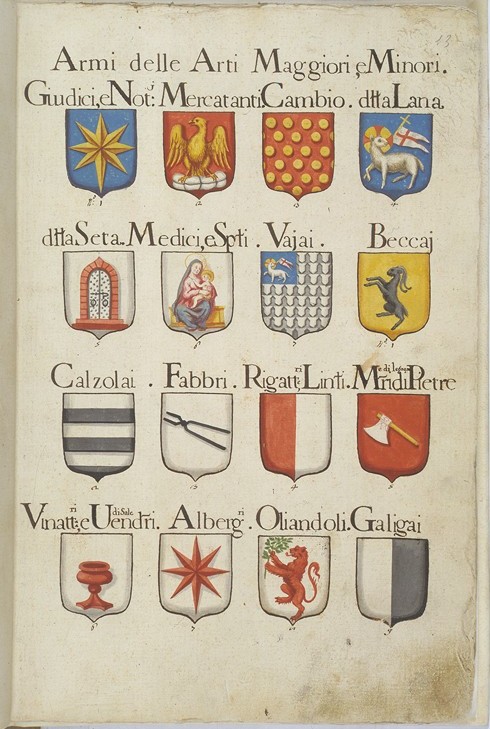
Now the guilds were associations between business owners and artisans, which were recognized by law. There were seven major guilds, the arti maggiori, and fourteen minor guilds, the arti minori. Among the major guilds were the guild of judges and lawyers, the guilds of the wool, silk, and foreign cloth merchants and upholsters, the animal skins and furs merchants, and the guild of doctors, apothecaries, and medicine, spice, and dye merchants. This guild also included painters. The minor guilds included the blacksmiths, stonemasons, shoemakers, and butchers. Six priors had to be from the arti maggiori and at least two had to come from the arti minori.
There were also two legislative councils who could pass or veto the laws passed by the Signoria, one which was composed of guild members and the other one with members from the nobility. However, they were not allowed to debate any proposals, only discuss the merits of the legislation being considered. Debate was only allowed in the patriche, the advisory councils whose members were directly appointed by the Signoria. But they could not vote on legislation and their meetings were not open to the public. The reason why the government was so debate-adverse was that it was felt that debate would lead to demagogues, who were always rightfully considered the great threat to good republican government. Meanwhile the parlemento, the general assembly of Florence’s citizens, continued to exist, but they didn’t have regular meetings, could not have debates either, and were generally only called in emergencies.
Probably the strangest thing to modern people is that republicanism in Florence wasn’t based on voting for candidates, but elections by lots. Eventually, nearly all of the city’s magistrates and civil servants were chosen by lot. Every neighborhood in Florence would set up a selection committee that would gather the names of every qualified citizen above the age of thirty. The lists of nominees were looked over by a commission of prominent Florentines. Names that were supported by a majority were put in a leather pouch, the borche. It was still not over even when the names were drawn. Those who were convicted of certain crimes, owed taxes, had recently served in a similar office, or had a parent in a similar post were eliminated from consideration.
But probably the most radical step the Ordinances of Justice took was how it kicked the nobility in the stomach, more or less. 150 noble families from Florence were legally declared magnates. They could not serve as priors or major magistrates and could only serve on a small number of minor political officers. Basically, it meant disenfranchising the nobility and empowering Florence’s merchants, shopkeepers, and artisans. It was, though, a bit more complicated than that. The Peruzzi were a very old noble family, but they were not declared magnates because one of the family patriarchs, Pacino Peruzzi, helped get the new reforms passed. Plus it backfired a bit. If someone in power wanted to get rid of a rival, they could get the government to declare that person a magnate, even if they didn’t have a drop of blue blood in their entire body.
So Florence definitely didn’t match up to our modern standards of a representative government, as tempting as elections by lot might look for those of us living through our current nightmare era. In any case, people who liked the Florentine experiment in government tended to see its limits on representation as a feature, not a flaw. For example, Leonardo Bruni wrote a Greek treatise about the merits of the Florentine government where he praises the city for its restrictions on the nobility and the working classes:
“The Florentine constitution is not completely aristocratic or democratic, but a kind of mixture of the two. This is quite clear from the fact that certain noble families are forbidden, because they have too great a power of numbers and of force at their command, to hold the chief offices in this city; and this rule is anti-aristocratic. On the other hand, mechanics and members of the lowest class do not participate in the political life of the community; and this seems to be antidemocratic. Thus, avoiding the extremes, the city looks to the mean, or rather to the best and the wealthy but not over-powerful.”
Needless to say, not everyone went along with this. The nobility threatened to launch a violent counterrevolution. Machiavelli in his History of Florence talks about why they backed down:
“…they ought to consider the people were as much superior to them in numbers and wealth, as they were in fury, and that the nobility they vaunted themselves upon was but an empty name, which would be of little help to them, when they came to across steel with so terrible a foe.”
Nonetheless, his enemies did manage to smear Giano della Bella’s reputation. They managed to get him exiled from the city just two years later. Not only that, but they got him excommunicated and the Pope threatened to issued an interdict, a ban on priests being able to perform certain rites within a city or country, against Florence if they ever allowed Giano back in the city. Giano left Italy altogether for Paris, where he became such an obscure figure historians do not even know when or how he died. And yet, the reforms he passed were so popular they lasted, which goes to show that ideas are much more durable than even the people who fight for them.
So we’re almost done setting the stage for the Medici, but I do want to take a telescope back a bit and talk about how the Republic of Florence fit in with its neighbors and how Florence saw itself. There was a sense of Florentine patriotism, which its form of government and its ability to commit to it while other city-states propped up more authoritarian regimes bolstered. But did Florence think of itself as part of a greater Italian nation? That’s a really thorny question that will likely always be debated, at least until the sun expands or possibly until the heat death of the universe. People have debated that Italian nationalism didn’t really start until around the late eighteenth/early nineteenth century with the spread of nationalism across Europe. Others have argued it started in the late medieval/Renaissance period. And then there are those who would say there was always a sense of the Italian nation; it just what that meant changed radically over time. Personally, I fall into the third camp and would argue that, much like ancient Greece which was also divided into independent city-states, there were hard political and cultural divisions but, at the same time, there was still a sense of shared culture, language, and heritage that you could describe as constituting a nation of sorts. And while there were strong regional differences in the language and patriotic love for one’s home city-state, Italians still had a strong sense of being the heirs to the Roman Empire and having their own distinctive customs and of Italy as a geographical region with firm boundaries. In fact, the old Roman habit of referring to foreign peoples as “barbarians” stuck around, with Italians using it to describe non-Italians. The idea of an Italian people was there; it’s just that the idea that the Italian nation didn’t really exist unless it was united under one government didn’t really take root until around the time of Napoleon.
But, of course, if there was an Italian identity, there was also the regional identities, and these co-existed. You could compare it to the United Kingdom, where a person might think of themselves as, say, both Welsh and British. But you could also look at modern Italy or any nation-state today and see different regional, tribal, and religious identities coexisting along with a broad national identity or even supra-national identity like European or Pacific Islander or Latin American.
But, of course, it should be emphasized that this doesn’t make the regional identities that popped up in medieval and Renaissance Italy any less powerful. Stereotypes are a fun and nasty way of looking at the strength of regional identities. West Virginians and Virginians are both Americans, but if you happen to be in the United States, try asking a Virginian for some West Virginian jokes or, for that matter, a West Virginian for some Virginian jokes. The same goes for the Italian city-states. If you go by Boccacio’s short story collection Decameron, the Sienese are naïve, Venetians are liars, Pisan women are ugly, Perugian men are sodomites and the Geneoese are pirates and murderers. Of course, being Florentine Boccacio described the Florentines as noble and attractive, but if you asked other Italians, they would say Florentines are greedy.
So there we have it. Florence is a proud and independent city-state, but one in an Italy that’s divided between oligarchical republics depending on trade like Florence itself or ambitious mini-dynasties. This is the world the Medici will appear in.
 The Medici Podcast