
Pope Clement tries once more to loosen Emperor Charles V’s grip on Italy, another revolution in Florence is narrowly avoided through one man’s incompetence, and the stage is set for one of modern history’s most notorious war-time atrocities.

Make a one-time donation
Make a monthly donation
Make a yearly donation
Choose an amount
Or enter a custom amount
Your contribution is appreciated.
Your contribution is appreciated.
Your contribution is appreciated.
DonateDonate monthlyDonate yearlyTranscript
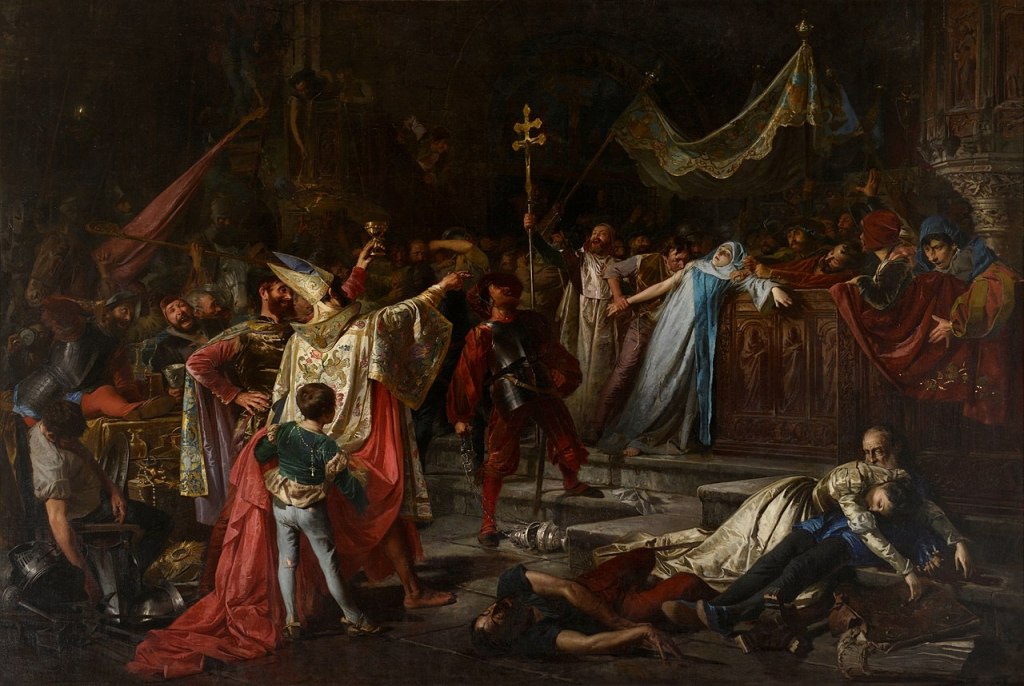
The Florentine Luigi Guicciardini, the brother of the more famous historian Francesco, was an eye witness to one of the darkest chapters in the history of the city of Rome. In his account of what happened to the city, he wrote, “All the sacraments of the modern Church were scorned and vilified as if the city had been captured by Turks or Moors or some other barbarous and infidel enemy.” Another eyewitness, Marino Sanuto, more succinctly wrote in his diary, “’Hell itself was a more beautiful sight to behold.” This was the Sack of Rome of 1527. It was certainly worse than the four times Rome was sacked in late antiquity and the Middle Ages, including the infamous pillaging of the city by Vandals in 410. In those times, the marauders still followed prevailing rules of warfare. Either that or Rome was so depopulated it was little more than a village or a small town. 1527 was something different, more akin to the atrocities we read about in the annals of the 20th century history. In fact, arguably it wasn’t just pillaging at all; it was an outburst of mass rage directed at a civilian population that was allowed to go on for not just days or weeks, but months.
But how did we get here? Well, when we last left off, the Battle of Pavia had been an unmitigated disaster for the papal-French alliance. King Francois of France was imprisoned, but Charles V released him, after which Francois immediately violated the treaty he had signed with Charles, even though Charles was holding his two sons hostage in Spain. Pope Clement organized an anti-imperial alliance, the League of Cognac, with Francois as a member, in spite of his own agreements with Charles.
It can be hard to imagine Clement’s reasoning here, especially since he had to have known that France was economically and morally exhausted after Pavia. Still, Clement’s decision to back an already beaten horse might make more sense if you look at the overall situation. Convinced by his own propaganda, Charles V had the ambition of calling a church council to deal with that Martin Luther guy and reform the church. After that, he would unify most of Europe in a grand crusade against the Ottomans to retake Constantinople and perhaps also Jerusalem. However, to do that, Charles had to assert control over Italy and neutralize both the Pope and the King of France. That Charles V was a threat to the continued independence of all the Italian states was made clear when he backed a violent coup against the Republic of Siena’s pro-French signore, Alessandro Bichi, and arranged his replacement with a pro-imperial government. With that in mind, it’s no surprise that Duke Francesco Sforza of Milan also turned against his benefactor Charles and joined the League of Cognac. As the historian Judith Hook put it, “Francesco’s only aim was survival.”
Now, from Clement’s perspective, a church council would be a disaster. The Popes had for centuries fought against the movement known as conciliarism, which held that the ultimate authority in the church was not with the popes, but with church counsels. And who historically usually called church councils? The Holy Roman Emperors. At best Clement would be reduced to little more than the emperor’s puppet; at worst he would be deposed, likely dooming himself and what was left of his family. It’s clear from Clement’s writings that, like Pope Leo, he wanted an independent Milan under the Sforza dynasty. But while Francois was still obsessed with annexing Milan, Francois was clearly the lesser of two evils, so, like many voters in the United States, Clement had no choice but to back one side as long as it was an option.
Unfortunately, the League of Cognac ran into a few blunders from the get-go. First, Henry VIII of England, in a very Henry VIII-like move, refused to join the alliance, apparently just because the treaty establishing the league was signed in the town of Cognac in France, hence the name, and not in England. Maybe this was just a savvy excuse to stay out of the war, but I would put my bets on Henry VIII meaning it. Also Clement VII had previously made it clear that he was still pressing the papacy’s claim to the cities of Modena and Reggio, then under the rule of Duke Alfonso of Ferrara. This alone drove Ferrara right into the pro-imperial camp, giving the imperial army friendly territory in northeastern Italy they could march through.
There was one other potential problem, one that Clement didn’t take seriously enough. Remember how the next generation of Medici men, Alessandro and Ippolito, weren’t quite old enough to handle Florentine affairs in their own right, so Clement appointed a Medici client, Cardinal Silvio Passerini of Cortona, to act as a regent? Well, it turns out this wasn’t the best choice. Cardinal Silvio might have been loyal to a fault to the Medici name, but he was also from a town that had traditionally been under Florentine control. In Florentine eyes, this made him an uncouth provincial. This made it even worse that Cardinal Silvio Florence like the regent of a monarch. Foreign policy was carried out without even consulting officials and important government meetings were held behind closed doors in the Palazzo dei Medici. Taxes and new laws were not voted on by the signoria or the legislative councils, but by councils filled with Medici supporters. And like I noted like this this was being done in a government that was still ostensibly a republic, where the Medici cousins Cardinal Silvio was ruling in the name of had no formal titles. The historian Cecil Roth describes it this way: “By this measure, the whole aspect of the Medicean rule was changed. It ceased to be that of an eminent citizen whose ability and influence secured him a preponderating voice in the administration, and became patently that of a nominee appointed by a non-resident and responsible to him. Nominal authority lay with mere children.” No wonder Clement VII’s popularity in Florence was plummeting, as events would soon make very clear.
That April, imperial forces reached Tuscany and had pillaged some of the countryside, causing refugees to flee into Florence. Worse, imperial scouting parties had been spotted near Florence. The League of Cognac’s forces managed to drive away the imperials, but the atmosphere in the city was one of menace and anxiety. Since the Medici were restored to power, it had been more or less illegal for average citizens to possess arms. A crowd of young men from the upper middle class and the nobility gathered around at the Palazzo della Signoria, demanding arms they can use to defend the city if the imperial armies attacked directly. A leading politician critical of the current regime, Niccolo Capponi, pushed to have the matter decided openly by the signoria, especially since Cardinal Silvio had been dithering on making a decision one way or the other. The signoria issued a declaration that every citizen who asks for weapons will receive them if they promise to join an official militia. When a rumor spread that imperials had been spotted near Florence, a public meeting of citizens was held to discuss the news. Things got heated when another rumor reached the citizens: some of the city’s political and military leaders were abandoning the city to its fate. Unfortunately, this rumor was actually half-true. Cardinal Silvio was about to leave the city to meet with the commanders of the League army which was camped not far from Florence, and he was taking a large garrison and a number of Florence’s military officers with him. Imagine a tense, nervous situation, and you find out your already unpopular leader who represents a regime you suspect doesn’t actually care about your homeland is leaving, and you can probably guess what happened next. A large mob, carrying the arms the government recently provided them descended on the Piazza della Signoria, shouting the old republican slogan, “Popolo e Liberta!” Thinking this was a repeat of the events of 1494 when Piero the Unfortunate and his family were exiled, the Signoria unanimously voted to exile the Medici again and restore the Florentine constitution to what it had been just before the Medici restoration.
This time, however, the revolution didn’t have any support from the working classes and the class of artisans and shopkeepers, who simply didn’t show up. Nor was the military sympathetic, and the few army commanders who considering backing the revolution were quickly brought back into line. Soon enough, the Palazzo della Signoria was completely surrounded by loyalist troops. So the Signoria quietly voted to nullify all of its earlier actions. The revolt had completely fizzled out in an undramatic fashion. In fact, Alessandro de’ Medici wasn’t even aware of what happened until the next day. The little revolution was further discredited when it turned out that several of its leaders had been secretly corresponding with the generals of the imperial forces and plotting to have a revolution inside Florence correspond with the imperials besieging the city. As King Charles of France learned decades ago, a city the size of Florence was a nightmare to occupy, so regime change was always the better option. However, Cardinal Silvio leaving the city and the furious reaction to it was seemingly too good an opportunity to ignore, so they pulled the trigger on the revolution too soon. Again, quoting Cecil Roth, “The rising had failed owing to Cardinal Silvio’s masterly inaction, though this was due to his stupidity rather than to his foresight.” Still, even if the revolt was a fiasco, it was a clear warning, one that neither Cardinal Silvio nor his master Clement heeded.
Clement got another warning when the imperial ambassador to the papacy convinced Cardinal Pompeo Collona to act against the Pope. Cardinal Pompeo was part of the Colonnas, an old Roman noble dynasty that had influence over the city and the papacy’s politics for centuries and who were said to be descended from the Julio-Claudian dynasty of ancient Rome. Pompeo Collona decided to bring some of that old-school feudal power back in September of 1526. Gathering an army of his family’s supporters and clients, he marched on Rome and occupied the neighborhoods surrounding St. Peter’s, letting his supporters pillage the Vatican. The imperial ambassador drew up a treaty that Clement signed, pledging to leave the League of Cognac and pardon Cardinal Colonna for his little revolt. Once Colonna sent his troops home, however, Clement naturally ripped up the treaty, on the somewhat valid excuse that he had signed it under duress. As soon as he could, he had the entire Colonna clan declared outlaws and confiscated their lands. Cardinal Colonna himself fled to Naples, where he joined up with the viceroy of Naples, Charles de Lannoy, who had raised his own army to strike the Papal States in the name of Charles V. Besides being sandwiched between two hostile camps, Pope Clement also lost his best general. His cousin, Giovanni of the Black Bands, fought a skirmish in November with the imperial army to the north to prevent them from crossing the River Po. He was shot in the leg and assisted the surgeon amputating his leg by holding a torch to illuminate his own operation. Even so, Giovanni died from complications in Mantua five days later. Guicciardini remarked, “It has pleased God to extinguish so much courage at the time when we needed it most.”
Even so, Pope Clement was optimistic. Lacking the funds to carry on with the war, the viceroy of Naples, Charles de Lannoy, signed a truce with the Pope, much to Cardinal Colonna’s chagrin. As for the other army coming in from the north, Clement does not seem to think they would dare take Rome itself. Even when the imperials were about to breach the borders of the Papal States in January of 1527, Clement didn’t listen to his advisors who suggested he leave Rome. On the contrary, he posted guards at the city gates to discourage a mass exodus. Perhaps he had confidence that Charles V’s piety would prevent him from ever allowing an army to desecrate Rome. Clement was even heard to say about the enemy forces, “God, in his mysterious way, having brought them to the principal seat of his Holy Religion, in order to make a notable example of them by having them all cut to pieces.”
Before we see how badly Clement’s prediction turned out, there’s some things we should know about the army that reached the outskirts of Rome by May 5. One, the army was largely composed of Spanish, Italian, and German garrisons. This was not at all unusual for the time, especially for armies serving under large, multicultural states or with large mercenary forces, but the cultural, linguistic, and indeed the religious gulf between the Germans and the Spanish and Italians was particularly wide, wide enough that commanders of one group had problems holding authority over the rank-and-file troops from another group, which will become painfully obvious with the Sack of Rome. Second, this was an era of warfare where even wealthy governments struggled to pay their armies. As I’ve talked about in earlier episodes, the technology of warfare had dramatically changed in a relatively short amount of time, making warfare even more of a financial burden than it had been in the Middle Ages. This meant not only that governments had to rely on mercenaries of dubious loyalty, but that the cost of paying soldiers and mercenaries had to be defrayed by allowing the soldiers to greatly plunder their conquests. Of course, pillage had always been a part of warfare, but it was also governed by certain rules and norms, and this was an era where those rules and norms were often loosened for the sake of keeping soldiers happy. And Charles V was late writing this particular army their paychecks. Finally, while we don’t know exactly how many, it’s safe to say a sizable majority of the German soldiers in the army were Protestant or were at least personally hostile to the Pope, whom Martin Luther had been explicitly calling the Antichrist for some time now.
So the troops were already eager to get their hands on the fabled wealth of Rome and get revenge on the Antichrist when they were besieging Rome during the unusually foggy morning of May 6. Because of the fog, Charles de Bourbon didn’t see the gunner on the walls of Rome who shot him, nor indeed did the gunner know who he was shooting. Bourbon was the army’s most popular commander and the only one who could exercise any kind of disciple over all the diverse garrisons. So when he died from his wound only a few hours later, the soldiers were enraged, nor could any of the other commanders take Bourbon’s place. This was the mood that the army was in when they finally managed to pierce Rome’s walls and entered the city.
It was part of the normal rules of war that soldiers could only begin pillaging a captured city once they fully occupied it. However, right away, this rule was completely ignored. As soon as they reached the streets and neighborhoods of Rome, the soldiers began indiscriminately killing everyone they came across. Almost all of the patients at the Hospital of San Spirito were killed, with many of them thrown into the Tiber River alive. Even the orphans at one of the city’s largest orphanages were all massacred. The slaughter only ended when the soldiers began to realize they could hold people ransom. Guicciardini paints the grim scene:
“How many courtiers, how many genteel and cultivated men, how many refined prelates, how many devoted nuns, virgins, or chaste wives with their little children became the prey of these cruel foreigners! How many crucifixes, crosses, statues, and vessels of silver and gold were stolen from the altars, sacristies, and other holy places where they were stored. How many rare and venerable relics, covered with gold and silver, were despoiled by bloody, homicidal hands and hurled with impious derision to the earth. The heads of St. Peter, St. Paul, St. Andrew and many other saints; the wood of the Cross, the Thorns, the Holy Oil, and even consecrated Hosts were shamefully trodden. underfoot in that fury. In the street you saw nothing but thugs and rogues carrying great bundles of the richest vestments and ecclesiastical ornaments and huge sacks full of all kinds of vessels of gold and silver – testifying more to the riches and empty pomp of the Roman curia than to the humble poverty and true devotion of the Christian religion. Great numbers of captives of all sorts were to be seen, groaning and screaming, being swiftly led to makeshift prisons. In the streets there were many corpses. Many nobles lay there cut to pieces, covered with mud and their own blood, and many people only half dead lay miserably on the ground. Sometimes in that ghastly scene a child or man would be seen jumping from a window, forced to jump or jumping voluntarily to escape becoming the living prey of these monsters and finally ending their lives horribly in the street.”
We also have a first-hand account from one commander of the imperial army Sebastian von Burtenbach wrote in his memoir, “On the sixth of May we took Rome by storm, killed 6,000 men, plundered the houses, carried off what we found in churches and elsewhere, and finally set fire to a good portion of the town. A strange life indeed! Here we are, all of us, rich.” On top of seizing anything of value, the soldiers destroyed all the administrative documents they could find and plundered or destroyed countless books and works of art. It was said – perhaps with exaggeration, perhaps not – they even took the nails out of floorboards and doors. The Vatican Library and the artistic treasures of the Vatican, including the Sistine Chapel, were only saved by the personal intervention of one of the army commanders, Prince Philibert of Orange.
Churches and monasteries were not at all spared. The soldiers stole from and terrorized and massacred clergy just as much as they did civilians. Nor did they spare the holy relics that had received the devotions of pilgrims for centuries. Some were stolen and taken back to the troops’ home countries; others were smashed or burned on the spot or even used for target practice. Many bankers, however, were spared, on the reasoning that they could help provide prisoners with the credit for their ransoms. Some of the rich were able to bribe the soldiers into protecting them from their fellow troops. Others, even people in positions of privilege, were not so lucky, even if they supported the imperial cause. The soldiers even broke into and looted Charles V’s embassy in Rome. The king of Portugal was an ally of Charles V, but his embassy in Rome was not left alone either. Because the embassy was located in one of the most fortified buildings in Rome, the soldiers assumed there must be a great deal of treasure squirreled away there. A Spanish garrison offered to protect the ambassador for a hefty fee, but he refused, reasoning that such a pay-off would be an insult against Portuguese honor. Needless to say, the Portuguese ambassador and his staff barely got away with their lives.
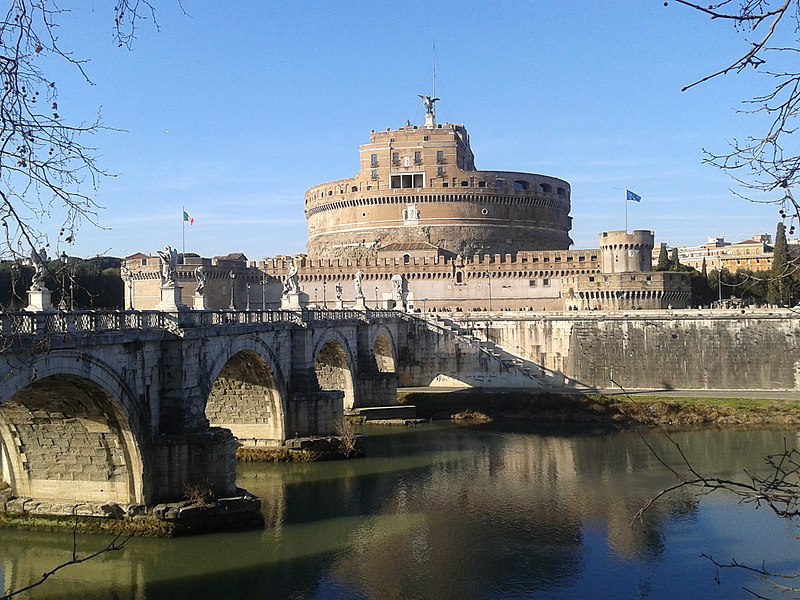
Many Roman civilians and the clergy stampeded into the papal fortress, the Castel del’ Sant’Angelo, once the Mausoleum of the emperor Hadrian. 3,000 people fled into the fortress before the gates were sealed. Pope Clement himself joined the crowd with Paolo Giovio, Bishop of Nocera, accompanying him. Bishop Paolo somehow managed to hold up his robes to let him run faster while also throwing his cloak around the Pope’s face so that none of the invading troops would recognize him. Despite the clumsy escape, Pope Clement eluded the clutches of the men who thought of him as the Antichrist. But he would spend a hellish month living on rations in a fortress filled to the brim with desperate people as his city burned and screamed around him.
Those bishops and cardinals not lucky enough to make it to the Castel del’ Sant’ Angelo became the recipients of the German troops’ rage. Martin Luther’s one-time opponent, Cardinal Silvestro Mazzolini, had the incalculable misfortune of being in Rome at the time of the siege. When the soldiers realized who he was, they put a jester’s cap on the seventy-year-old theologian and dragged him before the windows of Sant’Angelo, where they hoped the Pope would be watching while they killed him. Another cardinal, Cardinal Aracoeli, was marched around Rome in a fake funeral procession. The soldiers chanted the cardinal’s own funeral eulogy and listed off his crimes. Aracoeli was eventually able to pay off his ransom, although he apparently died from both the physical and psychological damage several years after the Sack.
However, it wasn’t just the wealthy prelates of the church that the soldiers humiliated or tried to ransom. One humble parish priest was killed because he refused to minister the sacrament to a donkey the soldiers had dressed up in priestly robes. Another priest had been tortured so badly to reveal the location of money he did not have he committed suicide by throwing himself out a window, even though such an act was and still is considered a mortal sin by the church. Christopher Macellio, a Venetian merchant unlucky enough to be in Rome, was robbed all of his property, which did not stop the Spanish soldiers keeping him prisoner from torturing him for a ransom. He was tied to a tree trunk and his fingernails were pulled out each day, until finally he died from shock. Another Venetian merchant, Giorgio Barassi, was somewhat luckier. His ransom was originally 1,000 ducats, but they reduced it to 140 after they found torturing Giorgio did no good. Giogrio wrote to his brothers back in Venice, begging them to send the money quickly, “for I have lost everything, though I care little for it. But I do not want to die so young.” As for what became of Giogrio, I’m honestly not sure if any account exists.
As you might expect, the commanders of the army barely had any control, if they were not themselves complicit in the looting. The wealthy and powerful noblewoman, Isabella Gonzaga, happened to be in her palace in Rome when the siege took place. She had given refuge to 1,200 women and 1,000 men. She was also the mother of one of the army’s commanders, Ferrante Gonzaga, but that made little difference. The soldiers still demanded that the refugees there pay a ransom of 100,000 ducats. Even then, twice Ferrante had to go to the Prince of Orange to keep the German troops from looting the palace anyway. When Isabella could no longer stand the pressure and fled Rome for the nearby city of Ostia, the soldiers descended upon the palace.
Pompeio Colonna arrived in Rome with his own entourage on May 8, two days after the siege. Seeing what had become of his city, he wept. To his credit, he opened his own palace to refugees and started paying ransoms out of his own fortune. He even paid the ransoms of several of his family’s political enemies and became involved in negotiations on behalf of his one-time enemy, the Pope. In the end, nearly all the buildings of Rome, from bishops’ palaces down to working-class tenant buildings, had been damaged in some way and entire districts of the city had burned down. The pillaging would actually last eight months, ending in February of 1528. The sack only ended with the complete lack of anything else worth taking and the fact that there were so many corpses left rotting in the city that a plague had broken out. In the end, between the deaths and the people who fled Rome, the city’s population plummeted from its pre-sack numbers of 50,000 and 60,000 down to a mere 10,000.
By June 7, Pope Clement surrendered unconditionally. As part of the negotiations, he gave up key fortresses in the papal states and handed over the cities of Modena, Parma, and Piacenza. Even after that, he was kept prisoner in the Castel del’ Sant Angelo. Luigi Guicciardini concluded his eyewitness account of the Sack by wondering what was going through Clement’s mind at the time. Personally, even centuries later, I wonder the same thing. This is what Luigi Guicciardini concluded:
“If he ever considered himself a wise and glorious prince, now he must acknowledge himself to be the most unfortunate and the most abject pontiff who ever lived. And since it is his fault that the Church, Rome, and Italy all find themselves in such extreme danger, we can easily imagine that he often looks toward the sky with tears in his eyes and with the bitterest and deepest sighs demands: “Wherefore, then, hast thou brought me forth out of the womb? Oh, that I had died, and no eye had seen me!” [Job 1c,18]
Thank you for listening, and buona notte.
 The Medici Podcast