
We conclude Savonarola’s story by looking at why one of his most fervent followers decided to try to shut up the growing criticism of Savonarola by resorting to an obsolete medieval ritual and how that decision backfired catastrophically.

Transcript
Just before his excommunication, Savonarola was at the top of the mountain. True, he had become not just an embarrassment but a liability because of his hostile relationship with the Pope. But he still had formidable political influence and was untouchable. No matter how many of his enemies the Arrabiatti got elected, none dared act against him out of fear that arresting him would cause a civil war or the collapse of the republic. But the mountain Savonarola stood on was turning into mud. Florence was still in an economic decline that would in some ways prove to be permanent, a plague was raging across Tuscany, and food prices were still high and would get even worse with another harsh winter in 1497-1498. Now Alexander’s excommunication didn’t knock Savonarola off the mountain, but to take the metaphor one step further, it was like turning a firefighter’s hose on an already increasingly slippery and muddy mountain.
Nonetheless, Savonarola was not one to go down without a fight. He wrote two letters in response to his excommunication, the first written in Italian and not Latin, which was still used as the international language of scholarship and the church, because it was addressed to “all Christians.”
Savonarola published his own two letters in response to the excommunication. It was addressed to all Christians. The second was addressed to theologians and other academics. Savonarola still did not dare the Pope directly. Instead, he stressed he was only suspected of treason and argued that he was not necessarily barred from preaching, never mind that Pope Alexander did explicitly tell him he was forbidden from getting behind the pulpit. In his sermons after the excommunication, Savonarola dared to be a tad more explicit. In a pretty direct attack on the Borgias, Savonarola imagined the reaction in Rome to his excommunication: “Once my excommunication was announced they once more abandoned themselves to excessive eating and drinking, to greed of all kinds, to consorting with concubines, to the sale of benefices, and to all manner of lies and wickedness.”
As much as Savonarola tried to turn the public relations tide against Pope Alexander, the excommunication gave both the government and the public permission to loosen the grip Savonarola had over the city. Prostitutes who had been banned from the streets and restricted to brothels returned to the old red light neighborhoods. Horse races were once more being announced and people felt safe making bets in broad daylight again. And people reacted to the news of the excommunication with public dancing and singing anti-Savonarola songs. In February of 1498, Savonarola tried to host another Bonfire of the Vanities. While it did take place, this time people gave up far fewer vanities for the fire. Worse, Savonarola’s boys were barred from entering some neighborhoods and in some cases were greeted with stones thrown from windows. If Savonarola’s supporters didn’t still have a strong hold on the government, it’s likely Savonarola might have been arrested or forced to go to Rome then and there.
But even political support couldn’t stop the opposition to Savonarola from escalating. The Arrabiatti became more outspoken and openly defined themselves as fighting for the natural world, as opposed to Savonarola’s world of prophecy. There was also an anti-Savonarola street gang, the Compagnacci, a term that Paul Strathern translates as “Bully Boys.” They were likely the ones who vandalized the cathedral and set up a trap on the pulpit for Savonarola. Now, they plotted to blow up Savonarola by putting gunpowder under the pulpit, but called off the plan when they realized that they might kill some of their relatives and loved ones who might set in the front pews. Lauro Martines thinks this might have been the first plan to carry out an assassination using explosives in European history. Matters only worsened when Alexander VI threatened to put Florence under an interdict, which would forbid most religious sacraments to Florentine citizens, unless Savonarola was sent to Rome.
But just as Savonarola’s enemies were getting bolder, so was he. Savonarola wrote a series of letters addressed to the Holy Roman Emperor and the monarchs of Castile, Aragon, Hungary, France, and England, making a case for holding a general council of the Church and deposing the Pope. Part of the letters were addressed personally to each monarch, but the rest of the letters shared the same text, which declared that not only did the Pope have a notorious personal life, but he was also a secret atheist.
“The Church is filled with abominations, from the crown of her head to the soles of her feet, yet not only do you neglect to cure her of her ailments, but instead you pay homage to the very source of the evils which pollute her. Wherefore, the Lord is greatly angered and has for long left the Church without a shepherd. I now herby testify, in the word of the Lord, that Alexander is no pope, nor can he be regarded as one. I declare that he is not a Christian, and does not believe in the existence of god, and thus far exceeds the limits of infidelity.”
We don’t know exactly what happened to all the letters or even if any of them arrived at their destination. Apparently most, if not all, of them were intercepted by agents of Alexander VI. At least, the letter meant for King Charles VIII of France ended up right in the hands of the Pope himself. It is a fun exercise to imagine Alexander’s reaction.
Even then, though, Alexander stayed his hand. Maybe he even knew that interdicts had a habit of backfiring, which you might remember is exactly what happened the last time a Pope put Florence under an interdict. Certainly Alexander was clever enough to realize that something was likely to give on its own. And changed the situation ended up being the rash actions of one of Savonarola’s own followers.
In what would prove a tragic development for Savonarola, a Franciscan preacher named Francesco da Puglia challenged in a sermon anyone who believed in Savonarola’s gift of prophecy to prove their case through a medieval trial by ordeal. Centuries ago trials by ordeal were a more or less accepted way for someone to prove that their case was backed by no one less than God. Someone accused of a crime like murder or lying under oath could prove their innocence through fighting a duel or by walking over heated plowshares or putting their hand in boiling water. Over time, though, such trials became less common and their use heavily regulated and circumscribed by the law. The official stance of the Church had also long turned against such trials, seeing them as going against biblical verses such as Deuteronomy 6:16: “You shall not put your Lord God to the test.”
Also it was felt among the educated, especially with the rise of humanism, that such rituals were just superstition. In fact, da Puglia may have just been making a rhetorical point and presenting a barbed critique of the Wailers, specifically that their views were so backward that they probably would sign up for a trial by ordeal. In fact, no trial by ordeal had taken place in Florentine territory since the eleventh century when a man named Giovanni Gualberto walked through flames to prove his accusation that the local bishop was a heretic.
However he meant it, that’s actually exactly what happened. It was said priests, nuns, monks, laymen and even children in Savonarola’s camp volunteered to be put to the test. Chief among them was a fellow friar and prominent Wailer, Domenico de Pescia. Now Savonarola’s own writings suggest that he too was skeptical of the whole trial by ordeal thing. As much as he had renounced the humanist learning he received as a university student, he was still in his own way a child of the Renaissance, and he too was skeptical of trials by ordeal actually reflecting the will of God. As a result, he sternly reprimanded Pescia and put a halt to any talk of any trial of ordeal to prove or disprove his prophecies.
Even so, when in a sermon Savonarola said, “I entreat each one of you to pray earnestly to God that if my doctrine does not come from Him, He will send down a fire upon me, which shall consume my soul in Hell”, Francesco interpreted it as Savonarola picking up the gauntlet. Even if he originally just meant the trial of ordeal as some kind of allegory, in his next sermon Francesco vowed he would walk through fire himself if it meant freeing the city of Savonarola. With this new declaration, de Pescia stepped up again and vowed that he would walk through flames to prove Savonarola was indeed a prophet.
All of Florence buzzed with talk of an honest trial by ordeal. As much as he loathed Savonarola, Pope Alexander was actually scandalized, but the Arrabiatti embraced the idea, especially since they reasonably assumed it would end in a bloody humiliation for Savonarola and his entire movement. Funny enough, no one in Savonarola’s camp suggested that the friar should offer himself to the flames. A modern biographer of Savonarola Donald Weinsten mused, “Why in this case friar Domenico should have to risk the fire himself he did not explain, but this was a time for miracles, not logic.” Still, the Signoria, then dominated by the Arrabiatti, debated over whether or not to allow the trial to take place. One prior Filippo Guigni argued the whole controversy was making Florence a laughing stock: “To me, this idea of passing through fire seems all very odd, and I for one am against it. Why don’t we instead use a trial by water? This would be much less dangerous. If Friar Girolamo could pass through water without getting wet, then I would certainly join in asking for his pardon.” Nonetheless, the Signoria voted to allow Domenico de Pescia to undergo the trial on April 6, although because of rumors that Alexander VI would forbid the event it was strangely delayed by one day.
In front of the Palazzo della Signoria, a platform about four feet high and sixteen feet wide, built over packed earth, was built over the center of the plaza. Unbaked bricks were laid out over the platform to keep it from catching fire. Over this were heaped thick pieces of wood along with branches and twigs. The plan was that the platform would be set ablaze and Pescia would walk across it. A huge crowd gathered to watch the proceedings, even though the Signoria banned women and children from being present. But while the crowd impatiently waited for the festivities to begin, both Savonarola’s supporters and his enemies squabbled over the proper procedures. For example, when Pescia showed up in a red cloak in a particularly shameless gesture of bravado, the objection was raised that the cloak might have been enchanted through witchcraft. Then when Pescia agreed to take off the cloak, the same objection was made to his regular clothes. In the end, Pescia had to consent to being stripped naked before the mob that had come to see him burn. Meanwhile Savonarola’s supporters debated endlessly whether or not Pescia should bring into the fire the Host, the sacramental bread believed to be changed into the body of Jesus Christ.
But in the end the audience would be disappointed. A severe thunderstorm, complete with hail, suddenly hit Florence and dissipated just as quickly. Savonarola had come around to the idea of the trial by fire, but apparently now that the day had arrived he was having his doubts. So he seized on the opportunity to declare that the unexpected thunderstorm was a sign of his vindication from God. The crowd, disappointed and angry and hungry, were forcibly dispersed. Savonarola’s opponents did not raise a fuss at this. They guessed that this stunt would do almost as much damage to Savonarola’s reputation in Florence as if Pescia had burned to death in the piazza and that even some of his most fervent followers would be disillusioned. And they were right. Savonarola may have thought he got out of a tricky situation, but instead his fate was as good as sealed. I should also mention that the very day of the aborted trial by ordeal, Savonarola’s one-time messiah and the man who inadvertently made his prominence possible, King Charles VII of France, struck his head against the stone lintel of a door while on his way to watch a tennis match. Although he was fine for several hours, apparently the wound did some real damage, since he fell into a coma he would never awaken from. Of course, given how slowly news traveled, Savonarola probably never found out, but it is one of the great odd coincidences of history.
The next day, which was the holy day of Palm Sunday, a supporter of Savonarola tried to give a sermon in the Cathedral of Florence, but the Compagnaci brazenly disrupted the sermon, chanting, “Get out of here, you sniveling psalm-singers.” At the monastery of San Marco, where the Signoria had been still allowing Savonarola to preach, an angry mob gathered by the Compagnaci and their allies in the government was forming and demanding that Savonarola leave Florence for good.
To his credit, Savonarola refused to give his followers the order to gather weapons. Indeed, he tried to leave the safety of San Marco and surrender to the crowd, but the friars there restrained him. Some at San Marco even ignored the pleas for non-violence and took to the roof, where they threw bricks and tiles down at the crowd. However, they were seriously outgunned, especially when the Signoria gave the anti-Savonarola revolution their blessing by ordering the arrest of Savonarola and two of his top lieutenants, Friar Silvestro Maruffi and Pasci himself. Riots broke out in other parts of Florence, with prominent Wailers getting attacked, even killed, and their homes looted.
Savonarola’s bulldog in the Great Council, Francesco Valori, had been present in San Marco for Savonarola’s sermons. When violence broke out, he fled through a secret exit, hoping to rally support from the Wailers in the government. It was too late, though. Stopping at his house, he found to his horror that it was being looted and burned down, his wife was killed, and his nephews who tried to stop the looters were injured. Guards found him and were about to take him to a cell, but then the rioters rushed the guards and struck him from behind, killing him. Vicenzo Ridolfi, who was the nephew of one of the pro-Medici conspirators executed last year, cut off his head with a pruning knife. The chronicler Landucci, who was a Wailer, wrote this about the riots:
“It was as if hell had opened beneath our feet: everyone kept saying wretch and traitor, no one dared to say a word in support of Savonarola, or they would have been killed, and everyone jeered at the citizens, calling them wailers and hypocrites.”
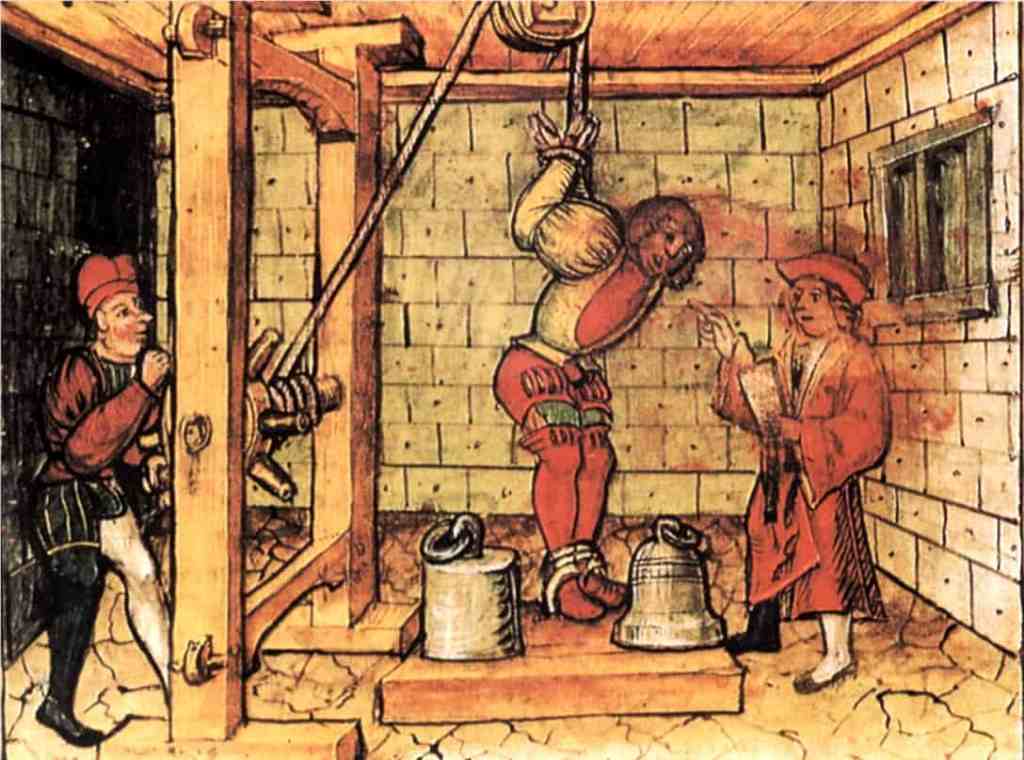
Savonarola himself handed himself over to the guards. Unlike with poor Francesco Valori, they did manage to protect him from the mob’s wrath and take the disgraced prophet to the Palace of the Signoria. There, he was met by representatives of Pope Alexander. Technically, the Church tortured nobody, but they certainly could order judicial torture through magistrates of the state. Savonarola was subjected to the strappado, a torture device where the victim’s hands were tied behind their back while they are suspended from a rope. Under this horrific torture which sometimes left victims with dislocated shoulders, Savonarola confessed that he had lied about his prophecies coming from God in order to achieve fame and glory. Later, he recanted the confession, but later under the threat of more torture he confessed again. He, Maruffi, and Pausci were charged with treason against the state, heresy, and encouraging a schism in the Church. The first two charges were trumped up, and modern historians agree that the trial and confession papers were doctored to support the charges. A case could be made that Savonarola’s insistence on the validity of his prophecies and the willful ignorance of his enemies was heretical, but Savonarola would not be the first or the last celebrity cleric to claim to be receiving messages directly from God, and many of them were never even seriously accused of heresy. The last charge of trying to bring about a schism, though, was very much accurate. There was almost certainly no way Savonarola could have gotten his wish of at least one of the monarchs of Europe deposing Alexander VI without a new church schism and even war.
By this point banishment or being judged by the Pope directly were off the table. Savonarola and his lieutenants had to die and at the hands of the republic, so that the Wailers could be neutralized and that no one could say Florence let the Pope kill one of its own citizens. On the morning of May 23, they were taken to the Piazza della Signoria where a group of church representatives pardoned them for their sins…and then formally handed them over to the Florentine magistrates to be killed. The three were stripped of their religious vestements. Left only in common, white clothes, they were hanged, and then a fire was set under their bodies. Guicciardini remarks, “Savonarola died with unyielding fortitude without uttering a word either claiming his innocence or confessing his guilt. None of this altered anyone’s opinion – either for or against him, or the strength of their feelings on this matter. Many viewed him as a charlatan, while on the other hand many were of the opinion that his public confession was simply a forgery.”
Honestly I debated over whether or not I should do this episode at all, since I couldn’t find a natural way to fit the Medici into this part of the narrative. But I came to the conclusion that Savonarola is a vital part of the Medici story, even though it seems at a glance he actually had little to do with them. Savonarola’s religious legacy became inseparable from the republican legacy of Florence, so much so that – spoiler warning – when the Medici would again be driven out of Florence the republicans would turn again to Savonarola. His writings would also have an influence over both Protestant and Catholic reformers in the coming age of the Reformation, combining the intellectual rigor of humanism with a view of religion as a tool to change society for the better that was arguably more modern than medieval.
But I think it’s just as important to consider how Savonarola failed and what that says about the direction of societies in Europe following the Renaissance. Like two political leaders you can see as his spiritual successors, Jean Calvin over the Swiss city-state of Geneva and Oliver Cromwell as the leader of the English Commonwealth, they tried to create governments that aggressively enforced morals. Any successes they enjoyed was always tempered by the fact they were resented and resisted by the majority of the population. In sum, Savonarola showed there was a future in the state taking over functions that previously belonged to the church and its courts and trying to mold their societies to fit moral and religious ideals. However, through his failure, he also showed that the future belonged even more to humanists like the Medici, and their vision of a cosmopolitan society where the church has to give way to open discussion of non-Christian ideas and philosophies.
Next time, we won’t be rejoining Piero de’ Medici just yet, since through all this he’s still just stewing in Venice. Instead, we’ll join the Popolano brothers, the sons of Pierfrancesco de’ Medici, one of whom is about to enter a love affair with one of the most formidable women of Renaissance Italy and by doing so change the future of the Medici.
 The Medici Podcast