
Piero doesn’t get to enjoy being the de facto lord of Florence for long before he has to deal with an impending French invasion of Italy. He decides to imitate his father’s boldest move, which would surely work…won’t it?
Transcript
The birth of the future King Charles VIII of France was even more celebrated than that of a normal heir. His father, King Louis XI of France, had two daughters, but by that time it would have been impossible even for their domineering father to have them accepted as his successors. Under what was called the Salic Law, daughters could not inherit the French throne. This law took its name from the Salian Franks, the Germanic people that first established the kingdom of France and gave it its name. In truth, the Salic Law just took its name from an old sixth century law that regulated property inheritance and had nothing to do with royal succession. But in the early fourteenth century it was a convenient excuse for King Felipe V to claim the throne instead of his elder brother’s daughter Jeanne. The excuse became even more convenient when King Edward III of England used the claim to the French throne he inherited through his mother to justify his invasion of France. By Louis XI’s time, the Salic Law was firmly locked in place. So without a son the crown would pass over his hated cousin and rival, Louis d’Orleans. However, since the day he was born to the happy parents Louis XI and his queen Charlotte of Savoy, Charles VIII was sickly. No wonder Louis XI was so afraid for his son’s survival that he kept him isolated and micromanaged his son’s governors.
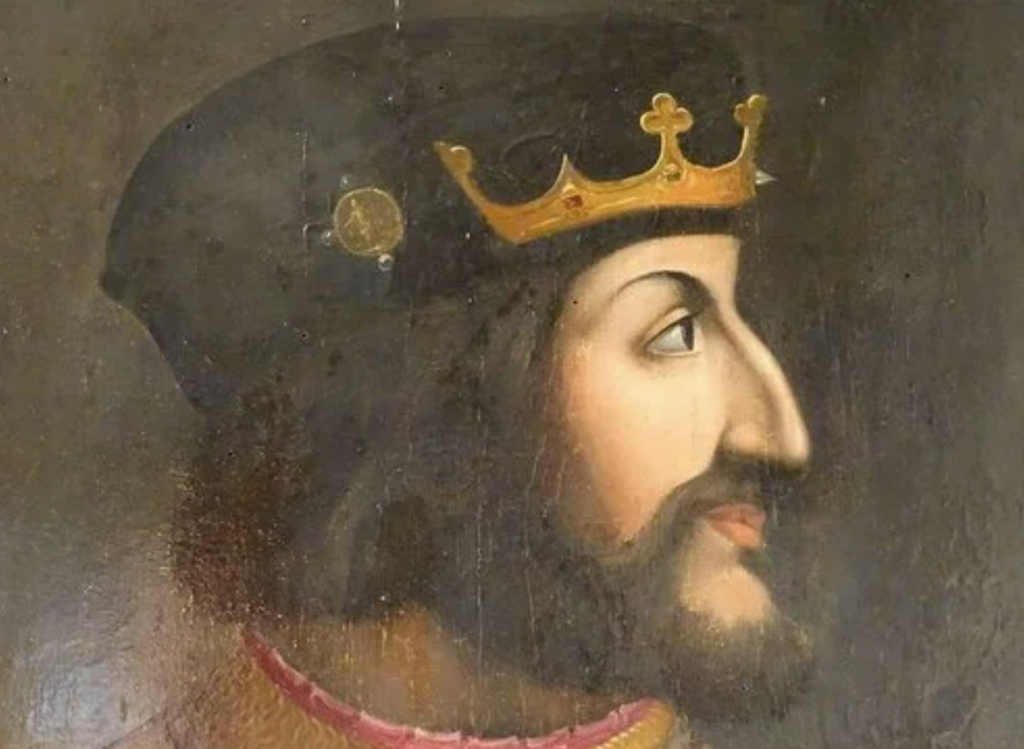
Neither modern historians or even the people who knew Charles and were ostensibly on his side give a flattering portrait of him. I like the way Paul Murray Kendal in his biography of Louis XI describes Charles VIII. “Charles was a sickly lad, slightly misshapen in the shoulders, not very intelligent, given to bouts of illness that kept his father in a state of alarm.” Also he was an “inoffensive, pleasure-loving ninny.” As for Charles’ contemporaries, Parenti wrote about Charles VIII having a kind expression but also a wispy beard. Meanwhile Bartolomeo Mesi described Charles VIII as “a small person, ill-favored, big shoulders, an aquiline nose, splay-footed, web-fingered.” Plus he had the habit of talking to himself in a low mutter. But to be fair Charles was never given any opportunity to gain actual leadership experience. Being the heir apparent Charles VIII never got much of a quality education, made all the worst by the fact that he might have had what we would today call a learning disability. Whatever the cause, Charles was said to have been practically illiterate as an adult. Nor did his father ever give him an opportunity to assume even a ceremonial role in politics. Instead Charles was left to busy himself with breeding and training hunting birds.
But while Piero de’ Medici cut a more dashing figure than poor Charles, the two men had much in common. They were both young men suddenly called upon to live up to the legacies of fathers who were both legends in their own lifetime. Louis XI had ended the Hundred Years War and secured France’s international position. Now, it was left for Charles to prove himself by going on the offensive. Since from his Angevin ancestors, he inherited ancestral claims to both Naples and the old crusader kingdom of Jerusalem, Charles had the perfect pretext to try his hand at succeeding where his legendary ancestor Charles d’Anjou failed by making a French empire in the east.
There were other reasons, of course. Italy was still rich, and it was still seen even by the French as the most civilized region of Europe. Even so, everyone knew how deeply its political divisions ran, which made it a tempting target. Also one of Charles’ chief advisors was Bishop William of Saint-Malo, whose family just happened to be a clan of wealthy merchants from Tours whose business depended on trade from Italy. And whispering in the new king’s ear was the cardinal Giuliano della Rovere, the great-nephew of Pope Sixtus IV and the archenemy of Rodrigo Borgia, a.k.a. Pope Alexander IV. After Alexander IV was elected, Giuliano fled Rome fearing that he would be imprisoned on trumped up charges of worse. He openly encouraged Charles’ ambitions for Naples and, oh, by the way, while you’re in the neighborhood, why not host a synod of the church and depose Alexander IV? Charles was also in contact with Ludovico Sforza, whose diplomatic relations with Naples had deteriorated after the death of his niece Ippolita Sforza, who was married to the heir of the throne of Naples, and Lorenzo the Magnificent. Sforza promised Charles safe passage through his territories if he decided to invade Naples. Still, it’s important not to discount how much Charles really wanted this crusade. It was even said he had dreams supposedly sent by God that saw him claiming his rightful inheritance in Italy and going on crusade.
Now if you read even recent accounts of Piero de’ Medici’s actions in this time the story goes something like this: Piero was so inept and irresponsible he simply let the alliance with Milan fall apart and let himself get completely taken advantage by his wife’s pro-Naples family. That isn’t quite the case. Piero was not oblivious to the danger he was in. As news of the likely French invasion trickled in to Florence, Piero told one of his confidants, “I am so depressed that I speak and write as though in a dream, I don’t think anyone in my state can live, I am so melancholic. I hope, God willing, there is a good outcome, since I do nothing all day long but stare out fixedly.” Granted he wasn’t just talking about the political situation, but also some problems he was having with his mistress, who we only know by the letter “R”. But we do know he had received detailed reports that the French had cutting edge artillery that could down a city’s walls in the matter of days and was horrified by what he heard.
More importantly, though, Piero didn’t just toss away the alliance with Milan. In fact, he kept up a correspondence with Ludovico Sforza, trying to get him to renew it. The problem was that Piero was stuck with a bad deal his father he had made on behalf of his son-in-law Franceschetto Cibo, who really was the Billy Carter of the Medici family. See, Pope Innocent IV had asked Lorenzo to loan Franceschetto some money so he could legally buy some land that belonged to the Papal State. After Pope Innocent’s sudden death and the election of Alexander IV who was not fond of Franceschetto either, Franceschetto sold the land for some quick cash he could use to get himself out of the new Pope’s reach. The buyer was Virginio Orsini, one of Piero’s in-laws. This infuriated Alexander IV, enough that it was a major reason why the Pope sided with Milan and the French.
While officially Piero threw in with Naples, in his letters Piero was also desperately trying to get in good with the Pope and Milan. He supported and through the Medici Bank financed Pope Alexander’s efforts to secure a Spanish dukedom for his son Juan. To Ludovico, he offered to have the signoria of Florence officially recognize him as the rightful duke of Milan. Piero was of course writing these letters behind the back of the King of Naples. At the same time, Ludovico Sforza and King Charles were carrying on a secret correspondence of their own, with Piero’s cousins, the sons of Pierfrancesco de’ Medici. They promised they would support a new Medici regime with the sons of Pierfrancesco at the helm in exchange for making sure that Florence would join the opposition to Naples and the papacy.
By the end of the summer of 1494, Charles VIII had secured most of his borders by signing treaties with England and the Holy Roman Empire. Now his hands were freed. Charles led an army of over 25,000 men over the Alps. Even then, Piero kept playing for time. Historians still present all this as Piero acting like an inept newbie, but honestly it’s hard to tell what choices he had. He wrote to Queen Isabel and King Fernando of Spain begging them to intervene. While they sympathized with Piero’s situation, they wouldn’t commit to anything. The Republic of Venice just gave Piero the cold shoulder. Piero tried ordering the Florentine envoys to France to convince Charles to instead go straight to war against the Ottoman Empire with Florentine and Neapolitan help.
Piero also knew that Ludovico Sforza was already having second thoughts about his houseguest. As the modern historian Paul Stethern wrote, “Although he was responsible for inviting the French into Italy, and knew they were his friendly allies, he now began to have his doubts about the whole enterprise. Considering the faithlessness of princes, and in particular the French, who appeared to have little honor or principle when their own interests were concerned, he began to have his suspicions about the French king and whether Charles VIII might find an excuse to remove him from power.” In fact, it might have been Charles’ presence and rumors that Charles would happily replace Ludovico Sforza with his nephew Gian Galeazzo that brought about the latter’s all too convenient sudden death.
So Piero had reasons to think the train could be slowed down, but it was already on a collision course with not just the kingdom of Naples but all of Italy. Charles demanded that the signoria of Florence grant his army passage through Florentine territory. Stuck between his current alliances and his in-laws on one side and the French on the other, Piero dithered. Meanwhile, the Florentine ambassador to France had found proof that Piero’s cousins had been in secret talks with Charles. The Council of Seventy had the cousins imprisoned and voted to execute them. However, Piero stepped in and had their sentences reduced to a comfortable exile to a villa north of Florence. Again, this is usually seen as another of Piero’s blunders. But killing his cousins would have given Charles VIII a pretext to overthrow him and might have turned half the Medici party against him. Even so, it was a loud and clear sign of weakness.
By October, Piero was no doubt desperate and became more so when he learned that the French army had already captured a key Florentine fortress on the Tuscan border, Sarzanello. So Piero took a page from his father’s book. Without the permission of the Signoria, he rode out from the city with a few trusted advisors and servants and set out to meet the king in person. In front of the stone walls of the fortress of Sarzanello, Piero approached Charles VIII at his camp. The king greeted Piero not with friendship, but with calculated contempt. There would be no negotiations, between equals or otherwise. Instead, Charles opened with his first and final offer. Piero would surrender all Florentine fortresses on the northern Tuscan border, give the French full control of the port cities of Livorno and Pisa in order for them to secure their supply lines from the sea, and give him a loan. Piero not only agreed to all the terms, but also meekly offered Charles personal use of the Palazzo Medici. According to the French chronicler Philippe de Commines, who was at the French camp during all this, even Charles and his courtiers were amazed at how quickly Piero caved. They talked about Piero with, Philippe writes, “smiles and laughter.” Of course, none of this was done with the consent or even consultation with the signoria.
Piero did what a lot of people who realize they screwed up massively do: try to put the best spin possible on things. He hosted a triumphal march of sorts in Florence, declaring that he had brought peace just like his father had done after returning to Naples, and dispensing sweet cakes and sugar-coated almonds to the crowd. But this hardly did anything to pacify the popular anger that was threatening to boil over once word of the deal Piero had made with Charles reached Florence along with accurate reports that French troops were going to occupy the city anyway.
The gonfaloniere, Piero Capponi, decided the time had come to act. Declaring that “it is time we stopped being ruled by children”, he sent a delegation, led by a certain friar named Savranola whom we’ll let take center stage soon enough. In the meantime, this delegation in of itself was a bold declaration. It claimed to represent the true government of Florence and by its existence made Piero’s own claims to represent the people of Florence in any way totally invalid. The signoria had noticed the ice-cold reception Piero de’ Medici was getting from the people.
Piero had one card to play: a contingent of mercenaries led by Verginio Orsini. But such was the public mood that Piero did not dare let them past the city wall. So he was quite helpless when he tried to enter the palace of the signoria to give a speech about his delegation to Charles VIII and found that the doors were barred against him and his retinue. Someone on the other side of the door told Piero he could only enter without his bodyguards and through one of the side entrances reserved only for servants. As Piero stood outside the doors, his mind no doubt racing, the bell signaling a city emergency rang. A crowd gathered. At first they were simply silent. Then they started chanting “Popolo e liberte” and pelting Piero with insults, stones, and trash. His guards hurried Piero away. In another part of the city, Piero’s younger brother Cardinal Giovanni rode through the streets, shouting the traditional slang for the Medici, “Palle! Palle!”, which referred to the balls on the Medici insignia. A crowd of supporters did show up, but they were dwarfed by the mob of angry citizens. It was enough for Piero Capponi to issue a decree that anyone who raised arms in defense of Piero de’ Medici would be executed. Piero, his family, his youngest brother Lorenzo, and his cousin and adopted brother Giulio all left the city. Cardinal Giovanni stayed behind to try to rally support but also to collect as many of the Medici’s treasures, including jewels and rare books, he and his men could carry before he too fled Florence disguised as a monk. The family met in the neighboring city of Bologna while, back in Florence, a new, revived republic was declared. And the unexpected man most poised to shape the future of that republic was the Domenican friar Girolamo Savonorola.
You might have noticed I tried to give Piero a fair shake. He certainly did make mistakes like turning a public park into a playground for himself and his rich friends. And trying to appeal to Charles VIII personally while signing off on all of Charles’ demands without the consent of the signoria was a catastrophic decision I doubt any of Piero’s predecessors would have even considered. But he wasn’t guilty of tossing away the valuable network of alliances his father had carefully built for no reason other than youthful caprice, as some modern historians suggest. Instead, he was inexperienced and caught in an impossible diplomatic situation that even his father would have been hard-pressed to salvage.
To be fair, it is easy to see why Piero has such a bad reputation. Just fourteen years before Piero set out to meet the king of France, his father had returned from Naples as a hero. Now, after attempting a similar bold maneuver, Piero had lost it all. And yet, it’s hard to see how something like this wasn’t inevitable, even without the French putting pressure on Florence. The invisible throne of the Medici was always precarious and constitutionally ambiguous. The Medici could have given themselves a title and set up a mini-monarchy, like the Visconti in Milan did. Or they could have made the riskier move of radically rewriting the constitution and giving themselves a hereditary office within the framework of a republic, like the office of stadtholder in the future Dutch Republic or like a royal office in the constitutional monarchies of today. Otherwise, though, people were just bound to find out that the fragile, see-through throne that Cosimo de’ Medici built was never really there at all.
 The Medici Podcast