
The Pope, his nephew, an archbishop, and a mercenary decide Lorenzo de’ Medici and his brother Giuliano have to die. Unfortunately, the conspiracy develops some hiccups, namely having to send a couple of clergy instead of a mercenary to take down Lorenzo…

Transcript
On a late summer day in 1477, a battle-hardened mercenary, Giovan Batista, Count of Montesecco, was ushered into the private chambers of the Pope himself. Already flanking the Pope were his nephew, Count Girolamo Riario, and Francesco Salviati, the Archbishop of Pisa. Count Girolamo still blamed Lorenzo de’ Medici for not helping his uncle acquire territories for him in the Romagna. The Archbishop was barred from assuming his rightful post. In the heart of the spiritual center of Christendom, the three had come to discuss sparking a rebellion, and maybe even murder. Giovan had met with the archbishop and Girolamo a couple of times before in order to discuss overthrowing the Medici-dominated government in Florence along with the assassination of Lorenzo de’ Medici and his brother Giuliano. Giovan was skeptical of the whole scheme’s chances of success from the start, or at least that’s what he told the men interrogating him in Florence after the fact. In any case, he believed the whole thing was just a hair-brained plot dreamed up by Girolamo and the archbishop behind the Pope’s back. Now, however, here they were, talking about overthrowing the Medici in the presence of the Pope himself.
Pope Sixtus started to rant, blasting Lorenzo for his many sins against the Pope and his family. Despite being a grizzled veteran of many military campaigns, perhaps some part of Giovan still couldn’t accept that the Holy Father would be so blasé about a violent coup. Giovan spoke up and said, “Holy Father, it is difficult to execute such an intention without the death of Lorenzo and Giuliano and several others perhaps.” Calming himself, the Pope replied stoically, “In no case will I have the death of anyone; it is not my office to cause the death of a man. Lorenzo has behaved unworthily and badly towards us, but I will not hear of his death, though I wish for a revolution in the State.” Maybe at this point the archbishop and Girolamo exchanged awkward glances. Girolamo spoke, “We will do our best that no one fall a victim. Should it, however, be unavoidable, your Holiness will pardon him through whom it happens.”
Here the Pope lost his temper. “You are a villain; I tell you I will have no one die, but only the government overthrown. And to you, Giovan Batista, I say that I wish the revolution to proceed in Florence and the government to be taken out of the hand of Lorenzo, for he is a violent and bad man, who pays no regard to us. If he were expelled, we could do with the Republic as it seemed best, and that would be very pleasing to us.” Riario answered, “Your Holiness speaks the truth. Be then satisfied that we shall do all in our power to attain to this end.” The meeting ended with the Pope again giving his blessing to the coup, but insisting that it be a bloodless one. “Go and do what you will, but no lives will be lost.”
Of course, I have to be a responsible historian and note that all of these details come from a single, unverified source, the testimony of Giovan Batista himself. And naturally Giovan had every reason to downplay his willingness to join the conspiracy to murder the Medici brothers while puffing up the sinister motives of the ringleaders. That said…it is true that the Archbishop of Pisa and Count Girolamo in Rome and Francesco de’ Pazzi in Florence were the masterminds of the plot and Giovan Batista was basically just the hired muscle. In my opinion, it also stands to reason that if Giovan was lying about the whole episode he could have made the Pope’s culpability in what happened more explicit.
That’s not to say there aren’t problems with Giovan’s testimony. As the historian Lauro Martines points out in his book April Blood: Florence and the Plot Against the Medici, Giovan only implicates the ringleaders, leaving out any mention of the King of Naples and the Duke of Urbino who at least knew about the conspiracy, and left out any mention of various minor conspirators. But personally I do find the description of the Pope’s hemming and hawing convincing. Since even his enemies agreed that he was genuinely pious, maybe he was balking at the idea of outright murder and holding on to the naïve hope of a bloodless coup. Or maybe everything Pope Sixtus said was with a wink-wink and a nudge-nudge just for the sake of appearances.
Well, one thing’s for sure. The Pope, who after the conspiracy launched went and purchased houses for his sisters in Rome, had ambitions for his family, and he saw Lorenzo de’ Medici as an unacceptable threat to those ambitions. For that reason, Pope Sixtus was willing to stoop to signing off on an attempt to overthrow a foreign government. To be fair, this was not the first time the papacy dabbled in regime change, and it wouldn’t be the last time. But usually the Popes could at least claim they were acting in the interests of the Church or the Papal States. This time, it was painfully obvious to everyone but perhaps the most gullible that the Pope was just acting in the interests of his family. Whatever the Pope’s innermost thoughts on the manner really were, Girolamo reportedly told Giovan the Pope was at his nephew’s command, despite what happened at the meeting. According to Giovan’s testimony, “Does our lord [Pope Sixtus] know about this? [Count Girolamo] told me: Of course he does. Then I say: hell, he’s really consenting to something big there! The Count answered me: Don’t you know we can make him do whatever we want, as long as things go well?”
After the fateful meeting with the Pope, Giovan was sent to Florence to serve as the go-between between the Archbishop and Girolamo and their allies in Florence, the patriarch of the Pazzi family, Jacopo, and his nephew Francesco. Just a reminder, the Pazzi were the Medici’s main competitors in Florence in the realm of banking. They had an unsteady understanding that was sealed when Francesco’s brother Giuglielmo married Lorenzo’s sister Bianca. However, Lorenzo was careful to exclude the family from political posts. Except of course the prestigious but powerless ones. Whatever truce had been reached between the Medici and the Pazzi, it was now off. Besides being the link between the Pazzi and their co-conspirators in Rome, Giovan helped arrange for mercenaries to be present in Florence on the designated day. They came under the pretext that they were part of the retinue of Rafaello di Riario, another nephew of the Pope’s who happened to be a law student at the University of Pisa staying in Florence at the time.
Even if they took the Pope’s protestations seriously, the conspirators marked both Lorenzo and his brother Giovanni for death. The day marked on the calendar was April 26, 1478, a Sunday. Like the assassins of Duke Galeazzo Maria, they decided to ambush the Medici brothers amidst religious services. As often happens with conspiracies, though, there were complications right away. Giovan was supposed to take out Lorenzo himself, but he refused, protesting that killing someone on a Sunday during Mass would be an act of blasphemy. I suspect, if his misgivings about the whole venture were genuine, he might have just been using an excuse to already distance himself from the whole thing. Anyway, the conspirators felt they had to act as soon as possible or risk being exposed, so they had to change who would assassinate whom. Francesco Pazzi and another conspirator, the Florentine banker Bernardo Bandini, would murder Giuliano since both were well acquainted with him. And the job of killing Lorenzo went to a papal notary, Antonio de Volterra, and a priest, Stefano. Machiavelli argues this was the fatal mistake made by the conspiracy. Instead of sending an experienced mercenary to do the dirty job, they chose two men who had no “experience with bloodshed.”
That Sunday, as was customary, both the Medici brothers went to the Florentine Cathedral for Mass. According to Machiavelli, outside the church Francesco Pazzi and Bernardo approached Giuliano about going to Rome to try to negotiate with the Pope as his brother’s representative Giuliano complained about an aching leg. Bandini remarked, “You’re getting as plump as a partridge. I’m sure all the girls will be looking for you in the cathedral.” They held him as if to support him on his shaky leg and to hug him, but secretly they were looking to see if he was wearing any armor under his clothes. In fact, he was not. Once they were assured that Giovanni was defenseless, they accompanied him to Mass and seated themselves besides him.
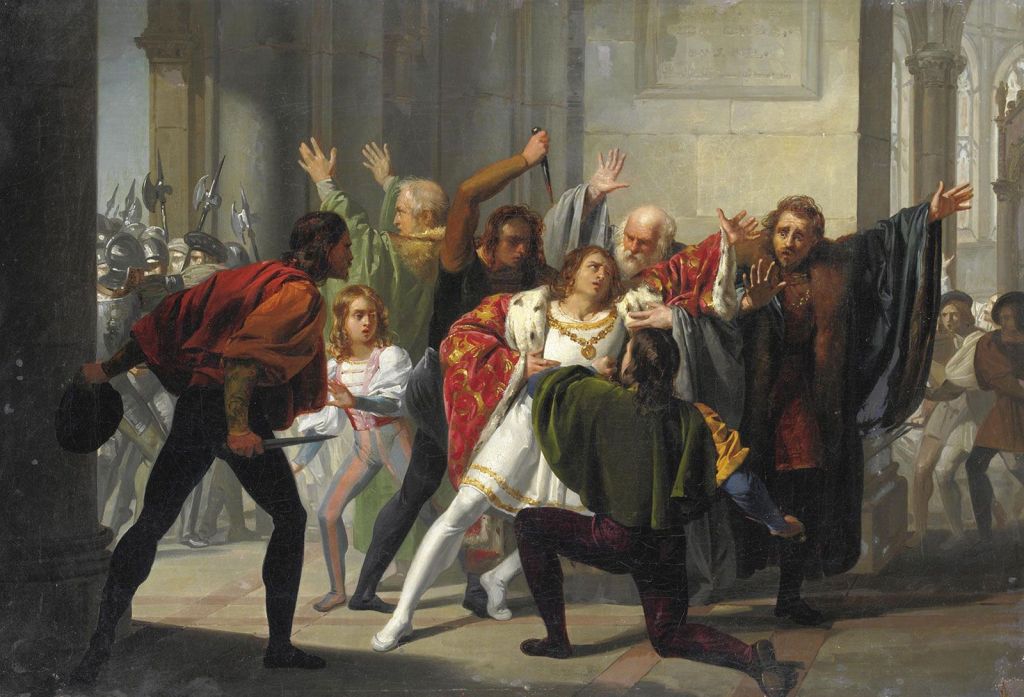
Either at the moment the priest elevated the host or when the priest concluded Mass with the Latin words “Ite missa est”, the conspirators acted. Bernardo shouted, “Here, traitor!” and stabbed Giuliano in the chest while he was kneeling in prayer. Francesco then started stabbing Giuliano frantically before he could get up. Examinations of Giuliano’s corpse in modern times found one deep cut at the top of his skull. Nineteen wounds on his body were counted. At the time of his assassination, Giuliano was only 24 years old.
Twenty yards away in another part of the cathedral, the two priests and armed soldiers who were hiding among the general congregation tried to ambush Lorenzo while he was chatting with friends. Someone grabbed Lorenzo and tried to cut his throat. They only managed to give him a light wound on his neck since Lorenzo had the presence of mind to draw his sword and face his attackers. He perried another strike or two, before his guards and his friends were able to come to his aid. They fought off the conspirators, although they managed to kill one man, Francesco Nori, a Medici bank employee and personal friend of Lorenzo’s. By then, panic had broken out with the congregation and the clergy rushing around to escape. Lorenzo’s Pazzi brother-in-law Guglielmo started screaming that he was no traitor and that he knew nothing of his brother and uncle’s scheme. Raffaele Riario was praying desperately at the high altar. Lorenzo’s men secreted him away in the chaos to a sacristy where he could take refuge behind heavy metal doors. Lorenzo, who had not seen what happened to his brother, only kept asking everyone if they had seen Giuliano and if he was safe. In the meantime, among a crowd of people fleeing the church was the classical scholar and poet, Poliziano, who was a client of the Medici. Seeing the corpse of Giuliano, a young man he thought of as a protégé, he stopped and covered the bloody remains.
The conspirators had only succeeded in killing one brother, but they also managed to leave suspicions on the minds of several onlookers that Sunday morning. A few people noticed that Jacopo de’ Pazzi was briefly present at the Mass and had a lot of armed men in his presence. The Archbishop of Pisa appeared for a while too. Normally as a prominent Florentine he would have been expected to stay, but he told people he had to leave to visit his sick mother.
Lorenzo was still alive and word that he was involved in the assassination was spreading, but Jacopo decided to bet it all on one hand. He would go with the original plan of trying to get the people of Florence to revolt against the Medici. So he rode through the streets of Florence while the bells signaling a city emergency rung. As he passed the streets he shouted “The people and liberty!” However, the crowds greeted his patriotic cries with boos and stones. In fact, some people even went to the Medici Palace, volunteering to help serve as guards. The Archbishop of Pisa was supposed to lead another group of mercenaries in seizing the palace of the Signoria. He tried to convince the Gonfaloniere himself to let him into the palace with a story about how he was leading a formal embassy from the Pope. But the Archbishop started stammering and trailing off. This poor performance couldn’t help but provoke the suspicions of the Gonfaloniere, who called for guards and had the Archbishop arrested. As for Francesco de’ Pazzi, he was supposed to join his uncle in convincing the people to overthrow their government. However, he was bleeding profusely from his leg, after accidentally stabbing himself in the leg during his frenzy in killing Giuliano. Instead of helping his uncle, Francesco had retreated back to the Pazzi palace to treat his wound. It was at his home that Francesco was found naked and dragged to the palace of the Singoria for interrogation.
A regiment of papal soldiers and troops supplied by the Duke of Urbino and led by Count Girolamo were supposed to march into Florence to come help the revolt. When they got word that the supposed revolt wasn’t happening, though, they turned around. The participants in what history would remember as the Pazzi conspiracy were left to face judgment from a government dominated by the man whose brother and friend they had murdered. Francesco proudly refused to confess. However, the Archbishop did make a complete confession, but unfortunately the documents did not survive. The two men along with Bernardo Bandini and several other conspirators caught in the dragnet were hung – not in the city’s traditional gallows, but right from the windows of a building facing the palace of the Signoria. Francesco and the Archbishop were lynched from the same window. Before he was strangled, it was said the Archbishop bit into Francesco’s chest, a bizarre sign of revenge on the man who helped get him into this situation. At least according to contemporaries, the Archbishop’s teeth remained locked in Francesco’s flesh even after they died. Another leading member of the Pazzi family, Renato, was hung while trying to escape Florence, despite the fact it was rumored he had opposed the conspiracy. All the other Pazzi men who were unfortunately within Lorenzo’s reach were arrested and eventually exiled. Even men who had married Pazzi women were barred from public office for life. Streets named after the family were renamed and all copies of their coat of arms were destroyed. Bianca pleaded for mercy for Lorenzo’s old childhood friend Guglielmo de’ Pazzi. Even then, Guglielmo was also banished from the city. Bianca and her children remained in Florence, quietly living in the Medici Palace.
Still, these Pazzi were the lucky ones. Now, I don’t usually do this, especially because my audience skews older, but you all show know things in this story are about to get even bloodier. So if you’re squeamish about torture and gore, it might be a good idea to end the episode here. Ready? Okay. Enraged Florentines hunted down people suspected of backing the conspiracy, including a poor clergyman whose main crime seems to have been working for the Archbishop, and butchered them. Lorenzo had to intervene to save Rafaello de Riario, who was almost definitely innocent of any crime, and several other relatives of the conspirators. The two clergy who attempted to kill Lorenzo had been caught by authorities hiding out in a monastery. They were beaten, tortured, and had their noses and ears cut off. Then they were hanged in the same place Francesco and the Archbishop were. Giovan Batista was captured by Lorenzo’s agents and forced to make the confession that’s our main primary source for these events. Luckily, he got off with just a beheading. Count Girolamo also eluded retribution, returning to Rome without incident. Yet maybe there is such a thing as karma because, ten years later, he too was stabbed to death in the town of Forlí in his own palace. This assassination actually wasn’t vengeance for Giuliani de’ Medici. Instead he died because of a dispute over money.
The worst, most degrading fate of all, though, was reserved for the Pazzi patriarch, Jacopo. He had tried to escape to the safety of papal territory, but he was detained by peasants right at the border between Tuscany and the Romagna. Knowing full well what was in store for him, he tried to pay them if they killed him on the spot. Instead, for his trouble one peasant struck him so hard he had to be carried to Florence on a litter. There, he was hung alongside the decaying corpse of the Archbishop of Pisa. Even then, though, he wasn’t allowed any peace. In life, Jacopo de’ Pazzi was notorious for his blasphemy, and perhaps even for atheism. So the locals near the church of Santa Croce where he was buried were convinced that his ghost haunted the site and was even causing heavy rainfall that were damaging crops. So he was buried elsewhere. It was at his new home that some boys dug up his corpse and dragged it around Florence using the hanging rope that was still around his neck, much to the amusement of onlookers. When they reached the door of the old Pazzi Palace they tied the rope to the door-bell, ordering the corpse to “Knock at the door!” When they finally got bored, they dumped Jacopo in the Arno river. The Florentines watched and laughed and cheered from bridges as it passed. Changing their minds, the little rapscallions picked up the body again later on, hung it from a tree, and then tossed it back into the river.
What can we say? Different times. And remember never let anyone get away with saying kids are worse today than they were in the past.
Anyway, all of this was just act one of the saga. Pope Sixtus wasn’t about to back down, especially after an archbishop who was related to him had been brutally killed. Never mind that the archbishop was technically killed by order of the Signoria, not Lorenzo himself, and that the archbishop had been pleated cuffs-deep in a plot of assassination and insurrection. No, now the Pope felt he had an excuse to draw one of the most potent weapons in the papal arsenal: excommunication.
 The Medici Podcast